VIDIFI leaders stated that once the plan is adjusted, the corporation will propose investment for the expressway's expansion when appropriate.
The 105 km Hanoi - Hai Phong expressway, which opened in 2015, currently features six lanes and two emergency shoulders. Under the Road Network Master Plan for 2021-2030, with a vision to 2050, investment in this route is slated to occur before 2030.
VIDIFI reported that after 10 years of operation, traffic volume on the expressway has surged from approximately 18,000 passenger car units (PCU) daily to around 65,000 vehicles, a more than 3,6-fold increase. By the end of 2024, annual vehicle traffic growth on the expressway averaged over 10%, with current volumes reaching about 90% of its design capacity.
The expressway's current capacity already leads to congestion, particularly during holidays, Tet (Lunar New Year), and weekends. Concurrently, National Highway 5, a parallel route, carries traffic volumes approximately three times its design capacity, resulting in frequent overload and gridlock. Consequently, VIDIFI forecasts that traffic on the Hanoi - Hai Phong expressway will surpass its design capacity as early as 2028.
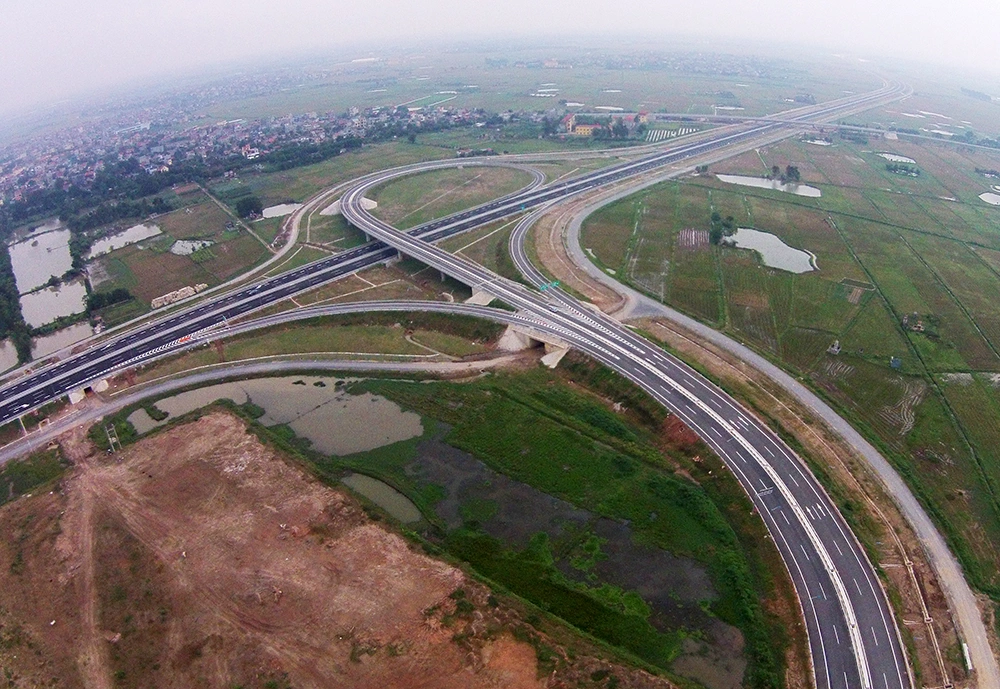 |
A junction on the Hanoi - Hai Phong expressway. Photo: Giang Huy |
The corporation noted that the expressway's right-of-way already spans 100 m, with green belts averaging about 17 m on each side. This existing cleared land means expansion will not necessitate further land acquisition, streamlining implementation and reducing investment costs.
Currently, the expressway has six lanes and two emergency shoulders. Expanding to 8-10 lanes while maintaining two emergency shoulders could involve utilizing a portion of the existing shoulders for additional traffic lanes. Service roads already run along both sides, serving as counter-pressure embankments to prevent landslides and ensure roadbed stability.
The expressway currently features 30 reinforced concrete bridges, including structures like cantilever spans, simple beams, and box girders. The proposed expansion plan involves constructing additional independent bridges parallel to the existing ones on both sides. These new bridges would have similar structures and span lengths, with each accommodating two traffic lanes and one emergency shoulder.
VIDIFI also assessed that future investment in the China - Lao Cai - Hanoi - Ha Long railway line will not significantly impact traffic volume on the Hanoi - Hai Phong expressway. Most container and cargo trucks currently use National Highway 5. Once the railway operates, freight transfer activities will alleviate pressure on National Highway 5, rather than reducing vehicle traffic on the expressway itself.
Anh Duy