On the morning of 21/11, Minister of Science and Technology Nguyen Manh Hung, authorized by the Prime Minister, presented the draft artificial intelligence (AI) law to the National Assembly. The draft law regulates all activities related to the research, development, provision, deployment, and use of AI in Vietnam. It also applies to foreign organizations and individuals whose AI products have an impact in Vietnam. Systems exclusively for national defense and security are excluded to ensure operational secrecy, but if used for civilian purposes, they must still comply with general regulations.
According to the Minister, the law is designed as a framework, only stipulating core principles. This creates flexible space for rapid technological development while ensuring no overlap with existing laws. The law comprises 8 chapters and 36 articles, focusing on principles, scope of regulation, and major policies for AI development.
The state plays a leading role in managing and creating a development environment. It will establish a National Committee on Artificial Intelligence to coordinate strategies and policies. The state will also build a one-stop information portal and a national database on AI systems for monitoring, reporting, and information retrieval.
A key aspect of the draft is a risk-based management mechanism, categorizing AI systems into four levels: unacceptable risk, high risk, medium risk, and low risk. Providers must self-assess and classify systems before market circulation and bear responsibility for these classifications. For medium and high-risk systems, businesses must notify the Ministry of Science and Technology via the one-stop information portal for monitoring.
Unacceptable risk systems are completely prohibited. This includes those that generate fake content for deception, manipulation, serious harm, or exploit the vulnerabilities of susceptible groups like children and the elderly. Also prohibited are systems that pose a threat to national security and social order and safety.
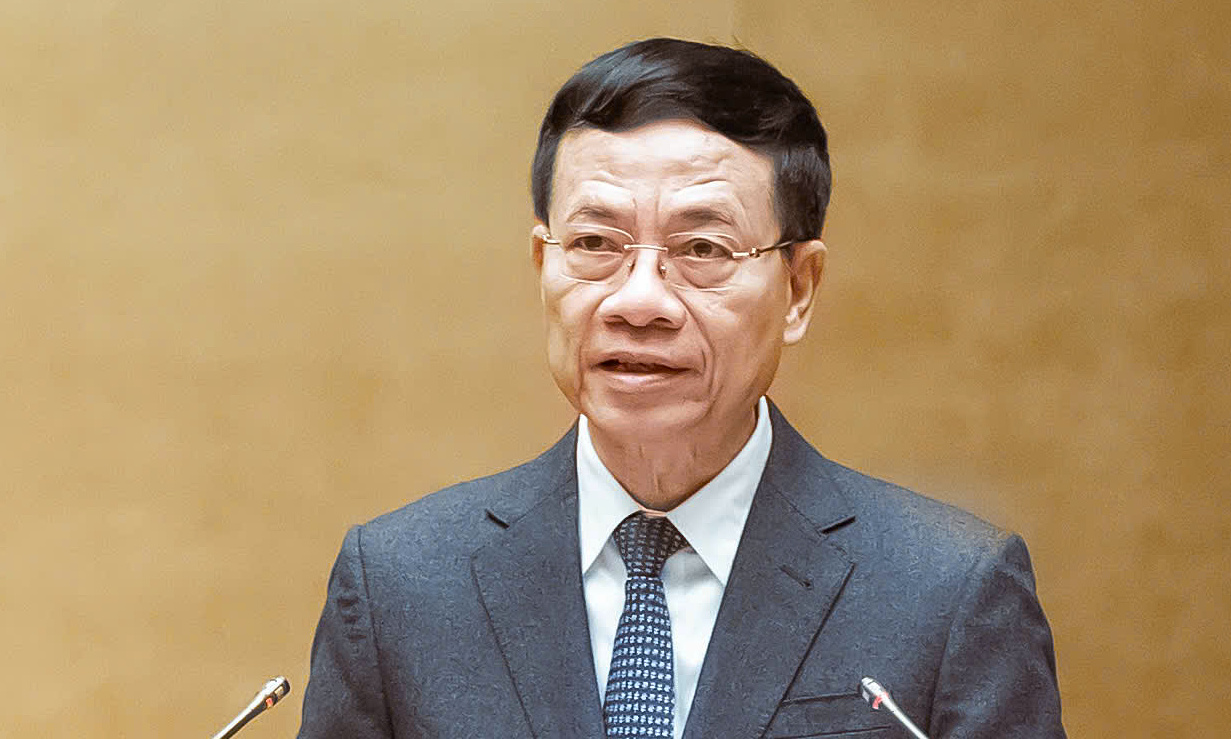 |
Minister of Science and Technology Nguyen Manh Hung, authorized by the Prime Minister, presents the draft artificial intelligence (AI) law to the National Assembly. *Photo: Hoang Phong* |
The draft introduces for the first time a management framework for general-purpose AI models, including open-source models. Developers must ensure basic safety, transparency, and conduct risk assessments before provision. Organizations and individuals using general-purpose models, whether developed domestically or internationally, must conduct assessments and attach appropriate warnings when building AI products or services.
Regarding liability and sanctions, high-risk AI systems are classified as "sources of high danger." This means providers and deployers must compensate for damages even without fault, unless exempted under the Civil Code. If multiple entities are involved, liability is determined by each party's level of risk control and foresight. The maximum administrative fine is two billion dong for organizations and one billion dong for individuals. For serious violations, fines can reach up to 2% of the previous year's revenue.
To promote development, the draft law proposes major policies such as: supporting research, training high-quality human resources, and developing data and high-performance computing infrastructure. It encourages businesses to invest in and test new products through controlled "sandbox" mechanisms. A national AI ethics framework will also be issued to ensure systems are developed and used safely, without bias, and with respect for human values.
Representing the draft law's verifying agency, Nguyen Thanh Hai, Chairwoman of the Committee for Science, Technology and Environment, agreed with the overall direction but stated that many aspects require further clarification. According to her, the current risk classification lacks specific qualitative and quantitative criteria. Moreover, corresponding management measures for each risk level are not fully designed, which could confuse businesses during implementation.
The committee recommended adding principles for ensuring AI data quality, including data that is "accurate, sufficient, clean, and up-to-date," along with mechanisms for connection and sharing to prevent fragmentation. It also suggested clearly defining requirements for cybersecurity and protecting national AI infrastructure.
The committee also noted that many legal issues surrounding AI could lead to complex disputes. These include liability among entities in the value chain, especially with foreign businesses providing cross-border services. Distinguishing between intentional, unintentional actions, or errors due to technical limitations also needs clarification. Closely related areas like copyright, the use of research data, and testing new models in universities and research institutes also need to be addressed to avoid legal gaps.
The National Assembly will discuss the draft artificial intelligence law on 27/11 and is expected to approve it on 11/12.
Son Ha