The Road Traffic Safety and Order Law, effective from 1/1/2026, stipulates that children under 10 years old and shorter than 1,35 m are not permitted to sit in the front passenger seat next to the driver (unless the vehicle has only one row of seats). Drivers must use and instruct passengers on the proper use of suitable child safety equipment. Non-compliance with this regulation, as per Decree 168/2024, could result in a fine of 800,000 to 1 million VND for drivers.
Thanh Minh, a ride-hailing driver residing in Cau Giay district, frequently transports passengers to Noi Bai Airport. He is contemplating whether to spend 3-5 million VND on a child seat, and remains unsure if drivers or passengers are responsible for providing them. If investment is necessary, he questions which type of seat to acquire, given the market offers various options for children aged one to four, booster seats for four to five-year-olds, and booster cushions for older children.
"I fear being unfairly fined if passengers prefer to hold their children, or facing tension if they demand drivers provide the equipment", Minh stated. He added that beyond increased costs, using child seats presents several inconveniences, such as drivers needing to stop to install and remove seats, which is time-consuming. Vehicle trunks often lack sufficient space for both a child seat and passenger luggage, especially when transporting travelers to the airport.
Sharing similar concerns about carrying child safety seats for passengers, Mr. Thanh, a taxi driver, explained that Hanoi's streets are frequently congested. "Stopping to pick up passengers is already difficult, let alone stopping to install and remove a seat", he noted. His taxi company has not yet taken steps to equip vehicles with child safety seats. If this regulation is enforced, Mr. Thanh indicated he would have to decline passengers traveling with young children, as his vehicles only have adult seatbelts.
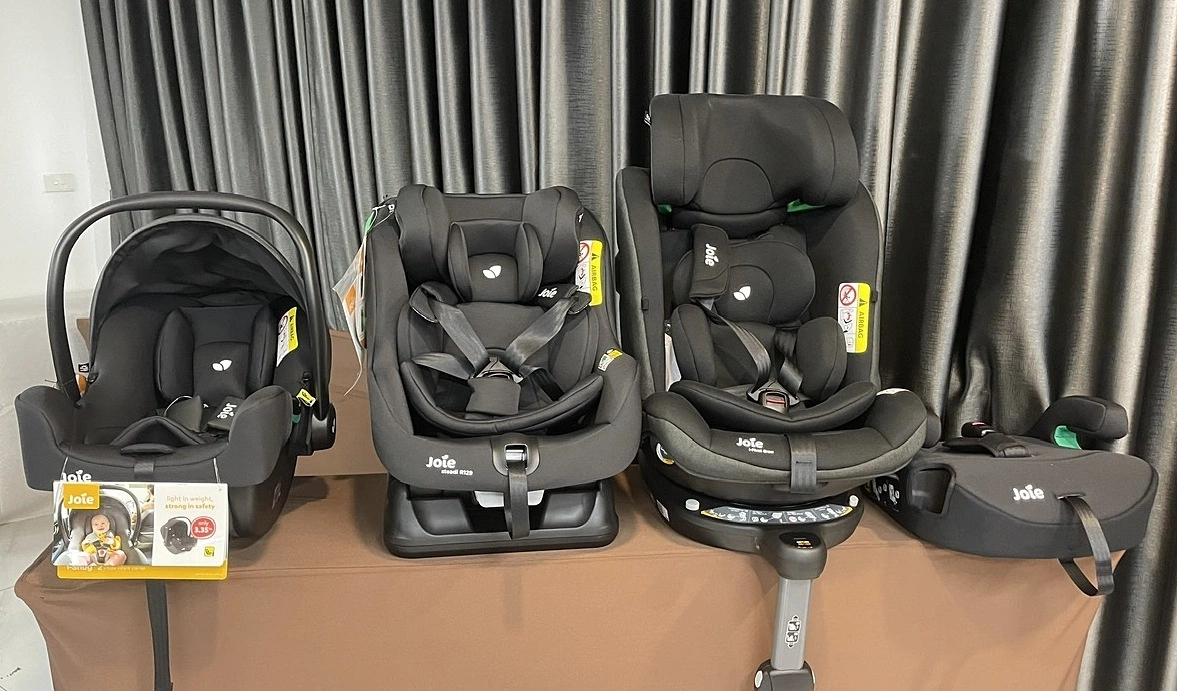 |
A selection of child safety seats available on the market. |
Luong Quoc Huy, CEO of Thanh Nga Taxi, estimated that with 400 vehicles, investing 3-5 million VND per child seat would cost the company billions of VND, significantly increasing financial pressure. According to Huy, while each taxi can typically carry a family of four, installing a child seat would reduce space, making it insufficient for four people. Furthermore, most taxi trunks are small and cannot accommodate both a child seat and luggage. Drivers would also need to ensure seats are properly maintained and cleaned, or passengers might refuse to use them.
Moreover, most taxis operate within city limits, where traffic speeds are low, reducing the likelihood of serious injury in a collision. Children held by adults in a vehicle might be considered safe, making a separate seat unnecessary. The Thanh Nga Taxi CEO proposed that authorities provide specific guidelines for businesses regarding the type of safety equipment to invest in. He suggested that, initially, from 1/1/2026, the child safety equipment regulation should only apply to private vehicles traveling on highways.
Doctor Tran Huu Minh, Chief of Office for the National Traffic Safety Committee, stated that while the law mandates child safety equipment in all automobiles, it should first apply to private cars, with a clear roadmap for commercial and public transport vehicles. This latter group should initially be encouraged to adopt the regulation and be required to provide information on child seat availability for each service trip, allowing passengers to be aware and utilize them.
Explaining the child safety equipment regulation, a representative from the Traffic Police Department (Cuc CSGT, Ministry of Public Security) stated that for children under 1,35 m, using a vehicle's standard seatbelt would not ensure safety during a collision. At that height, the seatbelt would only reach the child's neck, making it unsuitable and unsafe.
Furthermore, children over 10 years old are more receptive and obedient to parents and adults. Children under 10 are still playful and require supervision. Many people mistakenly believe that holding a child in their lap is safe, but this is incorrect. In a collision, a child can be thrown from the vehicle, causing injury. Even with sudden braking, a child could be propelled forward, posing a danger.
"We prioritize the safety of citizens above all else. People using child safety equipment is comparable to wearing a helmet", the Traffic Police Department representative said, adding that the recommendation for using child seats in cars is not a new initiative but has existed for many years.
Doan Loan - Pham Chieu