In a recent report to the government, the Ministry of Construction presented a comprehensive assessment of the technical and economic viability of elevated expressway designs for future projects in the Mekong Delta. This study followed the Prime Minister's directive for the ministry to compare options based on their full lifecycle efficiency, moving beyond initial construction costs.
The Institute of Construction Economics analyzed two approaches: the current method of building roads on earth embankments and constructing elevated reinforced concrete structures. The analysis revealed that elevated structures incur initial investment costs 1.6 to 1.7 times higher than embankment roads. However, when considering the 100-year design life of these projects, the total cost difference between the two options narrows to approximately 1.1 to 1.14 times.
This implies that the significant initial cost disparity diminishes when considering factors such as maintenance, repairs, foundation settlement treatment, and the long-term effects of climate change. Beyond cost savings, elevated structures also substantially reduce land acquisition needs. The Ministry of Construction estimates that land clearance for elevated roads would be only 82% to 85% of that required for embankment roads.
Crucially, in weak soil regions like the Mekong Delta, elevated structures address inherent issues associated with embankment roads, such as prolonged settlement and the need for frequent reinforcement and upgrades. These structures also demonstrate greater resilience to rising sea levels, land subsidence, and fluctuating water flows.
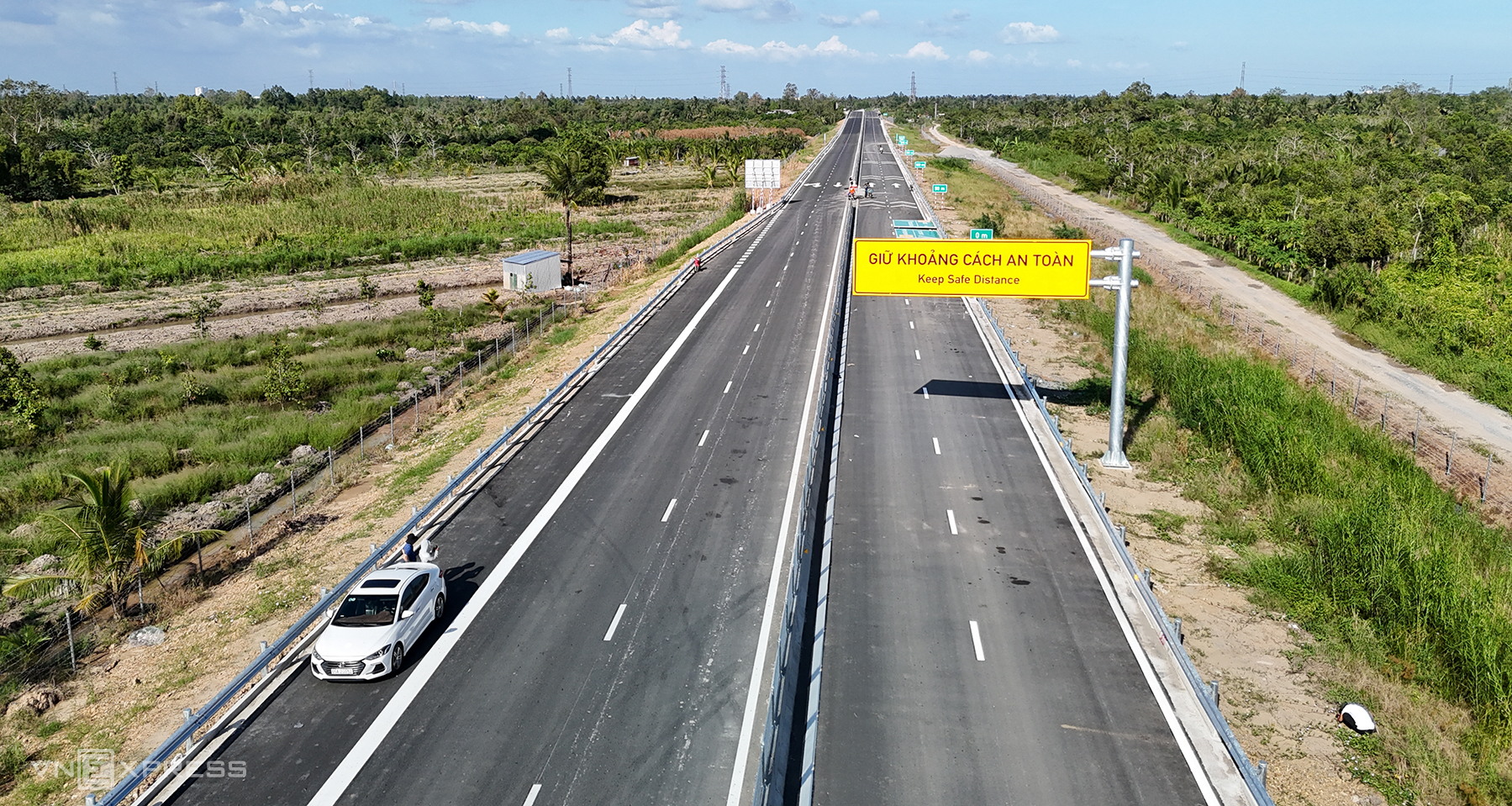 |
Can Tho - Ca Mau expressway in 12/2025. *Photo: Huy Phong* |
Consequently, the Ministry of Construction recommends prioritizing the study and implementation of elevated structures for expressway projects scheduled for phase 2026-2030 and subsequent periods. This approach is particularly crucial for areas with weak soil foundations or those requiring extensive excavation and high embankments.
For individual projects, the Ministry of Construction will mandate consultants and investors to thoroughly research and compare options. The goal is to select solutions that guarantee optimal technical and economic efficiency throughout the project's lifecycle.
The master plan for the Mekong Delta outlines approximately 1,256 km of expressways, consisting of three longitudinal and three lateral routes. Studies are also underway to extend the eastern longitudinal axis, connecting TP HCM – Tien Giang – Ben Tre – Tra Vinh – Soc Trang, by about 110 km to Ca Mau.
By the end of 2027, about 647 km of expressways across the region are expected to be complete, leaving approximately 719 km unfunded.
The Ministry of Construction estimates that approximately 326 km of expressways are slated for development before 2030. These include: the Can Tho bridge (15 km), the Duc Hoa – My An section (74 km), the Ben Tre – Tra Vinh – Soc Trang expressway (71 km), the Ha Tien – Rach Gia section (98 km), and the Hong Ngu – Cao Lanh section (68 km).
Concurrently, the Ministry of Construction is studying 393 km of expressway routes for investment after 2030. These comprise: the An Huu – Tra Vinh section (90 km), the Rach Gia – Bac Lieu section (114 km), the TP HCM – Tien Giang – Ben Tre section (79 km), and the Soc Trang – Ca Mau section (110 km).
The Ministry of Construction highlights that constructing the remaining 700 km of 4-lane expressways using the embankment method would require an estimated 191 million cubic meters of sand and 19.4 million cubic meters of stone. This represents a substantial volume, especially given the dwindling supply from natural sand mines. Consequently, elevated structures are viewed as a viable alternative that could reshape infrastructure development in the Mekong Delta.
Doan Loan