Under the Capital City Master Plan with a 100-year vision, the second airport for the Capital Region will serve as a multi-modal transport hub and a strategic economic driver for Hanoi for decades to come.
The proposed airport, covering approximately 1,500 ha, is planned for the Ung Hoa and Chuyen My communes in southern Hanoi. It will meet international standards with a designed capacity of 30-50 million passengers annually.
Hanoi envisions developing this area as an "aerotropolis", not only for air transport but also integrating hotels, outlet shopping centers, a free trade zone, logistics, high-tech industry, and international services.
According to the plan, the second airport will become an international cargo transshipment center. It will seamlessly connect air transport with roads, high-speed rail, the North-South railway, and Red River waterway transport. The southern corridor of Hanoi is expected to become a logistics hub for the entire region, featuring warehousing, cold chain logistics, inland container depots (ICDs), and high-tech industrial parks.
A free trade zone, planned to be established alongside the airport, will operate as a large-scale international trade hub. This zone will integrate logistics centers, duty-free shopping centers, and outlets to boost international import-export, services, and investment.
Hanoi also intends to selectively attract high-tech industries that offer high added value and are environmentally friendly. These include sectors such as electronics, semiconductor chips, artificial intelligence, digital technology, and logistics.
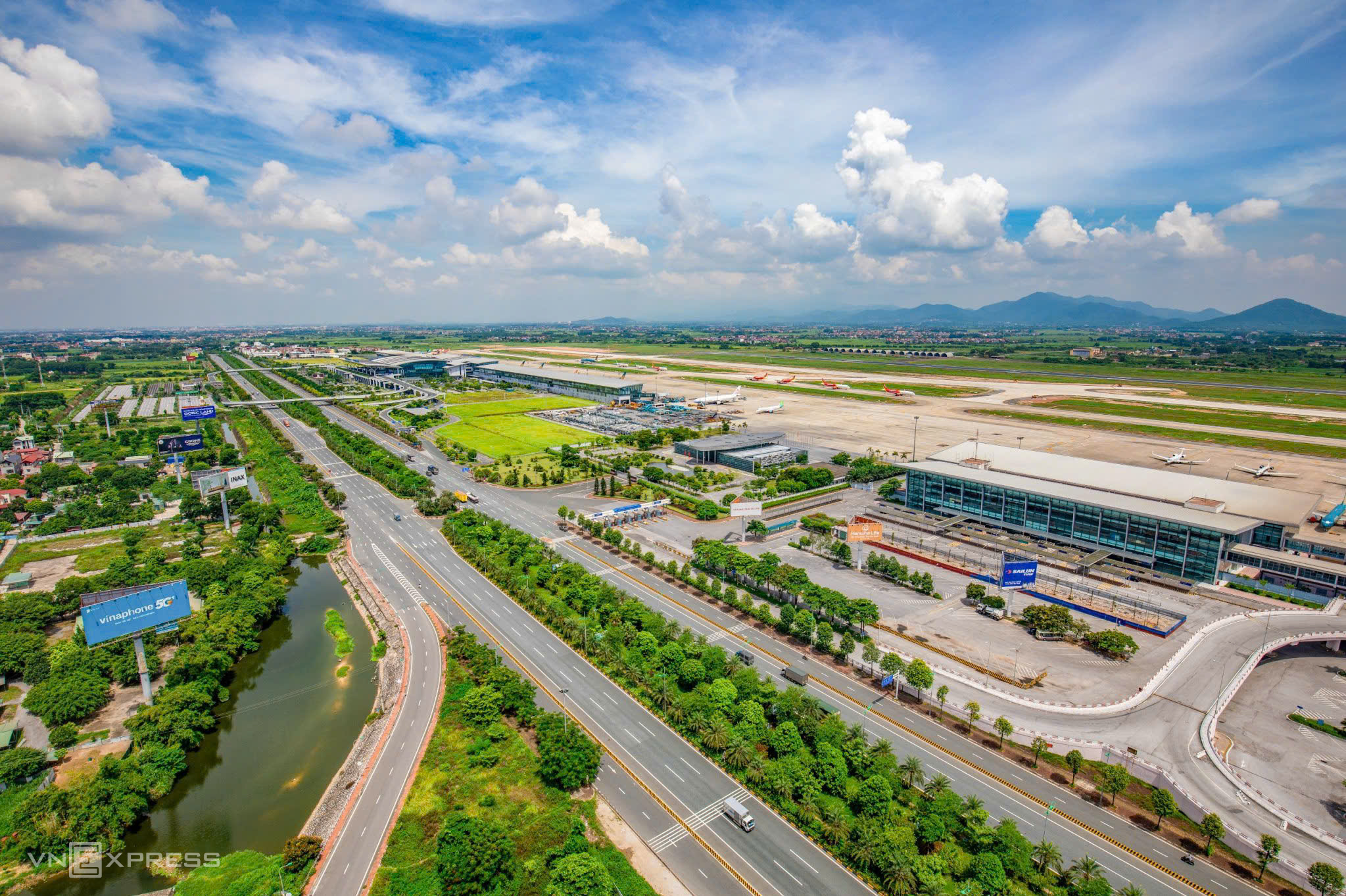 |
Noi Bai airport's T1 + T2 terminals. Photo: Giang Huy
The master plan also targets the formation of an industrial and high-tech development pole in the southern area of Phu Xuyen - Ung Hoa. Specifically, the Ung Hoa and Chuyen My areas are being studied for a railway industrial complex of approximately 250 ha, dedicated to manufacturing and assembling locomotives and railcars.
Beyond its logistics and industrial roles, the second airport is designated as an international tourism transit station. It will connect the Huong Son - Tam Chuc - Bai Dinh - Trang An spiritual heritage chain. Hanoi expects this area to become the capital's "southern tourism gateway".
The airport area will also be linked to a high-quality medical complex in Phu Xuyen, spanning about 100-160 ha, serving as a regional medical center.
Hanoi plans to use rail as the main connecting axis between the inner city and the second airport. Urban railway line 1A will directly link the Ngoc Hoi railway hub with the airport, categorized as a priority for implementation during the 2026-2030 period.
Ngoc Hoi station is planned as the largest transshipment hub in southern Hanoi, integrating a station, depot, and maintenance center. It will connect the urban railway network with the airport. This area will also link with the North-South high-speed railway line and inter-regional railway belts to alleviate radial traffic pressure through the inner city.
Road connectivity will rely on the southern corridor, utilizing key arterial routes such as National Highway 1A and the North-South expressway. Additionally, Red River waterway transport will be leveraged for international cargo logistics.
According to the plan, the study and construction investment for the second airport of the Capital Region, along with the free trade zone, are categorized as priority projects for the breakthrough period of 2031-2045.
Hanoi aims to mobilize diverse funding sources for the project, including public-private partnership (PPP), domestic and international strategic investors, issuing local bonds, project bonds, and leveraging land resources.
Currently, Hanoi operates Noi Bai International Airport, with a capacity of approximately 25 million passengers annually and potential for expansion. Separately, Gia Binh airport in Bac Ninh province is under construction, expected to reach a capacity of 30 million passengers and 1.6 million tons of cargo annually by 2030, increasing to 50 million passengers by 2050.
With an area of approximately 1,500 ha and a capacity of up to 50 million passengers annually, Hanoi's second airport is considered one of the largest infrastructure mega-projects in southern Hanoi for the next century.
Son Ha