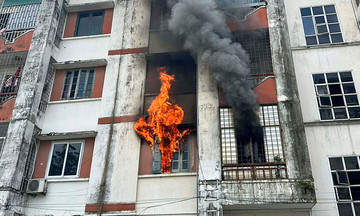
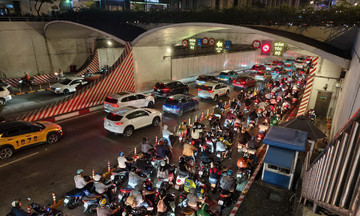
Hanoi's air quality has deteriorated significantly, with the air quality index (AQI) reaching "very unhealthy" levels, posing a serious threat to public health. The Department of Environment (Ministry of Agriculture and Environment) monitoring system reported an AQI of 150 at the Hanoi University of Science and Technology gate station on Giai Phong street at 8 PM yesterday. By 7 AM today, this figure had increased to 210.
An AQI at this level is classified as "very unhealthy" and can cause serious health impacts. Station 556 Nguyen Van Cu recorded an AQI of 201 at 5 AM, which has since slightly decreased to 197; Khuat Duy Tien Park registered an AQI of 160. AQI measures pollution levels on a scale from 0 to over 300, with levels above 200 considered hazardous, affecting everyone.
 |
Air pollution in Hanoi. *Ngoc Thanh*
Many monitoring sites in northern provinces also reported poor air quality: Thang Long 2 Industrial Park (Hung Yen) recorded 170; Bac Giang Provincial Inter-Agency Complex, 154; the former Hai Duong City People's Committee, 153; Nam Cao Park (Phu Ly), 153; and Thai Binh Bridge (Hung Yen), 189.
On the same morning, Hanoi's official air quality monitoring portal, moitruongthudo.vn, was inaccessible due to an "expired domain", preventing residents from viewing data. Meanwhile, the global air quality aggregator IQAir ranked Hanoi as the fifth most polluted city worldwide with an AQI of 225, comparable to heavily polluted urban centers like Kolkata, Delhi (India), Tashkent (Uzbekistan), and Baghdad (Iraq). IQAir's map also showed several Hanoi monitoring points at "very unhealthy" levels: Thanh Xuan 232, Le Duan 231, Tay Ho 282, and Vinh Tuy 223.
In response to the escalating pollution, on 27/11, the Ministry of Agriculture and Environment urged ministries and sectors to implement urgent measures to address air pollution in Hanoi and its surrounding areas. The Ministry of Industry and Trade was specifically requested to instruct thermal power plants, steel, chemical, and fertilizer factories to operate their exhaust gas treatment systems efficiently, ensuring no untreated waste is discharged. These facilities were also advised to reduce capacity or schedule maintenance when the AQI surpasses 200.
The Ministry of Construction was advised to require key construction projects to cover sites, wash vehicles, spray mist to suppress dust, and even temporarily suspend activities that generate significant dust during hazardous air days. Local authorities must reroute traffic and control construction material transport vehicles to prevent congestion that contributes to pollution.
Furthermore, the Ministry of Agriculture and Environment requested the Ministry of Public Security to increase enforcement against uncovered material transport vehicles, expired vehicles emitting black smoke, and illegal waste burning. The Ministry of Health is tasked with guiding residents on health protection, particularly for vulnerable groups. The Ministry of Education and Training has directed schools to limit outdoor activities when air quality levels are poor.
Corporations and factories in Hanoi and its surrounding areas must ensure their dust and exhaust treatment systems operate stably. They should reduce capacity or shift major emission-generating stages to periods with favorable weather conditions. Thermal power, cement, and steel plants are required to use clean materials, cover storage facilities, and spray water to suppress dust along transport routes.
The Ministry of Agriculture and Environment stated it would use online data, satellites, and drones to monitor for unusual emission sources. An inter-agency task force will be established to inspect, address, and publicize violations.
By Gia Chinh