This initiative is part of a plan to review, arrange, and deploy cadres, civil servants, and public employees in communes, wards, and special zones, recently issued by the Ho Chi Minh City People's Committee. The city currently has a surplus of 1,052 civil servants but faces a shortage of 935 people across 27 job positions at the commune level.
The imbalance of surplus and shortage is observed across all three former areas of Ho Chi Minh City, Binh Duong, and Ba Ria - Vung Tau. It primarily affects areas such as administration, finance-planning, construction, and industry-trade. The main reason for this disparity is the mechanical merger of wards and communes during administrative unit restructuring, which resulted in personnel surpluses in some locations and shortages in others.
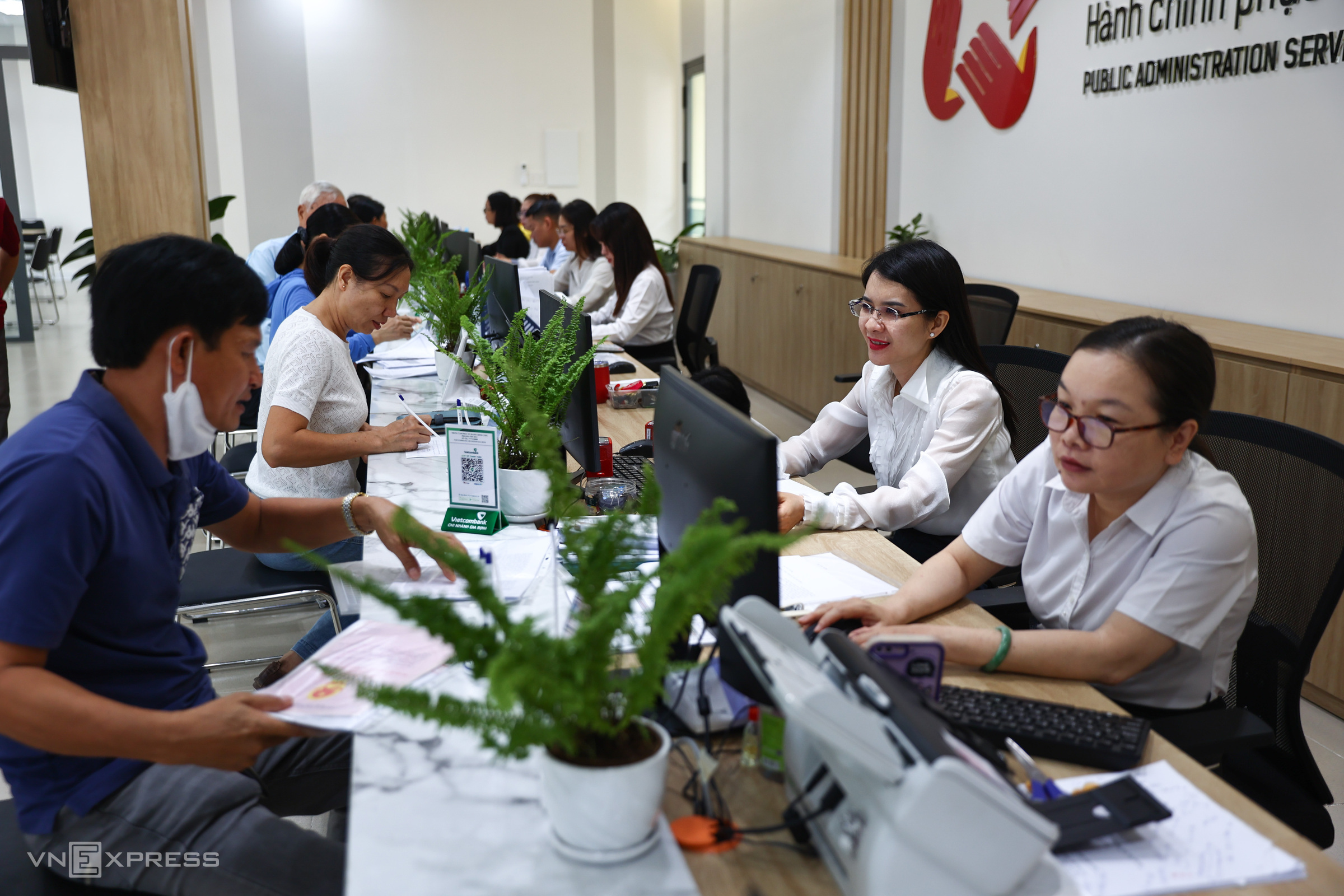 |
Civil servants assisting residents with administrative procedures at the Thu Duc Ward Public Administration Center, Ho Chi Minh City, 7/2025. Photo: Quynh Tran
At the commune level, there is a lack of two vice chairpersons of the People's Committee, and 60 positions for heads and deputy heads of specialized departments remain vacant. Additionally, 11 commune-level People's Committees currently exceed their quota for deputy positions.
To rectify this situation, Ho Chi Minh City plans to arrange and reassign approximately 472 civil servants internally within each commune and ward, and between different localities. The city will also facilitate personnel exchanges between government agencies and Party, Fatherland Front, and mass organizations. Furthermore, 92 civil servants will be transferred from Party and mass organizations to work in 18 understaffed communes.
For the remaining 270 vacant positions, the city intends to bolster support from various departments and sectors, prioritizing fields such as information technology, finance-accounting, construction-transport, and land management. The reassignment process will prioritize civil servants who previously worked in the former Binh Duong and Ba Ria - Vung Tau areas to ensure their convenience and stability.
In parallel, Ho Chi Minh City will implement training and development programs for its workforce. Civil servants who do not yet meet qualification standards may continue in their roles if they are currently pursuing further education and are fulfilling their duties. However, those who do not meet the requirements will undergo workforce streamlining.
The Ho Chi Minh City People's Committee mandates that all cadres and civil servants subject to rearrangement must strictly comply with reassignment decisions. Personnel deployment must follow a clear roadmap, avoid superficiality, and ensure the smooth operation of the grassroots administrative apparatus.
At the Ho Chi Minh City Party Committee conference on 15/12, Party Secretary Tran Luu Quang emphasized the need for careful consideration and an appropriate roadmap in cadre deployment, urging against perfunctory or rushed decisions. He stressed that reassignments must ensure seamless coordination between the civil servant's current workplace, the receiving unit, and the individual being reassigned.
Le Tuyet