This perspective was shared by Associate Professor-Doctor Vu Anh Tuan, Director of the Transport Research Center at Vietnamese-German University, during a seminar on bus development in Ho Chi Minh City. The event, organized by Saigon Business Magazine and the Vietnam Initiative Institute on 15/4, took place as the city prepares to offer free bus services to encourage public transport use.
"The level of infrastructure provision and the number of buses per capita in Ho Chi Minh City are too low, making it one of the system's biggest weaknesses," said Tuan. Compared to similar cities like Jakarta or Bangkok, which have about 900-1,000 buses per million residents to meet 15-20% of travel demand, Ho Chi Minh City currently achieves less than one-third of this level.
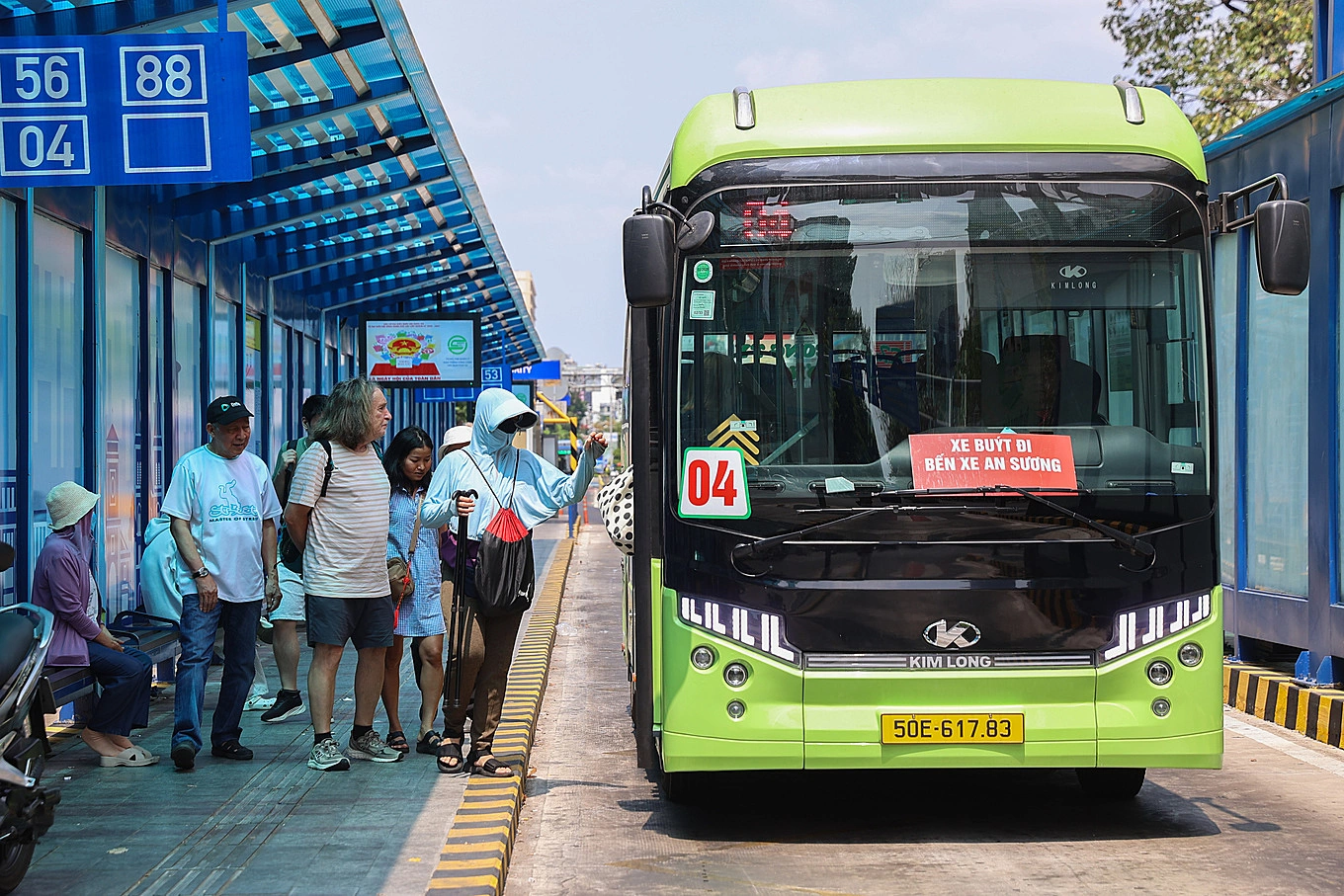 |
People catching a bus in central Ho Chi Minh City, 4/2026. Photo: Quynh Tran |
Tuan noted that following the administrative expansion to include areas from Binh Duong and Ba Ria - Vung Tau, Ho Chi Minh City's population increased to approximately 14-15 million people. However, the entire bus system only has over 2,400 buses. This limited scale leaves many areas without service, compelling residents to rely on private vehicles. Consequently, public transport ridership stands at only 4-5%, even including the Ben Thanh - Suoi Tien metro line.
At this rate, he argued that the current system only meets minimal travel needs for vulnerable groups or those without private vehicles, lacking the competitiveness to rival private transportation.
To achieve the target of 15-20% public transport usage, alongside further metro development, Ho Chi Minh City must expand its bus fleet by at least three times, reaching approximately 14,000-15,000 vehicles. The aim is to increase coverage, improve accessibility for residents, and foster a habit of using public transport, which will then maximize the effectiveness of the free fare policy.
Doctor Huynh The Du, a member of the Vietnam Initiative Institute, also asserted that the city's current primary public transport scale is too low compared to demand. The entire system comprises nearly 20 km of metro lines and over 2,400 buses; in fact, the number of vehicles has even decreased compared to some previous periods.
According to Du, while the city has strong expansion ambitions, the increase must be substantial, potentially three to four times the current fleet, to create a noticeable improvement.
Du believes the free fare policy will have a positive impact, but achieving overall effectiveness requires additional "pull" solutions to attract users: enhancing service quality, ensuring punctuality, high frequency, cleanliness, and safety. Concurrently, coverage must be optimized so residents only need to walk about 500 m to reach a bus stop.
Additionally, buses require better integration with metro lines, bicycles, and pedestrian infrastructure; the ticketing system should be smart, interconnected, and support expanded electronic payments. In the long term, the city needs to accelerate transit-oriented development (TOD) and apply technology to establish an efficient public transport ecosystem.
Alongside these are "push" solutions, such as congestion charges, increased parking fees, or fuel tax adjustments, aimed at limiting private vehicle usage.
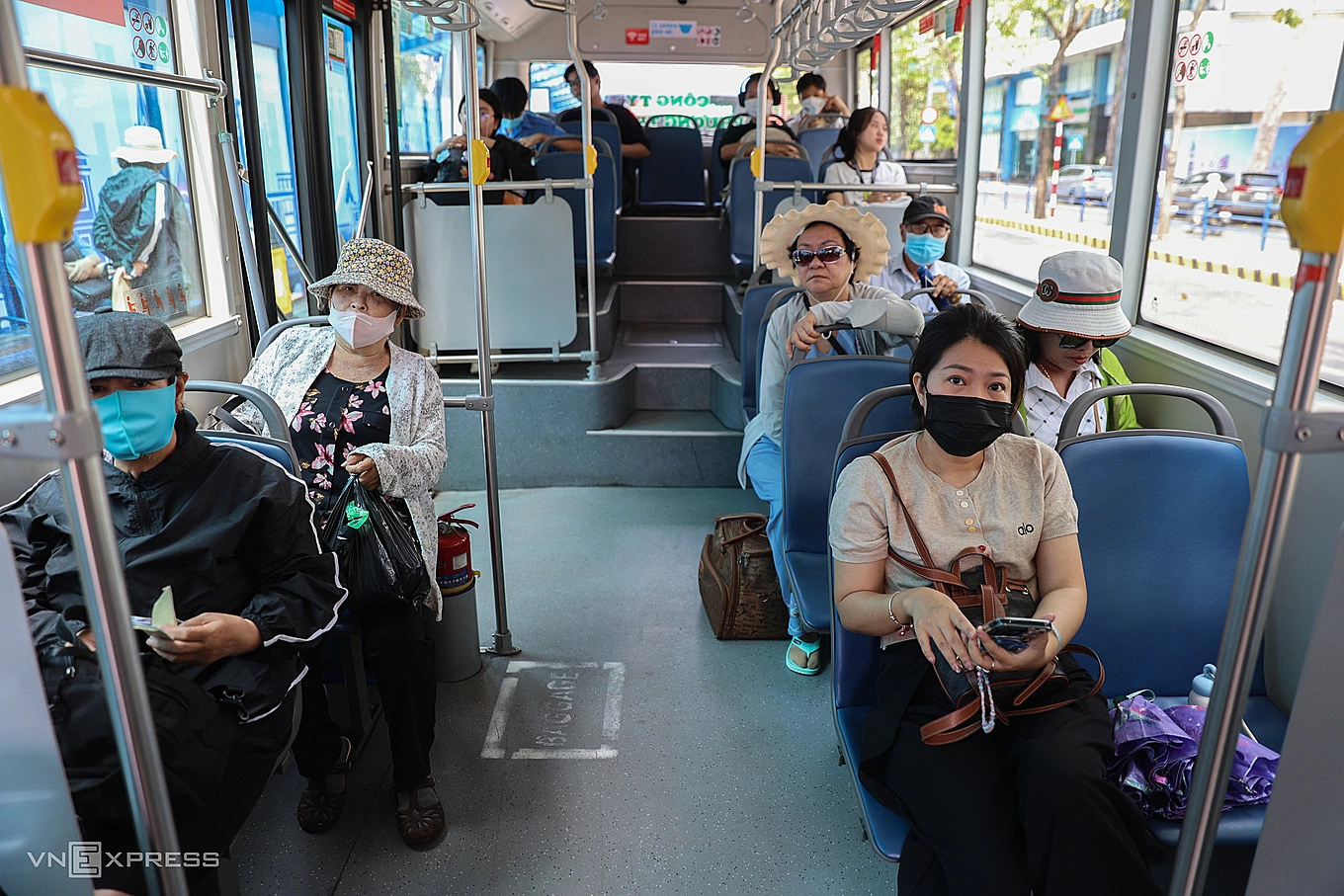 |
Passengers riding an electric bus in Ho Chi Minh City, 4/2026. Photo: Quynh Tran |
At the seminar, Bui Hoa An, Deputy Director of the Ho Chi Minh City Department of Construction, stated that the city currently operates 180 bus routes. These are primarily located in areas prior to the merger, resulting in uneven distribution. Beyond limited coverage, the system also faces shortcomings in punctuality, connectivity, and accessibility.
One important solution, according to An, is to implement bus priority lanes on major routes to improve speed and punctuality. When service becomes more reliable and convenient, buses can gradually change private vehicle usage habits.
Pham Ngoc Dung, Director of the Public Transport Management Center, added that the city is reviewing and adjusting its network. Concurrently, it is developing smaller-scale routes using green vehicles to serve residential areas, enhancing resident accessibility.
One new direction under research is demand-responsive transport (DRT). This model utilizes small vehicles with nine to sixteen seats, operating with flexible routes and schedules. It is suitable for narrow roads and alleyways, where larger buses face accessibility challenges.
Additionally, the city plans to open more routes connecting expanded areas such as the former Binh Duong and Ba Ria - Vung Tau regions, as well as Long Thanh airport, thereby increasing overall system coverage.
Giang Anh