The Ministry of Construction recently convened a meeting to review the pre-feasibility study report for the Ho Chi Minh City - Can Tho railway investment project, with an estimated total investment of approximately VND 171.3 trillion.
According to the meeting announcement, due to the route traversing areas with weak soil, complex terrain, and impacting multiple localities, the Ministry of Construction leadership emphasized the need for careful study and an innovative approach during investment preparation. This ensures the project's feasibility and long-term sustainability.
One crucial aspect highlighted was transport demand forecasting. The My Thuan Project Management Board is tasked with collaborating with relevant agencies to update actual passenger and cargo traffic data along the TP HCM - Can Tho corridor. This forecast must extend beyond mere transport volume to assess the railway's attractiveness, competitive landscape, and market share distribution among rail, road, and inland waterway transport modes.
Regarding the transit-oriented development (TOD) model, the Ministry of Construction mandated its inclusion in the pre-feasibility study report. It also requires clear identification of land parcels around stations for urban, service, commercial, and logistics development.
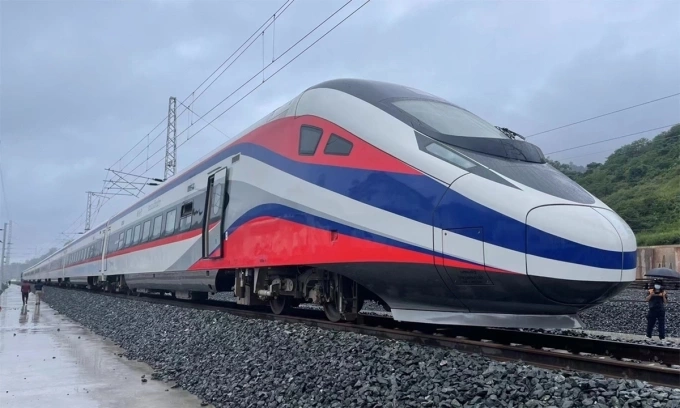 |
Lao railway operates at a maximum speed of 160 km/h. Photo: Xinhua |
According to the Ministry of Construction, the TOD model can generate additional resources for infrastructure development, enhance land exploitation efficiency, and bolster the project's financial viability. The Ministry further stated it would work directly with localities along the route to agree on TOD land development plans and organize subsequent project implementation steps.
For the technical plan, the Ministry of Construction approved the principle of initial phased investment with a single track, using a 1,435 mm standard gauge. However, the design must account from the outset for a future double-track configuration, preventing significant cost overruns or operational disruptions later.
In areas with weak soil within the Mekong Delta, the Ministry requires selecting appropriate treatment solutions to ensure long-term stability, mitigate subsidence risks, and meet train operation safety requirements. The My Thuan Project Management Board and its consultants are urged to complete the dossier by July.
As per the pre-feasibility study proposal, the TP HCM - Can Tho railway line will commence at An Binh station (Di An ward, TP HCM) and conclude at Can Tho station (Hung Phu ward, Can Tho City), spanning a total length of 175.2 km.
Initially, the line will be constructed as a single track, 1,435 mm gauge; it will later be completed as a double track as planned. The entire route is projected to feature 12 stations and three depots at An Binh, Tan Kien, and Can Tho. Designed speeds are expected to reach 160 km/h for passenger trains and 120 km/h for freight trains.
Approximately 56% of the railway will be built on bridges over rivers, through urban areas, and existing infrastructure, while about 44% will run on ground level. Preliminary calculations suggest that integrating the railway with the Can Tho 2 bridge would result in an estimated total investment of VND 171.3 trillion. An independent railway bridge option would increase the total investment to approximately VND 175.11 trillion.
The TP HCM - Can Tho railway project is slated for submission to the National Assembly for investment policy consideration in August, with groundbreaking anticipated in 2028 and substantial completion by 2035.
Anh Duy