The Ministry of Agriculture and Rural Development outlined this position in a document responding to the Ho Chi Minh City People's Committee's request for support in completing procedures to expand the Da Phuoc Waste Treatment Complex, invested by Vietnam Waste Management Company Limited (VWS).
According to the Ministry, both the environmental impact assessment (EIA) report approved in 2005 and its revision in 2015 specified the complex's total receiving capacity as 24 million tons. This parameter has remained unchanged in all environmental documents approved by competent authorities.
However, the landfill has already received approximately 31,5 million tons of waste, exceeding the approved capacity by 7,5 million tons. The Ministry assessed this as "not in line with environmental documents and procedures," urging the Ho Chi Minh City People's Committee to inspect and address any violations, and report the findings.
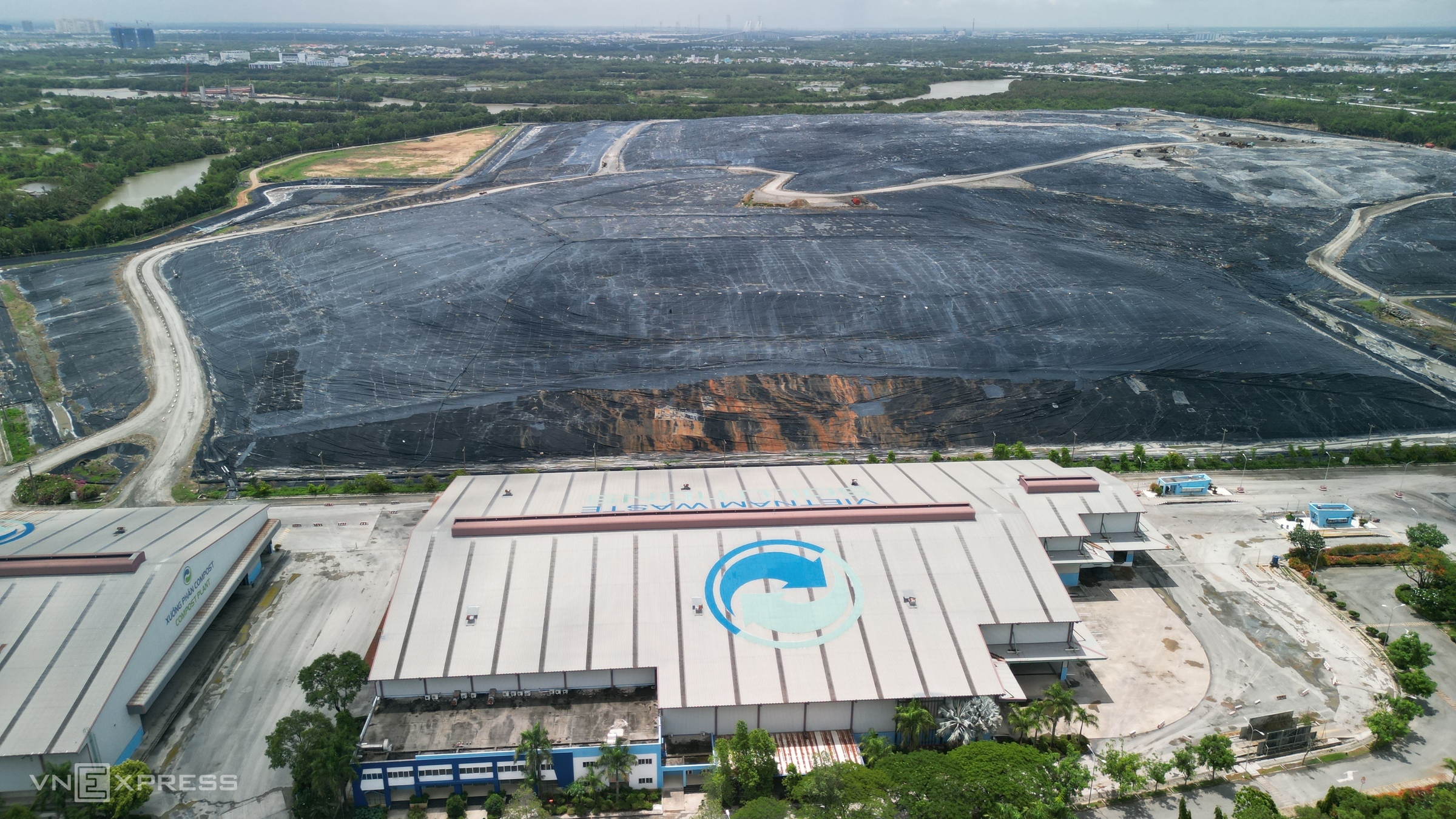 |
Current state of Da Phuoc landfill, Ho Chi Minh City, 22/5. Photo: Dinh Van |
Earlier, the city administration requested the Ministry's support for VWS to complete procedures for increasing Da Phuoc's capacity to receive and landfill household waste from 24 million to 41 million tons. The city also sought to adjust the fertilizer processing technology to a capacity of 100 tons of product per day.
Ho Chi Minh City argued that the Ministry of Construction appraised the landfill in 2006 and reconfirmed its capacity in 2024 as 24 million m3. Based on the actual receiving capability, the city proposed converting this volume to approximately 41 million tons.
The Ministry of Agriculture and Rural Development stated that construction documents and environmental documents are different in nature. The volume in the basic design reflects only the maximum technical capacity of the facility, serving as a basis for the construction sector to evaluate project plans.
In contrast, the landfill's operations must comply with the scale approved in the environmental documents. If the investor wishes to increase the amount of waste received, they must follow adjustment procedures as regulated.
In 8/2025, the Ministry temporarily halted its appraisal of the EIA report prepared by VWS to increase capacity, requesting the company to supplement and revise it.
The regulatory body also found that VWS had not planted the required 7,03 ha of isolation trees, as stipulated in the 2015 EIA and the 2020 certification of environmental protection works completion. Ho Chi Minh City was asked to urge the company to complete this item to reduce impacts on surrounding areas.
According to the Ministry, the National Assembly and Government's orientation is to reduce landfilling, prioritizing recycling and waste-to-energy incineration. However, in 2025, approximately 58,7% of household waste in Ho Chi Minh City was still directly landfilled.
The city currently operates two waste incineration facilities, one of which does not recover energy. Many waste-to-energy incineration projects have completed investment procedures but are not yet operational. The Ministry urged Ho Chi Minh City to accelerate these projects and proactively allocate land for waste treatment facilities using modern technology.
The Da Phuoc Waste Treatment Complex spans 128 ha, with an investment exceeding 107 million USD, and has been operational since 2007. It is Ho Chi Minh City's largest landfill, receiving about 4,000-5,000 tons daily, primarily processed by landfilling.
For many years, residents in southern Ho Chi Minh City have regularly complained about foul odors from the landfill affecting their lives, prompting the city administration to repeatedly demand the investor to remedy the issue. City environmental officials had anticipated the landfill would reach full capacity and close by 2024.
Le Tuyet - Giang Anh