The Dong Nai provincial people's committee recently sent a document to the ministry of construction and relevant agencies, proposing a plan for the arrangement of railway stations within Long Thanh international airport.
According to the proposal, the north-south high-speed railway line will be positioned along the central axis of the railway system's main corridor.
The urban railway line extending the Ben Thanh - Suoi Tien metro to Dong Nai city's administrative center and Long Thanh airport will be located to the left of the North-South high-speed railway line (when traveling from TP HCM to Dong Nai city).
The Thu Thiem - Long Thanh urban railway line will be situated to the right of the North-South high-speed railway line, following the same direction.
Given that the area in front of terminal T1 is constrained by access roads, viaducts, parking lots, and existing or developing technical infrastructure, Dong Nai city proposes a staggered arrangement for the stations on the ground plan.
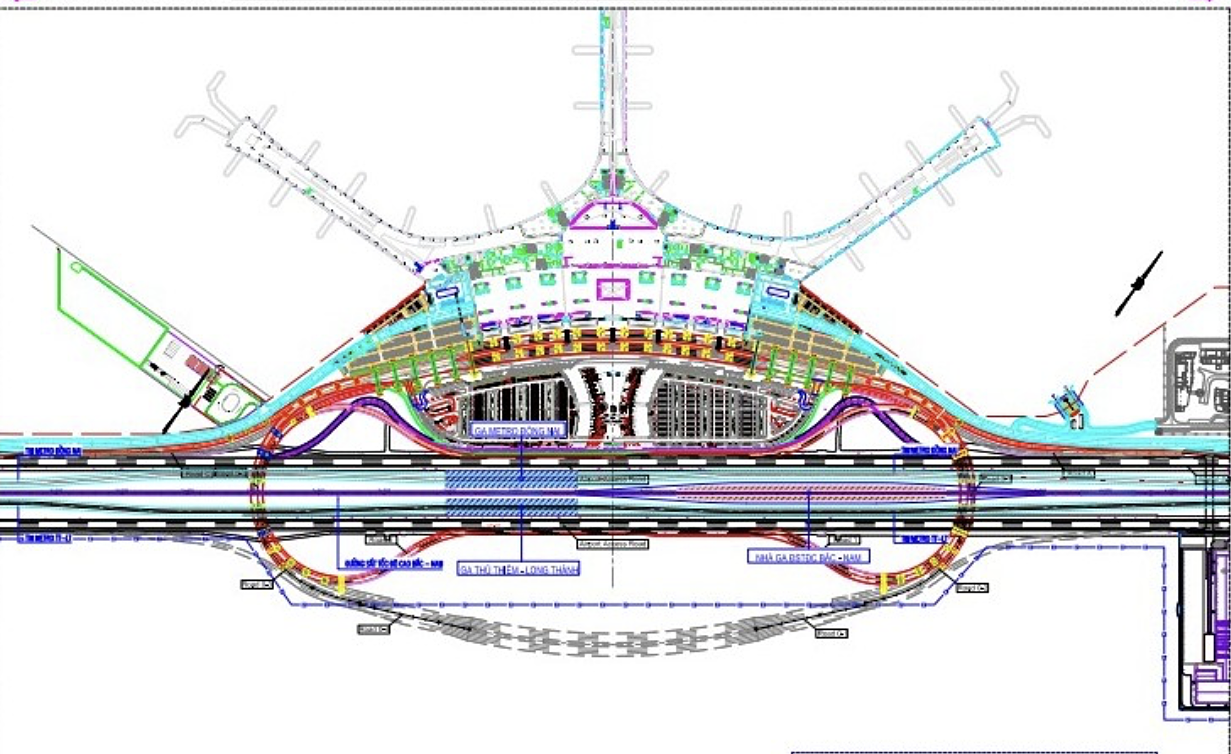 |
Simulation of railway station locations at Long Thanh airport.
Accordingly, the North-South high-speed railway station will be offset to the northeast of the terminal T1 axis, serving as the central facility of the transport hub, connecting the high-speed railway line with Long Thanh airport and urban, inter-regional metro lines. The two metro stations will be offset to the southwest of the terminal T1 axis, positioned parallel and symmetrically across the high-speed railway line's center.
The North-South high-speed railway station will operate independently from the two metro stations; concurrently, the two metro lines will also be independently structured in terms of construction, technology, signal systems, train control, and operational management.
According to the Dong Nai provincial people's committee, the station areas are designed with sufficient space for line tunnels, platforms, station box structures, passenger distribution levels, staircases, escalators, elevators, technical rooms, ventilation systems, fire prevention and fighting, and evacuation routes.
The specific locations, dimensions, and elevations of each station will be determined in the subsequent design phase, based on topographical conditions and the consensus of relevant agencies.
Connectivity between terminal T1 and the Dong Nai city metro station, the Thu Thiem - Long Thanh metro station, and the North-South high-speed railway station can be achieved via pedestrian bridges, connecting tunnels, or a combination of both.
The Dong Nai provincial people's committee believes that the proposed integrated, staggered, yet centrally connected railway-metro station cluster arrangement is a suitable option for further study.
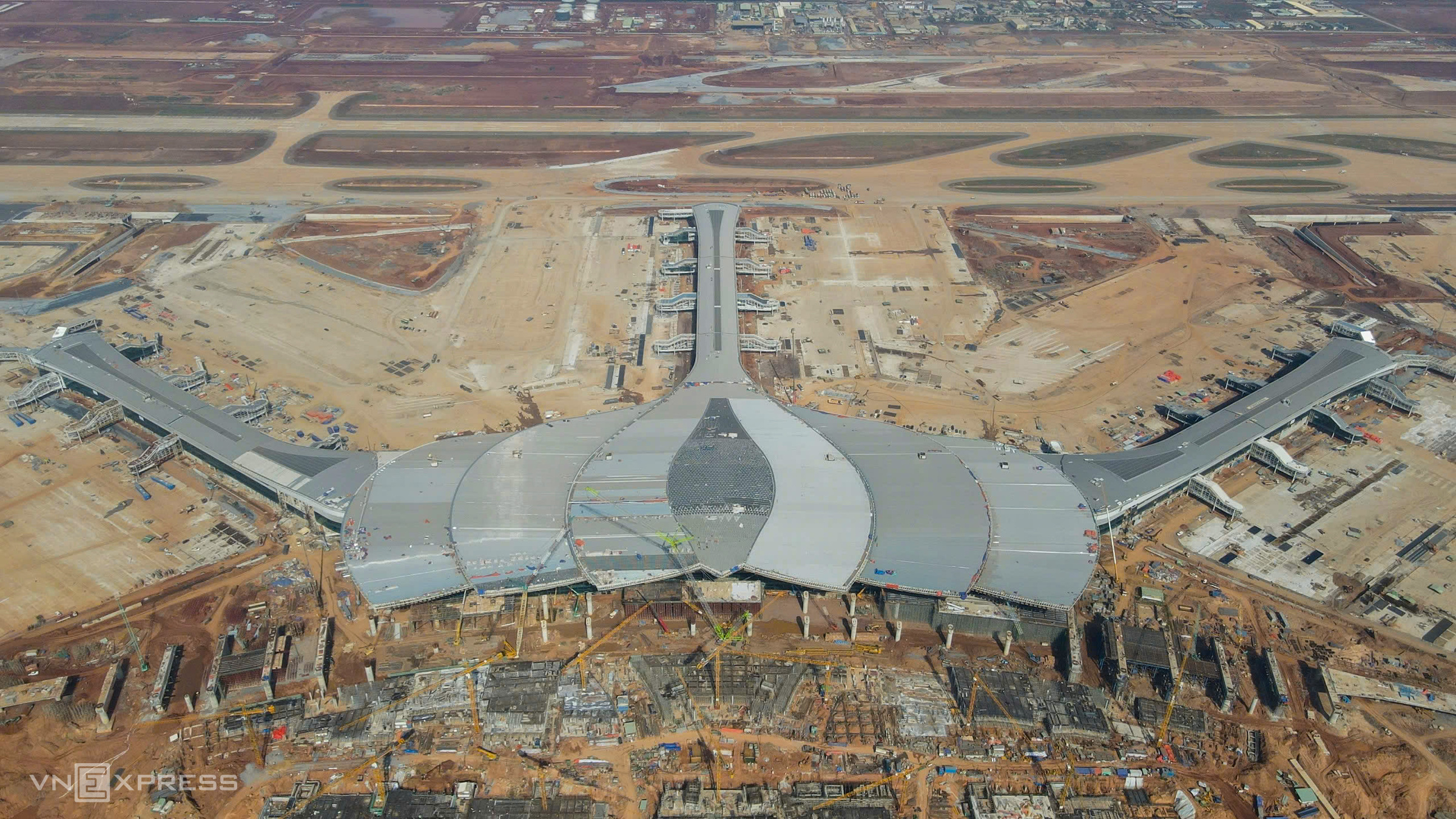 |
Long Thanh airport construction site, 12/2025. Photo: Quynh Tran
This solution offers advantages such as ensuring independent operation of lines, reducing technology interface risks, limiting operational crossovers, facilitating independent project implementation, and enhancing passenger transfer capacity. Furthermore, the plan aligns with Long Thanh international airport's role as an international aviation gateway and a national transport hub.
Long Thanh airport is currently in phase one of its development, with operations expected to commence by late 2026, serving an estimated 25 million passengers annually.
To connect the airport, numerous railway projects are being promoted for investment, alongside the road network. Among these, the Thu Thiem - Long Thanh line is the most vital axis connecting TP HCM with the airport, with groundbreaking anticipated next july. The government has also agreed in principle to extend the Ben Thanh - Suoi Tien metro to Dong Nai's new administrative center and the airport.
In addition to these two lines, Long Thanh airport will also serve as a connection point for the North-South high-speed railway, which will transport inter-regional passengers at high speeds, linking major economic centers across the country.
Anh Duy