Speaking at a group discussion on the socio-economic development plan on the morning of 10/4, National Assembly Chairman Tran Thanh Man emphasized that achieving double-digit growth from 2026 requires comprehensive and decisive solutions that yield tangible results.
He identified promoting the private economic sector as a key focus. When this sector maintains double-digit growth, the economy can achieve a corresponding growth rate. Concurrently, it is essential to foster more large private corporations capable of undertaking national-scale projects.
Man cited examples where large projects executed by private enterprises have met both deadlines and quality standards, whereas state-implemented projects often take three to four years to complete administrative procedures. Therefore, he urged continued improvement of mechanisms to effectively utilize private resources.
The National Assembly Chairman advocated for a significant shift in the growth model towards science, technology, innovation, and digital transformation, in line with Resolution 57. He highlighted artificial intelligence as an important factor in enhancing management efficiency, legal framework development, and data control, including within the National Assembly's operations.
Regarding macroeconomic management, Man called on the Government to be flexible and proactive in responding to external factors, such as international conflicts. He also stressed the importance of ensuring high growth while controlling inflation and implementing a focused expansionary fiscal policy.
The Chairman concurred with Prime Minister Le Minh Hung's directive to concentrate public investment capital on large, impactful projects, avoiding scattered allocation and the "ask-and-give" (patronage) mechanism. He proposed accelerating the resolution of stalled projects and key infrastructure works to improve investment efficiency.
To meet the high growth demands of the next five years, Man proposed a "five-ization" reform approach: digitalization, greening, resource optimization, smart governance, and harmonization of interests. He emphasized that economic development must be linked to ensuring social equity, with a strong focus on education, healthcare, vocational training, and job creation.
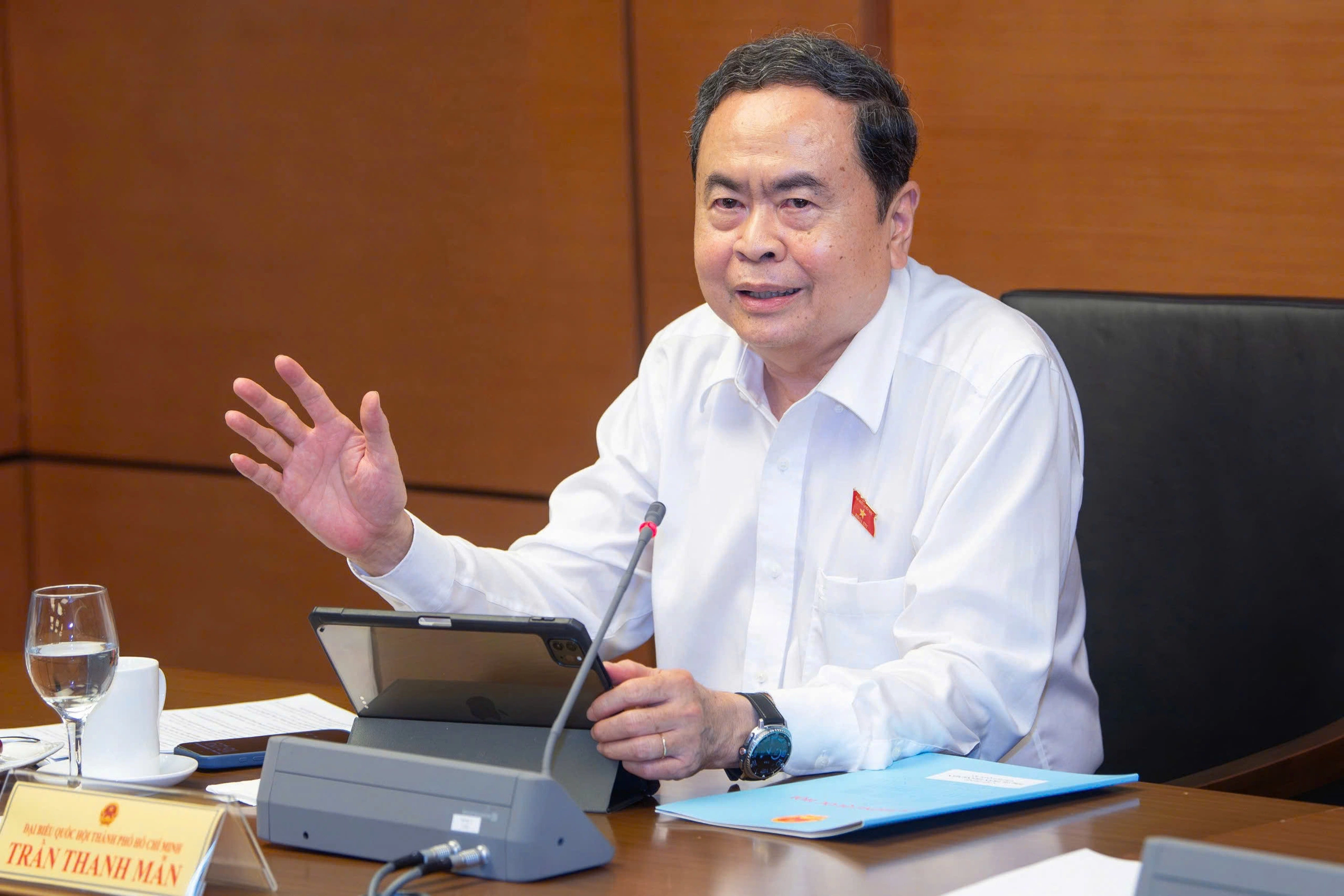 |
National Assembly Chairman Tran Thanh Man speaking at the group meeting. Photo: Hoang Phong |
He also recommended reforming management to reduce compliance costs and shift from pre-inspection to post-inspection. Additionally, a mechanism should be established to protect officials who dare to think and act. This should be accompanied by increased decentralization and delegation of power, empowering localities to make decisions, implement policies, and bear responsibility, while the Central government acts as a facilitator and supervisor.
Man stated that the National Assembly would focus on deciding major national projects, such as the Ninh Thuan nuclear power plant, the North-South high-speed railway, and urban railways in Hanoi and TP HCM, rather than allocating small, fragmented capital amounts.
He underscored a vision for 2026: no wasted day, no delayed week, no missed opportunity in a month, and no passivity in a year. Accountability must be clearly defined for each agency and locality to ensure smooth workflow and prevent situations where officials merely go through the motions without producing results.
Delegate Nguyen Thi Tuyen, Deputy Secretary of the Government Party Committee, asserted that achieving double-digit growth requires breakthrough solutions, including the effective exploitation of the marine economy. She proposed leveraging Vietnam's long coastline to develop a system of 36 seaports and logistics, thereby creating growth momentum and employment.
Tao Duc Thang, Chairman and General Director of Viettel Group, suggested expanding development into international markets to sustain double-digit growth. According to him, Viettel's experience demonstrates that growth from foreign markets accounts for 60% to 70%, helping the enterprise expand its scale and maintain long-term development.
He also recommended improving public investment efficiency by adopting a business-like approach, with a strong emphasis on post-investment evaluation. Furthermore, he proposed refining mechanisms for resolving international investment disputes and adding regulations on eligible parties for legal action to protect Vietnam's legitimate interests when participating in the global market.
Son Ha