Eng English
China 中国人

Eng English
China 中国人
  • News
  • World
  • Business
  • Entertainment
  • Sports
  • Law
  • Education
  • Health
  • Lifestyle
  • Travel
  • Science
  • Digital
  • Automobiles
  • Trở lại Thể thao
  • News
Monday, 1/12/2025 | 10:54 GMT+7

National Assembly representatives warn of radiation risks from rare earth mining

Several National Assembly representatives proposed tightening technology standards and environmental monitoring, warning that rare earth mining could generate naturally occurring radiation and hazardous waste if not strictly controlled.

On the morning of 1/12, the National Assembly discussed the draft Law amending and supplementing the Law on Geology and Minerals. Representative Trinh Thi Tu Anh, a full-time member of the Lam Dong delegation, emphasized that rare earth is a strategic resource for key industries such as semiconductors, electric vehicles, and national defense. Therefore, she argued, the law must prioritize environmental safety and ensure unified management at the national level.

Tu Anh explained that the process of rare earth extraction and processing consistently generates naturally occurring radioactive materials, heavy metals, and difficult-to-treat acidic solutions. Many countries that previously engaged in extensive, uncontrolled mining left behind areas of persistent radioactive contamination. In these cases, environmental restoration costs far exceeded the economic value gained. "This is a lesson Vietnam cannot afford to repeat," she stated.

Drawing from international experience, Representative Tu Anh advocated for the adoption of closed-loop extraction technology, modeling of radiation dispersion, continuous environmental monitoring, and international-standard treatment methods for sludge waste. She stressed the need for the national radiation and nuclear safety agency to independently oversee the entire process, from technology and risk assessment to on-site inspections and waste treatment.

Tu Anh also noted that rare earth projects have long cycles, requiring extensive technology trials and thorough environmental assessments. If the priority period for investors is too short, companies might rush project development, fail to establish deep processing chains, and easily revert to crude extraction. Therefore, the law needs more flexible mechanisms to attract investors with genuine technological capabilities.

Representative Trinh Thi Tu Anh (a full-time member of the Lam Dong delegation). Photo: Hoang Phong

Representative Dang Thi My Huong, Deputy Head of the Khanh Hoa delegation, added that the current draft law lacks mechanisms to ensure environmental safety and manage radioactive and chemical waste. She proposed independent environmental risk assessments by a third party, requiring businesses to deposit higher environmental bonds than for conventional mineral mines, and periodic public disclosure of environmental data to ensure transparency and sustainable development.

From a broader mineral policy perspective, Representative Nguyen Tam Hung (TP HCM) argued that rare earth holds significant economic value and strategic importance, necessitating strict management. However, he emphasized that the law must also harmonize with other strategic minerals. He cited the case of bauxite, a crucial mineral with large reserves in the Central Highlands provinces, where long-term planning limitations impacted local livelihoods, hindered infrastructure development, and resulted in wasted resources.

Therefore, he proposed reviewing planning boundaries, retaining only areas with confirmed reserves and medium to long-term mining potential to avoid repeating past shortcomings with other strategic resources.

Associate Professor Hoang Anh Son, Director of the Institute of Materials Science, reported that Vietnam possesses substantial rare earth reserves, estimated at 22 million tons by the U.S. Geological Survey, ranking second globally after China. However, Vietnam currently lacks facilities to process rare earth concentrate into export-grade products. This is due to companies not yet mastering the technology to produce required purity levels or to extract individual elements. This situation highlights that strict management must be coupled with a long-term technology investment strategy for sustainable rare earth industry development.

The National Assembly is expected to vote on this draft law on 11/12.

Son Ha

By VnExpress: https://vnexpress.net/dai-bieu-quoc-hoi-canh-bao-rui-ro-phong-xa-tu-khai-thac-dat-hiem-4988156.html
Tags: artificial intelligence semiconductors minerals rare earth

News in the same category

Frost appears in Nghe An highlands

Frost appears in Nghe An highlands

For the past two days, the border commune of Na Ngoi, formerly part of Ky Son district, has experienced temperatures below 0 degrees Celsius, leading to frost on vegetation and rooftops.

Hoang Sa special administrative region gets first female chairperson

Hoang Sa special administrative region gets first female chairperson

Hoang Sa special administrative region has its first female chairperson as Director of the Department of Home Affairs Tran Thi Kim Hoa is appointed to the position.

Fire at Hanoi Beer Factory

Fire at Hanoi Beer Factory

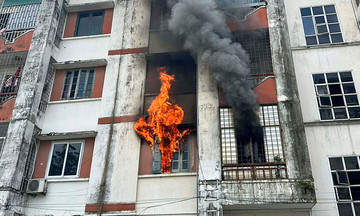
Fire erupted from a corner of a two-story administrative building at the Hanoi Beer Factory on Hoang Hoa Tham street, spreading to the entire structure on the morning of 1/12.

Passenger bus collides with garbage truck on Hanoi - Thai Nguyen expressway

Passenger bus collides with garbage truck on Hanoi - Thai Nguyen expressway

A 16-seat passenger bus, attempting to overtake at high speed, collided with a sanitation garbage truck on the Hanoi - Thai Nguyen expressway, resulting in the driver suffering a broken leg and traffic congestion stretching over 2 km.

A month of rescue boat driving from north to south

A month of rescue boat driving from north to south

When he launched the canoe brought from Da Nang into the floodwaters in the North, Dao Dang Cong Trung did not imagine the rescue trips would continue for over a month, spanning three regions of the country during this year's particularly severe natural disaster.

Mimosa Pass, Da Lat's gateway, reopens

Mimosa Pass, Da Lat's gateway, reopens

A temporary road, built along the mountainside through the landslide area on Mimosa Pass, National Route 20, reopened to traffic from 18:00 on 30/11, with a recommendation to limit travel during heavy rain.

Car rams into group of women, one fatality

Car rams into group of women, one fatality

A dispute led Nguyen Tan Thanh to ram his car into a group of people in Ben Cau commune, resulting in one fatality on the afternoon of 30/11.

Northern Vietnam sees reduced dryness

Northern Vietnam sees reduced dryness

Next week, as the upper-level divergent wind field weakens, air humidity in northern Vietnam will improve, gradually reducing dry conditions.

Secretary Tran Luu Quang: front must not avoid hot issues

Secretary Tran Luu Quang: front must not avoid hot issues

The Ho Chi Minh City Fatherland Front must not shy away from hot issues and should propose amendments and additions to ensure citizens' rights, according to the Secretary of the Ho Chi Minh City Party Committee.

Phu Quoc submarine cable severed, 30,000 households without power

Phu Quoc submarine cable severed, 30,000 households without power

The 110kV Ha Tien - Phu Quoc submarine cable experienced a break yesterday afternoon, affecting tens of thousands of households and numerous tourism facilities.

Eng English
China 中国人
  • News
  • World
  • Business
  • Entertainment
  • Sports
  • Law
  • Education
  • Health
  • Lifestyle
  • Travel
  • Science
  • Digital
  • Automobiles
FPT Tower, 10 Pham Van Bach Street, Dich Vong Ward,
Cau Giay District, Hanoi, Vietnam
Email: contacts@vnportal.net
Tel: 028 7300 9999 - Ext 8556
Advertise with us: 090 293 9644
Register
© Copyright 2025 vnnow.net. All rights reserved.
Terms of use Privacy policy Cookies