Vietnam Social Security announced on 27/8 a nationwide initiative to transition from using social insurance (BHXH) codes to personal identification numbers or citizen identification cards. This move aims to streamline data and enhance the efficiency of the social security system.
The conversion process will unfold in two phases. The first phase, from 15/8 until before 1/9, focuses on standardizing data for all social and health insurance participants and contributing entities, ensuring they meet the necessary conditions for conversion. During these two weeks, the sector is actively cleaning data for individuals who currently lack a personal identification number or citizen identification card, or whose existing information has not been verified against the National Population Database. The second phase, commencing from 1/9, will see a concentrated, system-wide conversion across the entire Vietnam Social Security network.
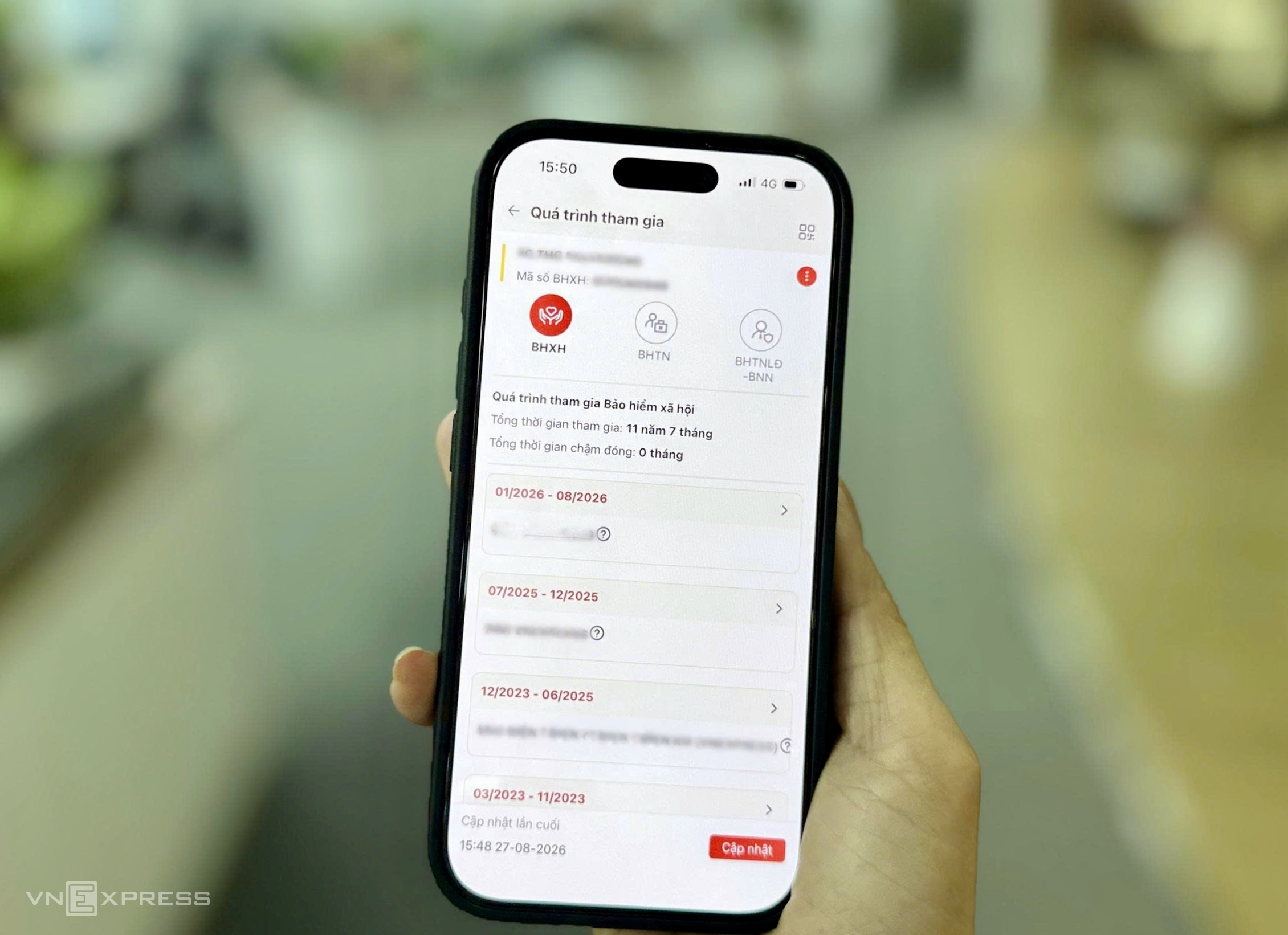 |
The social insurance contribution process for employees displayed on VNeID level 2. Ngoc Thanh
Chu Manh Sinh, Deputy Director of Vietnam Social Security, has directed the Information Technology and Digital Transformation Center to oversee this nationwide transition. His instructions include upgrading and testing software, performing data backups, and developing comprehensive recovery plans and incident response scenarios. These proactive measures are crucial for promptly addressing any technical issues that may arise, thereby safeguarding the benefits of all participants.
Concurrently, the Professional Department has urged local Social Security offices to meticulously review cases where individuals lack a personal identification number or citizen identification card, are unverified, or whose information contains discrepancies with the National Population Database. These local units are authorized to proceed with the conversion only when records fully comply with criteria such as a valid personal identification number or citizen identification card, full name, date of birth, gender, and synchronization status. All identified discrepancies must be resolved prior to initiating the conversion process for each individual record.
According to the agency, during this transition, all processes related to social insurance benefits, health insurance medical examinations and treatment, collections, card issuance, electronic transactions, and payments will continue without interruption. Should any issues arise, participating units are instructed to prioritize resolving them for individuals and businesses to prevent any adverse impact on their entitlements.
The personal identification number is a 12-digit sequence issued by the Ministry of Public Security. For individuals possessing a 12-digit citizen identification card, this number functions as their personal identification number. For children, the identification number is directly printed on their birth certificate.
The social insurance code, which is being replaced, is a 10-digit sequence uniquely assigned to each individual by the Social Security agency throughout their participation. Users have been able to look up their contribution and benefit history using this code on the VssID application.
As of 3/2026, nearly 21.6 million people nationwide are participating in social insurance, accounting for over 45% of the working-age labor force. This total includes over 19 million participants in the compulsory social insurance sector and over 2.5 million in the voluntary social insurance sector.
Hong Chieu