On 30/1, Truong Quang Hien, Chairman of the Phan Thiet Fish Sauce Association, stated that the association has proposed the Lam Dong Provincial People's Committee prepare a scientific dossier on "Traditional Phan Thiet Fish Sauce Production" for inclusion in the list of national intangible cultural heritage in 2026.
"This is the initial procedure for competent authorities to prepare the dossier in accordance with the Law on Cultural Heritage," the association's leader said, adding that they are coordinating with the Lam Dong Provincial Department of Culture, Sports and Tourism to strengthen the scientific arguments.
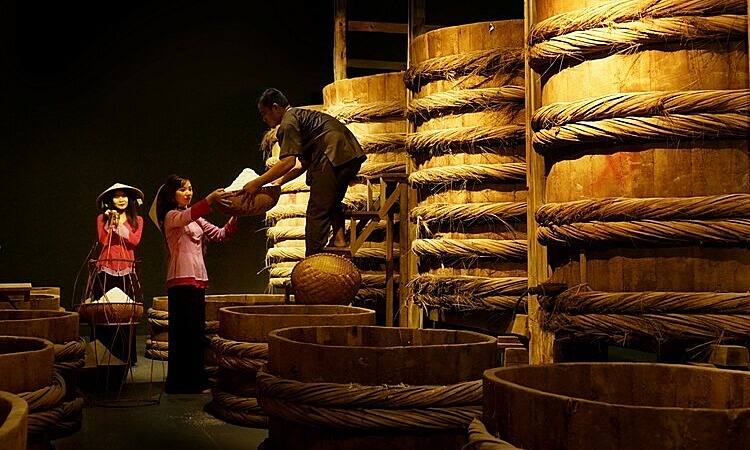 |
Stages of fish sauce production in barrel houses in Phan Thiet. *Photo: Old Fishing Village Fish Sauce Museum* |
The traditional craft of salting fish to make fish sauce in this coastal region dates back to the late 17th century. At that time, residents from provinces such as Quang Binh, Quang Tri, Quang Nam, Quang Ngai, Binh Dinh, Phu Yen, followed the southern fishing season, from may to november annually, entering the Phan Thiet sea to fish.
Recognizing the fertile land rich in seafood, many families settled there. Initially, each household produced a few tens of liters of fish sauce for family consumption, later expanding production to sell in town markets and rural areas, gradually forming the fish sauce production craft.
Phan Thiet fish sauce is primarily made from anchovies, scad, and coarse salt, using two traditional fermentation methods: wooden barrels and ceramic jars. Fish is fermented for 8 to 18 months, naturally hydrolyzing into fish sauce with a straw-yellow to reddish-brown color and a distinct aroma. The first liquid drawn off is called mam nhi; after which more water is added to draw off the second liquid, known as mam ngang.
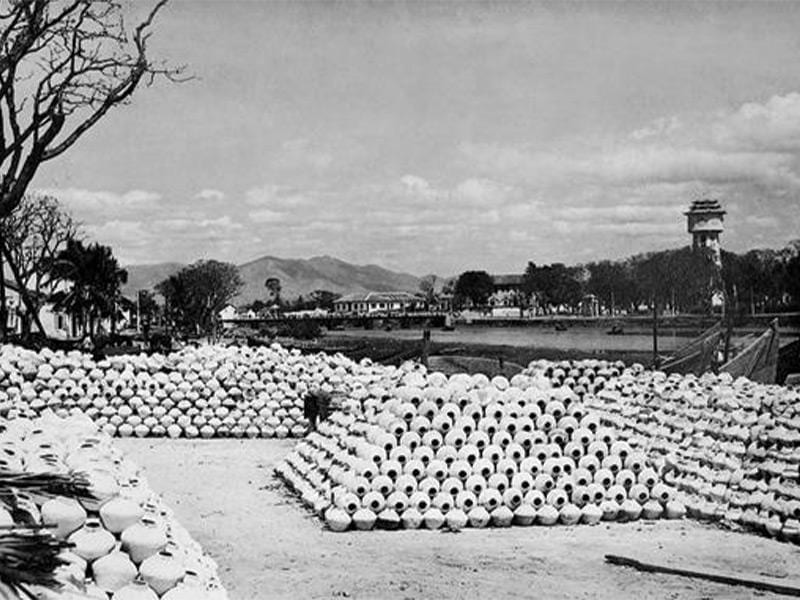 |
Terracotta jars, called tin, holding fish sauce lined along the Ca Ty riverbank in Phan Thiet before 1975. *Photo: Old Fishing Village Fish Sauce Museum* |
In the early 20th century, Phan Thiet saw the emergence of many large-scale fish sauce production facilities, which locals called "ham ho", including Bat Xi, Cuu Nghia, and Cuu Phung. The fish sauce was stored in terracotta jars known as tin and distributed by merchants' ghe bau (traditional boats) throughout the north and south.
In 1904, the French protectorate government designated Phan Thiet as the most important center in Central Vietnam for the development of commerce and the fish sauce processing industry. By 1925, the entire region produced over 4 million liters annually; and by 1928, production increased to approximately 50 million liters.
After 1954, the fish sauce production craft continued to develop as many people from the north and central regions migrated there to live, contributing to the widespread renown of Phan Thiet fish sauce both domestically and internationally.
 |
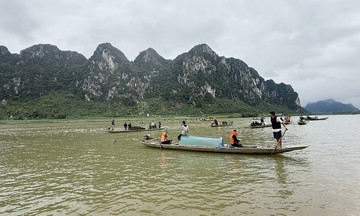
The Phan Thiet sea region has abundant anchovy resources for traditional fish sauce production. *Photo: Viet Quoc* |
After a period of decline, the traditional Phan Thiet fish sauce production has gradually recovered in recent years. During the 2021–2024 period, production reached approximately 30 million liters annually, with estimated revenue of around 1,000 ty dong.
According to the association, the craft of fish sauce production not only holds unique culinary cultural value but also creates jobs and contributes significantly to the local economy. Currently, many Phan Thiet fish sauce products are exported to numerous countries, becoming a culinary cultural symbol of Vietnam.
Viet Quoc