The Politburo issued a resolution on 19/5 regarding the development of Ho Chi Minh City in the new era.
The resolution sets a goal for the city to become a civilized, modern, dynamic, and innovative urban area by 2030. It envisions TP HCM as the country's center for economy, culture, society, science, technology, innovation, logistics, and international integration, holding a prominent position in Southeast Asia.
By 2045, TP HCM is guided to become Asia's hub for economy, culture, science, technology, and innovation. It aims to be an attractive global destination offering a high quality of life and deep international integration.
Looking towards 2075, the 100-year anniversary of national reunification, TP HCM is slated to be a global, smart, modern, and comprehensively developed city, on par with leading urban centers worldwide. It will pursue green, sustainable growth and adapt well to climate change.
The resolution targets a minimum 10% annual GRDP growth for TP HCM during the 2026-2045 period. By 2030, per capita GRDP is projected to reach at least 14,000 USD, with the digital economy accounting for approximately 40% of GRDP. The city plans to complete around 200 km of urban railway and achieve a Human Development Index (HDI) of about 0,9. TP HCM will also largely resolve issues of flooding, environmental pollution, traffic congestion, and drug problems.
By 2035, per capita GRDP is expected to reach at least 25,000 USD, with the digital economy comprising about 60% of GRDP. By 2045, per capita GRDP is set to hit at least 75,000 USD, with the urban railway system fully connected and net-zero emissions achieved.
From 2046 to 2075, TP HCM aims for a minimum 6% annual GRDP growth. By 2075, per capita GRDP is targeted to reach at least 100,000 USD, while social equity, environmental protection, and human development indicators remain high.
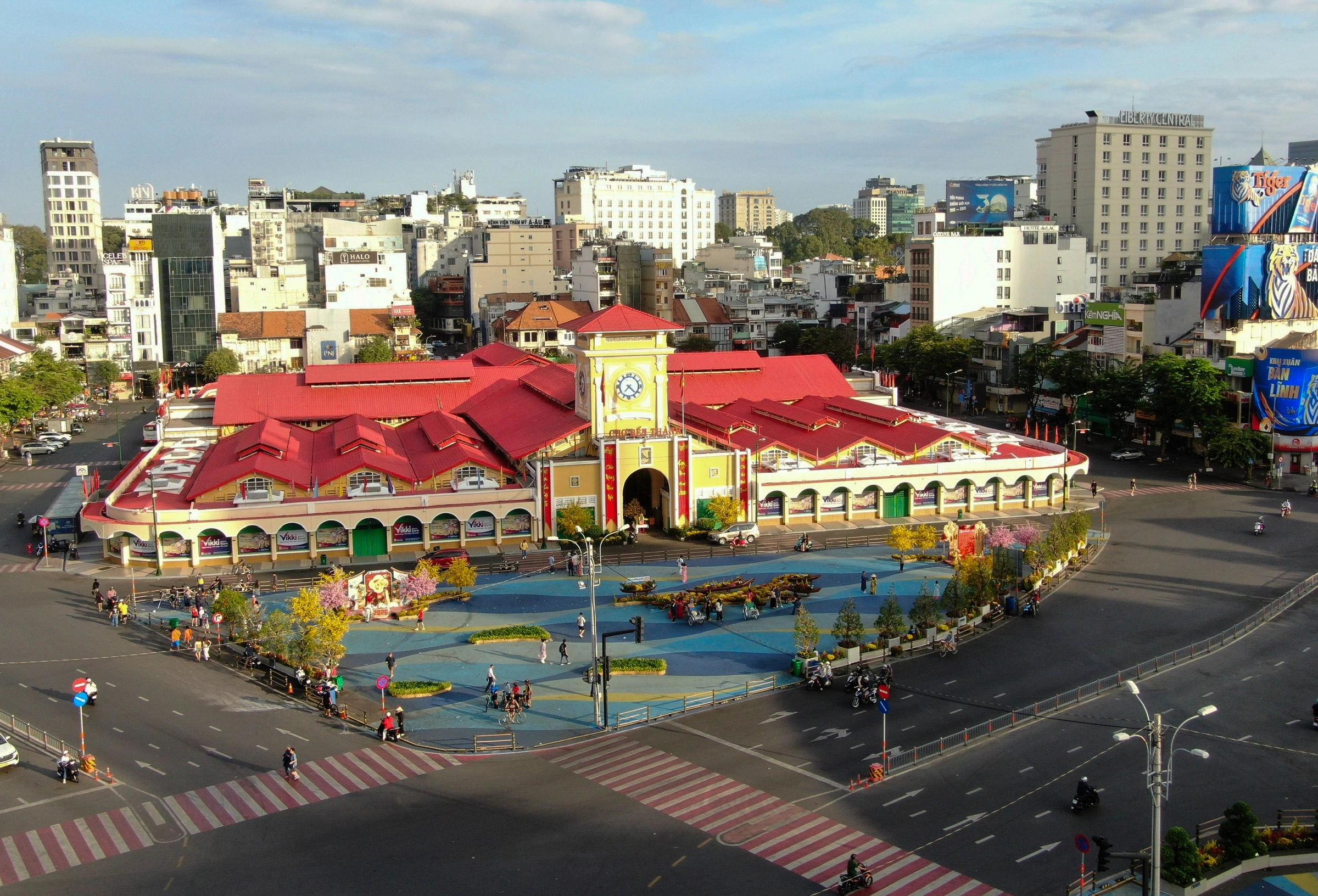 |
Ho Chi Minh City center, 2/2026. *Photo: Giang Anh* |
To achieve these goals, the Politburo mandates that TP HCM develop a new growth model. This model will be based on science, technology, innovation, and digital transformation, aiming to boost labor productivity and competitiveness. The city's development will rely on a knowledge-based economy, an innovation ecosystem, entrepreneurial spirit, and modern urban governance.
TP HCM is tasked with strengthening its mastery of scientific and technological research systems. Key areas include information technology, artificial intelligence, semiconductor microchips, biotechnology, clean energy, new materials, and technologies for marine and green economies.
The resolution also calls for the city to implement specific policies to attract investment and technology transfer, particularly for core and source technologies in key economic sectors. It will develop high-tech parks, concentrated digital technology zones, science-technology urban areas, research institutes, and universities. The science-technology market will expand to attract multinational corporations to establish research, innovation, and technology transfer centers in the city.
According to the resolution, TP HCM will establish a national marine economic center. This center will focus on maritime, logistics, oil and gas, renewable energy, tourism, and sustainable coastal urban development, aligning with international standards. It aims to be the leading force in the country's marine economy. Concurrently, the city will develop regional and international financial and logistics centers.
A special urban law for TP HCM will also be enacted. This law will create superior mechanisms and a synchronized legal framework, enabling the city to maximize its potential and mobilize all resources for rapid, sustainable development. TP HCM will receive priority in applying more favorable local regulations and will be allowed to pilot new mechanisms and policies, including controlled experiments or deviations from current regulations.
The Politburo further requires the development of a master plan for TP HCM with a 100-year vision. This plan aims to expand urban space, foster new development drivers, and enhance resilience to climate change. Several new satellite cities will emerge around the central urban area. Large-scale projects such as the Cai Mep Ha port cluster, the Can Gio international transshipment port, the Ho Chi Minh City regional railway network, the urban railway system, and sea and river navigation channels will receive investment for completion.
The resolution envisions TP HCM as a special, civilized, and modern urban area, prioritizing the improvement of residents' quality of life. It aims to cultivate a population characterized by patriotism, resilience, solidarity, compassion, dynamism, and creativity.
Vu Tuan