Prime Minister Pham Minh Chinh announced that a minimum of 3% of the total annual state budget expenditure must be allocated to digital transformation. This directive, issued during a meeting of the Government Steering Committee on science, technology, innovation, digital transformation, and Project 06 on the afternoon of 25/2, emphasizes prioritizing human resource training and establishing a comprehensive legal framework for data and artificial intelligence.
The Prime Minister also set the theme for 2026 as 'Breaking Through the Digital Economy - Leveraging Data Economy and Artificial Intelligence as New Pillars for Sustainable, Smart Development'. He stressed that achieving double-digit growth and rapid, sustainable development requires science, technology, innovation, and digital transformation, linked with the implementation of Project 06, as a fundamental platform. Data is recognized as a strategic resource and a core foundation for digital economy development, with a specific focus on the data economy. The guiding principle for this initiative is: the state creates, enterprises lead, officials spearhead, public and private sectors collaborate, the nation develops, and the people benefit.
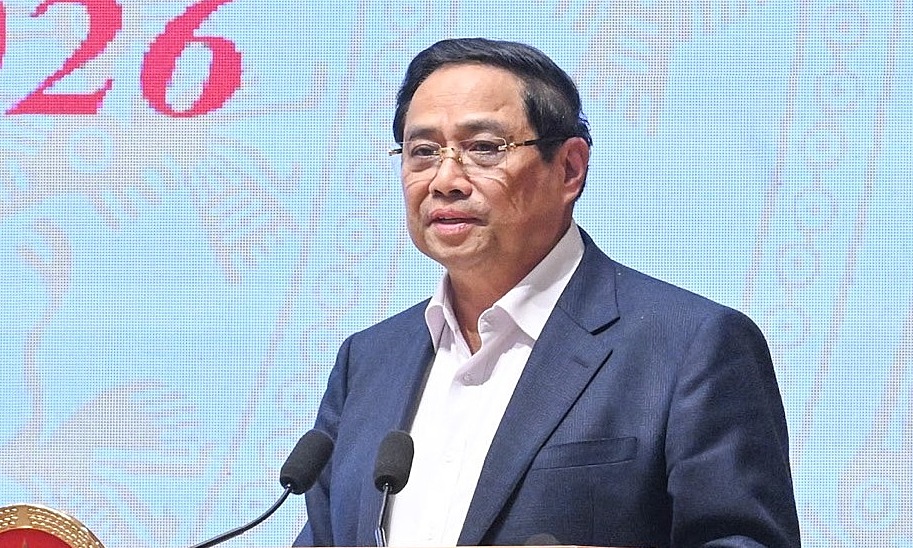 |
Prime Minister Pham Minh Chinh speaking on the afternoon of 25/2. *Photo: Nhat Bac* |
To achieve these goals, the Prime Minister issued specific directives to various ministries. The Ministry of Finance is tasked with ensuring the minimum 3% budget allocation for digital transformation, prioritizing funds for human resource training. The Ministry of Science and Technology, in coordination with the Ministry of Public Security and the Ministry of Industry and Trade, must promptly develop legal guidance documents concerning digital transformation, artificial intelligence, cybersecurity, and e-commerce to prevent legal gaps.
The Ministry of Public Security has several key responsibilities for 2026: submitting a decree on breakthrough development mechanisms for the Data Innovation and Exploitation Center, a component of the National Data Center, in Quarter I/2026; proposing organizational and operational mechanisms for the Data Exchange in Quarter II/2026; and outlining data economy development mechanisms and policies in Quarter III/2026. Additionally, the ministry will lead the completion of the Administrative Violation Processing Database in Quarter IV/2026 and bring National Data Center No. 1 into official operation in 2026, coordinating with enterprises to label data for the development of autonomous artificial intelligence platforms.
Further inter-ministerial collaboration is mandated. The Ministry of Finance, in conjunction with the Ministry of Public Security, is tasked with establishing a legal framework for data valuation, fees, and data exploitation pricing from the National Data Center. This framework will also include tax and capital incentive policies for businesses operating in data-related fields, with completion scheduled for 6/2026.
The Ministry of Home Affairs is directed to accelerate data connectivity and sharing, particularly concerning the National Database on Cadres, Civil Servants, and Public Employees, as well as the social security database. Concurrently, the Government Inspectorate will complete the database for inspecting and controlling the assets and incomes of cadres and civil servants.
In terms of infrastructure and administrative reform, the Prime Minister called for the expedited commercial operation of low-orbit satellite internet services in 2026. Telecommunications enterprises are urged to increase investment in 5G base stations to achieve nationwide coverage this year. Authorities are also directed to streamline administrative procedures and address situations where citizens and businesses are asked to resubmit information already present in national databases or integrated into VNeID.
The Ministry of Science and Technology is assigned to finalize and implement a list of priority strategic product development tasks, including: artificial intelligence, unmanned aerial vehicles, nuclear power, digital transformation, green transformation, creative economy, low-carbon economy, and high-speed rail. The Government Office and the Ministry of Science and Technology are also tasked with developing a set of real-time performance indicators to evaluate the implementation of tasks by various ministries and agencies.
During the Steering Committee meeting in 11/2025, the Prime Minister announced that the 2026 budget would allocate 95 trillion VND for the development of science, technology, innovation, and digital transformation. According to a report from the Ministry of Finance, the expenditure rates for science and technology during the 2021-2024 period were 1,37%, 1,72%, 1,39%, and 1,97% of the total state budget expenditure, respectively. For 2025, a full 3% has been allocated.
Vu Tuan