According to the plan submitted by CT Group to the Ministry of Construction, the proposed railway would feature a double-track, electrified system with a 1,435 mm gauge. It is designed for speeds of 200-250 km/h, with further studies exploring speeds up to 300-350 km/h.
The project's starting point is planned at Thu Thiem station in Ho Chi Minh City, connecting to the existing North-South railway. The line would terminate at Dat Mui station in Ca Mau, passing through six provinces and cities: Ho Chi Minh City, Dong Thap, Vinh Long, Can Tho, An Giang, and Ca Mau.
CT Group considers the 200-250 km/h speed range appropriate for the Ho Chi Minh City - Can Tho - Ca Mau railway, ensuring efficient mixed operations for both passenger and freight trains.
In response to CT Group, the Ministry of Construction acknowledged the Ho Chi Minh City - Can Tho railway as a significant new national project requiring substantial investment. The Ministry has tasked the My Thuan Project Management Board with preparing the project's pre-feasibility study.
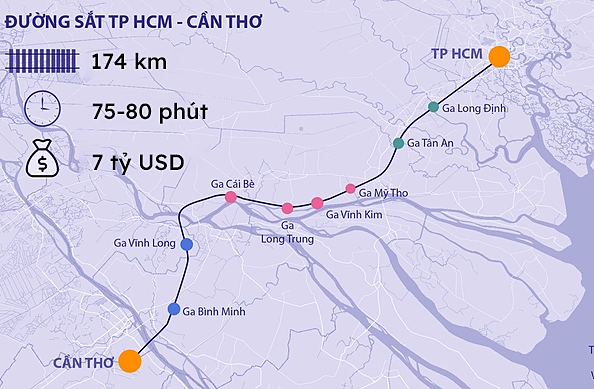 |
The proposed Ho Chi Minh City - Can Tho railway route is currently under study by the Ministry of Construction. Graphics: Khanh Hoang |
The Can Tho - Ca Mau railway segment has been approved by the Government for inclusion in the revised Railway Network Master Plan for 2021-2030, with a vision to 2050. According to the planning documents, passenger and freight transport demand on this segment is projected to emerge by 2050.
Given the project's scale and complexity, the Ministry of Construction is prepared to arrange a meeting to discuss detailed project information with the investor.
Currently, the construction sector is focusing on the pre-feasibility report for the Ho Chi Minh City - Can Tho railway. This 175,2 km segment would begin at An Binh station in Ho Chi Minh City and end at Can Tho station in Can Tho City.
Regarding the investment scale, the My Thuan Project Management Board has proposed a new mixed passenger and freight railway with a 1,435 mm gauge, electrified, and designed for speeds of approximately 160 km/h.
Giai doan 1, slated for completion before 2030, involves building a single-track railway spanning 175 km, with an estimated initial investment of 173.640 ty VND (equivalent to 7,16 billion USD). Giai doan 2 will upgrade the entire route to a double-track system, with an estimated investment of approximately 64.970 ty VND (equivalent to 2,7 billion USD, excluding financial costs).
Anh Duy