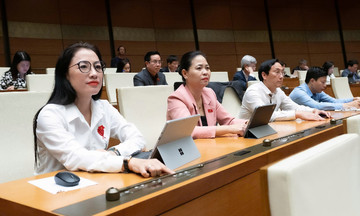
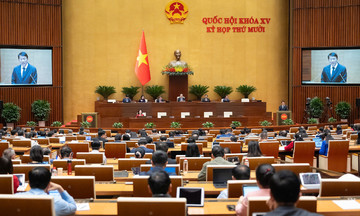
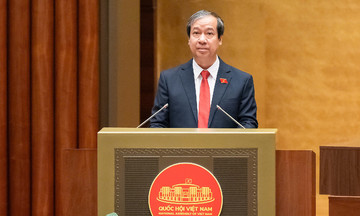
On 20/11, contributing to the Resolution on specific policies for educational development, delegate Trinh Thi Tu Anh (Lam Dong delegation) emphasized that a unified and free textbook system is an important step towards educational equity. However, this system only holds meaning if strictly managed. She stated that in many places, even though textbook fees are not collected, parents still have to purchase additional workbooks and advanced books with overlapping content, which does not reduce the financial burden.
Given these shortcomings, Ms. Tu Anh proposed researching an electronic textbook system and supporting disadvantaged students by lending them reading devices. "The electronic format helps save printing costs, allows books to be reused for many years, and aligns with the digital transformation process in education," the delegate said.
 |
Delegate Trinh Thi Tu Anh (specializing in the Lam Dong delegation). Photo: Hoang Phong |
This view is similar to the opinion of delegate Duong Minh Anh (Principal of Hanoi College of Art) during a previous group discussion. Ms. Anh argued that issuing new paper books annually easily leads to waste as many sets of books are discarded after each school year. In contrast, a model of lending books from school libraries and developing electronic textbooks offers a more economical and sustainable solution.
Ms. Anh emphasized that despite the initial high investment in digital infrastructure, it would significantly reduce learning costs for parents in the long run. It would also allow book content to be updated quickly and integrate images, videos, and interactive exercises. This also presents an opportunity for teachers to enhance their digital competency and innovate teaching methods.
Clarifying subjects requiring textbooks and tightening the appraisal process
Vice Chairwoman of the People's Petitions Committee, Tran Thi Nhi Ha, pointed out another shortcoming: the draft Education Law does not clearly define which subjects require textbooks. Many experiential and physical subjects, such as physical education or experiential activities, still have full sets of books printed despite rarely being used, leading to waste. She proposed clearly defining the scope of subjects that need textbooks and assigning specialized agencies to provide detailed guidance.
Delegate Nguyen Tam Hung (Ho Chi Minh City delegation) expressed concern that the mechanisms for textbook appraisal, approval, and revision are not transparent, while teachers bear direct pressure when books contain errors. He proposed clearly defining the accountability of the National Appraisal Council and the book revision process.
The National Assembly is expected to pass the amended education laws on 10/12 and the Resolution on specific mechanisms for implementing Resolution 71 on 11/12.
Son Ha