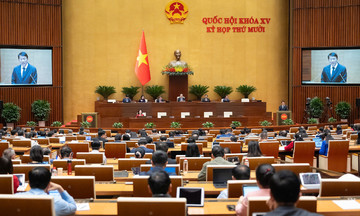
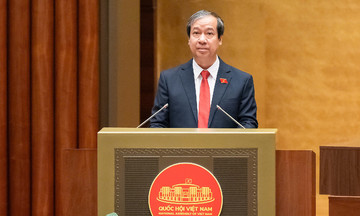
On 19/11, the National Assembly held a group discussion on the investment policy for Gia Binh airport, located in Bac Ninh. Delegate Ta Van Ha, Vice Chairman of the Committee for Culture and Social Affairs, expressed strong agreement with the investment policy. He stated that developing international-scale aviation infrastructure would create new momentum for the capital region, including Bac Ninh, while also sharing the burden with the perennially overcrowded Noi Bai airport. The proposal to mobilize private capital was seen as a significant step forward, opening up a more dynamic aviation market.
However, delegate Ha noted that the project's implementation period, from 2026 to 2050, was "a bit long." He considered the first phase, scheduled from 2026 to 2030, to achieve a capacity of 30 million passengers and 1,6 million tons of cargo per year, to be appropriate. Yet, he argued that the second phase did not necessarily need to extend until 2050. He urged the government to accelerate the progress, implementing the project more focused and decisively to shorten the completion time for this crucial infrastructure.
He also emphasized the need to plan traffic connections between the airport and the expressway and urban railway systems to ensure the most efficient operation. Additionally, since the planned airport area encompasses many villages with long-standing cultural and historical values, appropriate support and compensation policies are essential to ensure residents are not disadvantaged when their land is used for national infrastructure development.
Given that 25 historical relics need relocation, he proposed that the government clarify the mechanism for national-level relics, as well as the method for their re-recognition after relocation. "A place name is tied to the land through thousands of generations. If an entire communal house is moved elsewhere, can it still be called a national historical relic?", he questioned.
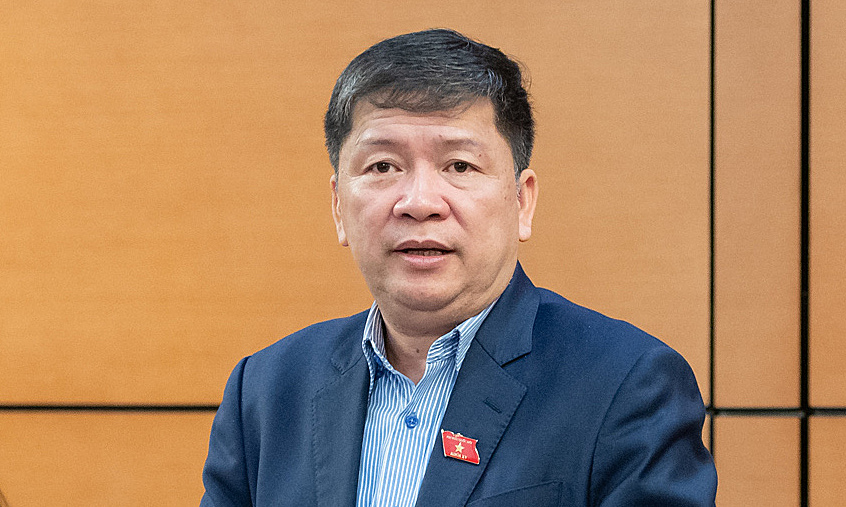 |
Delegate Ta Van Ha, Vice Chairman of the Committee for Culture and Social Affairs, speaks at the group session. Photo: Pham Thang |
Delegate Nguyen Thi Lan, Director of Vietnam National University of Agriculture, observed that Noi Bai, the capital region's largest aviation gateway, has seen an average annual passenger growth of 11,8% for over a decade and is currently operating beyond its capacity. Efforts to expand Noi Bai to the south face challenges due to the need for extensive residential relocation and prohibitively high site clearance costs. Therefore, constructing Gia Binh airport is a strategic and groundbreaking move, contributing to the restructuring of the capital region's aviation network, creating a new growth pole, and boosting sectors such as logistics, e-commerce, tourism, and services.
However, Ms. Lan also expressed concerns about the progress of site clearance for 7.100 households. She cautioned that without careful execution and appropriate livelihood policies, the entire project could easily face delays. She proposed additional support mechanisms for residents whose land is acquired and requested the investor to thoroughly assess environmental impacts, including noise, water flow, drainage, and waste treatment.
Delegate Truong Thi Ngoc Anh, from the Can Tho delegation, agreed with the investment policy but suggested that the government conduct a deeper analysis of operational efficiency. With a distance of approximately 40 km between Noi Bai and Gia Binh, a careful calculation of the impact on the existing airport's capacity is needed once Gia Binh becomes operational within the next 5 years.
According to the master plan, Gia Binh international airport will be located in Gia Binh, Luong Tai, Nhan Thang, and Lam Thao communes (Bac Ninh). It will be built to the International Civil Aviation Organization (ICAO) 4F standard. In its first phase, by 2030, the airport aims to serve 30 million passengers and 1,6 million tons of cargo annually. The second phase targets 50 million passengers and 2,5 million tons of cargo by 2050.
The project's total investment is approximately 196.370 ty dong, with 141.230 ty dong for the first phase and 55.140 ty dong for the second phase. This will be financed by the investor's equity and legally mobilized capital.
The National Assembly is scheduled to discuss the project's investment policy in the hall on 5/12 and consider its approval on 11/12.
Son Ha - Anh Tu