The Ministry of Agriculture and Environment is drafting a revised Land Law project, expected to be submitted to the National Assembly for comments in August. According to the draft, a common feature of both options is that provincial People's Councils will decide land price tables, land price adjustment coefficients, and amend or supplement these contents as necessary.
The key difference lies in how the authority of People's Committees at various levels is determined for decisions concerning land acquisition, compensation, support, and resettlement, as well as procedures for land allocation, land lease, change of land use purpose, and recognition of land use rights.
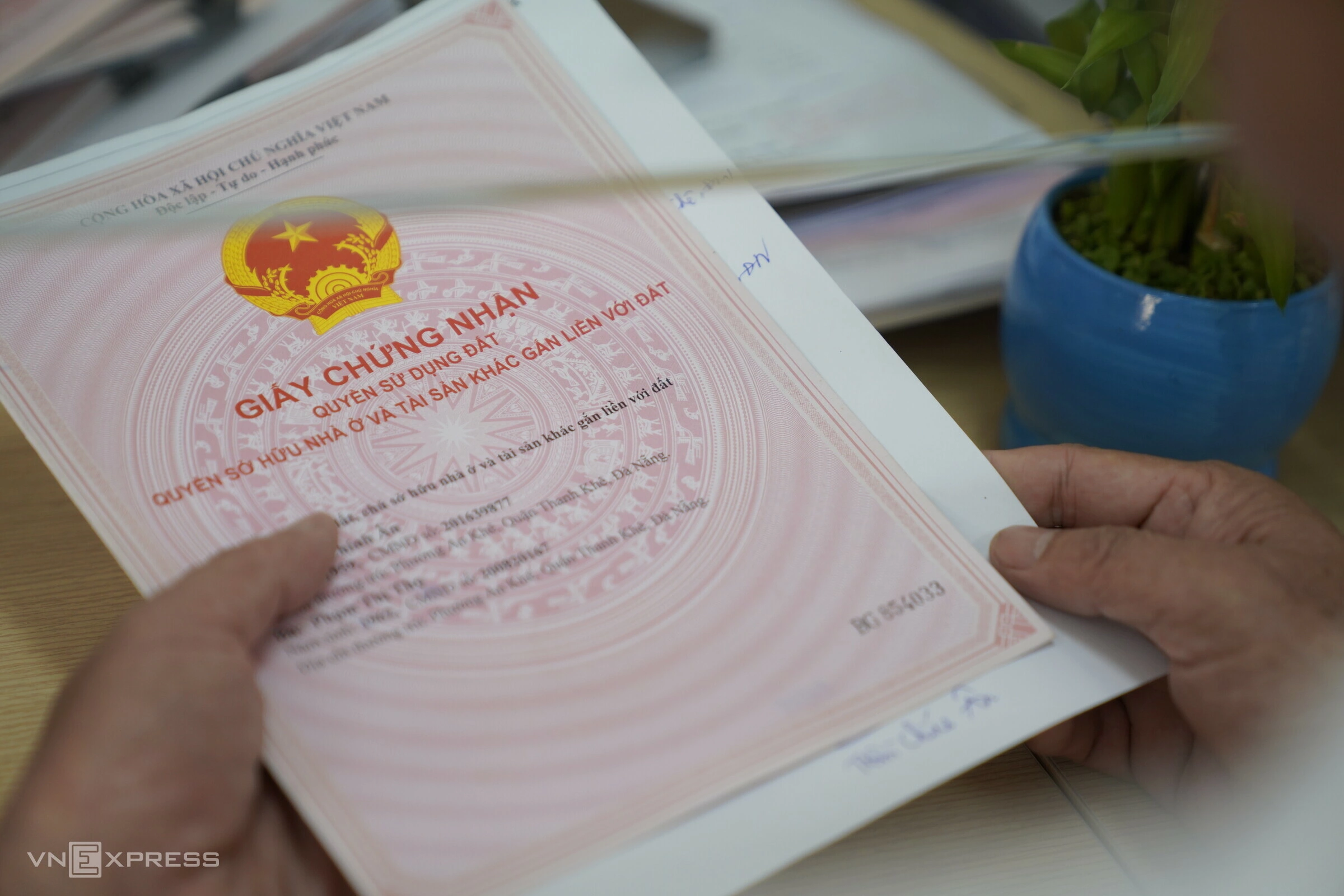 |
People processing administrative procedures to convert land use right certificates at the Public Administrative Service Center, Thanh Khe ward, Da Nang City, 6/2025. Photo: Nguyen Dong. |
Under the first option, the draft proposes to codify regulations currently applied in Decree No. 49/2026. Accordingly, all decisions regarding land acquisition, compensation, support, resettlement, land allocation, land lease, permission to change land use purpose; adjustments to terms, extensions, changes in form, and recognition of land use rights will fall under the authority of the provincial People's Committee.
Based on the Law on Organization of Local Government, relevant legal provisions, and practical conditions, the provincial People's Committee can decide to decentralize or authorize competent agencies or individuals to perform these tasks. Unspecified state management contents regarding land will be regulated by the government. Additionally, the provincial People's Committee is tasked with stipulating the administrative procedures to implement cases falling under this law.
The second option directly specifies the authority of each level of government within the law. Accordingly, the provincial People's Committee will decide on land acquisition, compensation, support, and resettlement for domestic organizations, religious organizations, foreign organizations with diplomatic functions, overseas Vietnamese, and foreign-invested economic organizations.
For individuals and residential communities, the communal People's Committee holds the authority. If a project involves subjects under the authority of both provincial and communal levels, the provincial People's Committee will decide on land acquisition or authorize the communal People's Committee to carry it out.
The Land Law 2024 already provides detailed regulations on state land acquisition in truly necessary cases for national defense, security, and socio-economic development for national and public interests. It ensures compliance with the Constitution, facilitates land access for investors, and clearly defines the basis, conditions, and authority for land acquisition.
The drafting agency stated that the revision aims to adjust the authority for decisions on land acquisition, compensation, support, resettlement, land allocation, land lease, and other administrative procedures to align with the new organizational model. The goal is to unify management by enhancing local responsibility, strengthening central inspection and supervision, reducing bottlenecks and intermediaries, and streamlining administrative procedures.
Exploring a special land acquisition mechanism for important projects
Under the Land Law 2024, approving compensation, support, resettlement plans, and arranging resettlement must be completed before issuing a land acquisition decision. This regulation aims to ensure that people have a new place to live before they have to hand over the land.
However, reviews of its implementation show that this regulation has prolonged project timelines, especially for important national projects, urgent public investment projects, and projects with broad public consensus. Consequently, the drafting agency proposes to refine land acquisition procedures by no longer rigidly requiring land acquisition only after resettlement arrangements are complete.
Instead, the drafting agency suggests allowing land acquisition before approving compensation, support, and resettlement plans for certain specific projects to accelerate progress. This adjustment aims to create more flexibility in implementation and address difficulties arising when deploying large-scale projects or those requiring faster site clearance.
Codifying the principle of 'new homes equal to or better than old ones'
The Land Law 2024 mandates that individuals whose land is acquired must have living conditions equal to or better than their previous homes. In its implementation review report, the drafting agency proposes to further codify this principle in a specific and verifiable manner during implementation.
Accordingly, evaluating living conditions will not only focus on the availability of new housing but also consider multiple factors: infrastructure, livelihoods, employment, income, schools, healthcare, transportation, public services, and resident satisfaction. Quantifying these criteria will provide a clearer basis for implementation and help assess the effectiveness of resettlement projects.
Son Ha