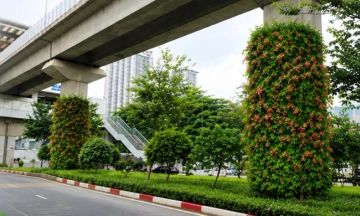
Hanoi's elevated transportation system is rapidly expanding with numerous ring roads, overpasses, and urban railways. To soften the harshness of concrete structures, Hanoi is exploring the use of climbing plants on bridge piers in areas such as the Cat Linh - Ha Dong urban railway, the Le Van Luong - To Huu underpass, and the Le Van Luong - Lang Ha overpass.
The most apparent benefit of greening bridge piers is the transformation of the urban landscape. Instead of stark concrete blocks that can become stained over time or serve as illegal advertising spaces, lush green columns offer aesthetic value, creating a soothing visual effect and reducing eye strain for commuters.
From an environmental perspective, associate professor, doctor Vu Hoai Nam of Hanoi University of Civil Engineering, noted that rows of elevated bridge piers bear a significant amount of dust, smoke, and exhaust fumes. Planting greenery around these piers helps improve air quality at lower levels, where commuters breathe daily.
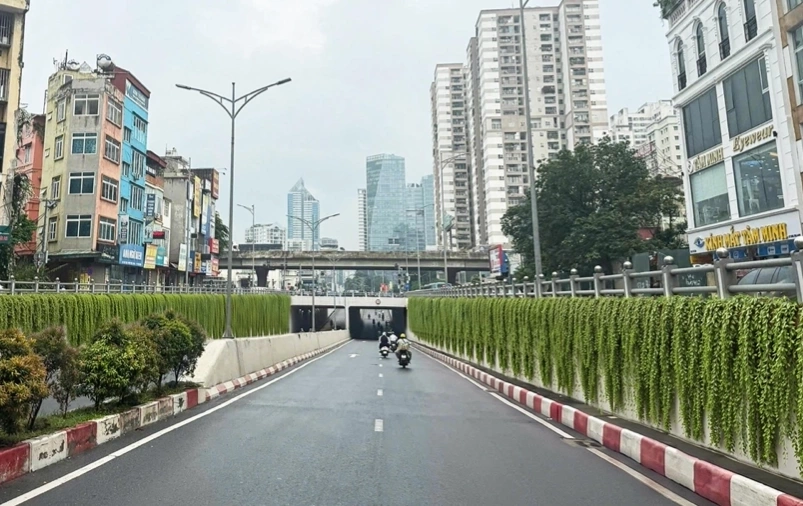 |
An artist's impression of greening the Le Van Luong underpass wall. |
This solution also contributes to mitigating the urban heat island effect. During summer, concrete surfaces absorb substantial heat, radiating it into the environment and increasing road temperatures. A layer of vegetation helps block direct sunlight, significantly reducing concrete surface temperatures and cooling the surrounding area.
Professor, doctor Nguyen Lan Hung, General Secretary of the Vietnam Biological Associations, believes that bridge piers can be more than just concrete and steel infrastructure; they can become urban focal points when adorned with plants, trellises, and planters. Some locations, such as the Long Bien underpass and the Vo Nguyen Giap elevated road, already feature various types of greenery, enhancing the city's beauty.
Experts also recognize that utilizing the vertical surfaces of bridge piers increases green space without consuming valuable land, a scarce resource in major cities like Hanoi.
Despite the benefits, experts warn of risks if planting is uncontrolled. Professor, doctor of science Vu Quang Con of the Vietnam Biological Associations, suggests that allowing plants to directly cling to bridge piers could negatively impact structural integrity. Some aggressive climbing plants have parasitic roots that can penetrate small cracks in concrete, leading to moisture accumulation and accelerating weathering and surface degradation of the structure.
Additionally, there is a risk of pests and sanitation issues. Dense vegetation on the piers can become a breeding ground for mosquitoes, insects, or rodents, and easily accumulate waste during rainy and stormy seasons. Mr. Con noted that Vietnam has yet to conduct a full impact assessment of climbing plants on bridge piers, urging caution in implementation.
Regarding traffic safety, if plants are not regularly trimmed, branches could extend into the roadway, obstructing drivers' visibility or concealing road signs and traffic lights.
Associate professor, doctor Vu Hoai Nam expressed concern that a dense layer of plants could hide defects or damage to bridge piers during operation. If cracks or degradation appear but are not detected promptly, structural safety could be compromised.
Furthermore, maintaining a vertical greening system requires complex and costly upkeep. Lacking natural soil contact, plants need support systems (like steel mesh) and automatic irrigation, along with regular fertilization. Relying solely on manual labor to reduce costs poses safety risks for workers operating amidst traffic.
Hanoi's urban climate is harsh, with intense summer heat and dry, cold winters. Incorrect plant selection could lead to widespread plant death, incurring significant replanting costs.
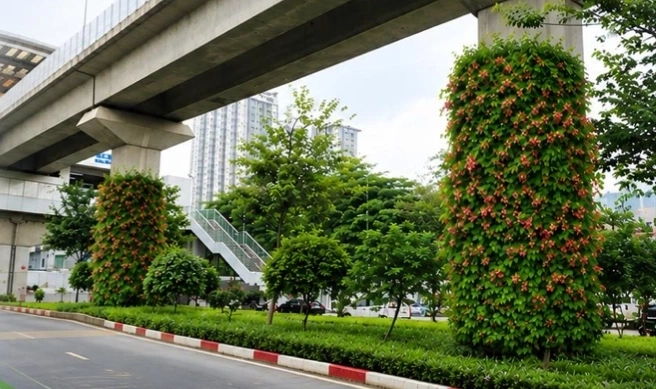 |
An artist's impression of climbing plants around the Cat Linh - Ha Dong urban railway bridge piers in the Nguyen Trai area (in front of the Royal City building). |
To realize this idea while ensuring the safety of transportation infrastructure, experts propose integrated technical solutions. Doctor Dang Van Ha of the University of Forestry emphasizes the importance of selecting suitable plant species, rather than making arbitrary choices. Chosen plants must be heat-tolerant, shade-tolerant, especially in dimly lit underpasses, and easy to maintain. Instead of allowing plants to directly climb piers, trellises should be used for support.
Mr. Vu Hoai Nam recommends that the green space management unit collaborate closely with the project design unit for detailed surveys of each pier location. It is crucial to avoid covering sensitive areas like bridge bearings or points requiring regular technical inspection. Instead of letting plants cling to concrete, a modular planting system on trellises or steel mesh, separated from the pier surface, should be adopted. This method protects the concrete and facilitates easy removal or replacement of damaged plants.
Mr. Nam also suggested investing in automatic irrigation systems to reduce labor costs, conserve water, and ensure operational safety on these routes.
Considering that bridge piers and underpasses are typically hot and dry, posing no concern about plants causing mold, professor, doctor Nguyen Lan Hung suggests that for Hanoi's climate, plants like bougainvillea, euphorbia milii, snake plant, and poinsettia could be planted, as they are easy to grow and require little water. Under tall bridge piers, Taiwan banyan trees could be planted alongside hanging trellises.
Doan Loan