The Prime Minister recently approved Quang Ninh province's master plan until 2050, with a vision to 2075. Under this plan, the province will develop into a modern, smart, green, and sustainable centrally-run city. It aims to be a contemporary maritime economic center and a national and international tourism hub, characterized as a "coastal-border-heritage city, smart and adaptable to climate change." Quang Ninh will also serve as a growth pole for the northern region and a leading international trade gateway, particularly in its diplomatic relations with China.
By 2050, Quang Ninh anticipates a population of 2.8-3 million people, with 2.3-2.4 million permanent residents. The province expects to welcome 30-31 million visitors, including approximately 10 million international tourists. Urban development land will expand significantly, projected to reach 90,000-100,000 hectares by 2050, to support industrial and service sector growth.
A key focus of this strategy is to organize urban space with strong connections between conservation and development. Quang Ninh will avoid sprawling urban expansion, instead concentrating on a network of core areas. Ha Long will maximize its bay and mountainous landscapes. Dong Trieu and Uong Bi will integrate with the Yen Tu chain of historical and spiritual cultural sites. Van Don and Co To will develop as modern island cities, linked to national defense and security, while Mong Cai will serve as an international trade gateway with China.
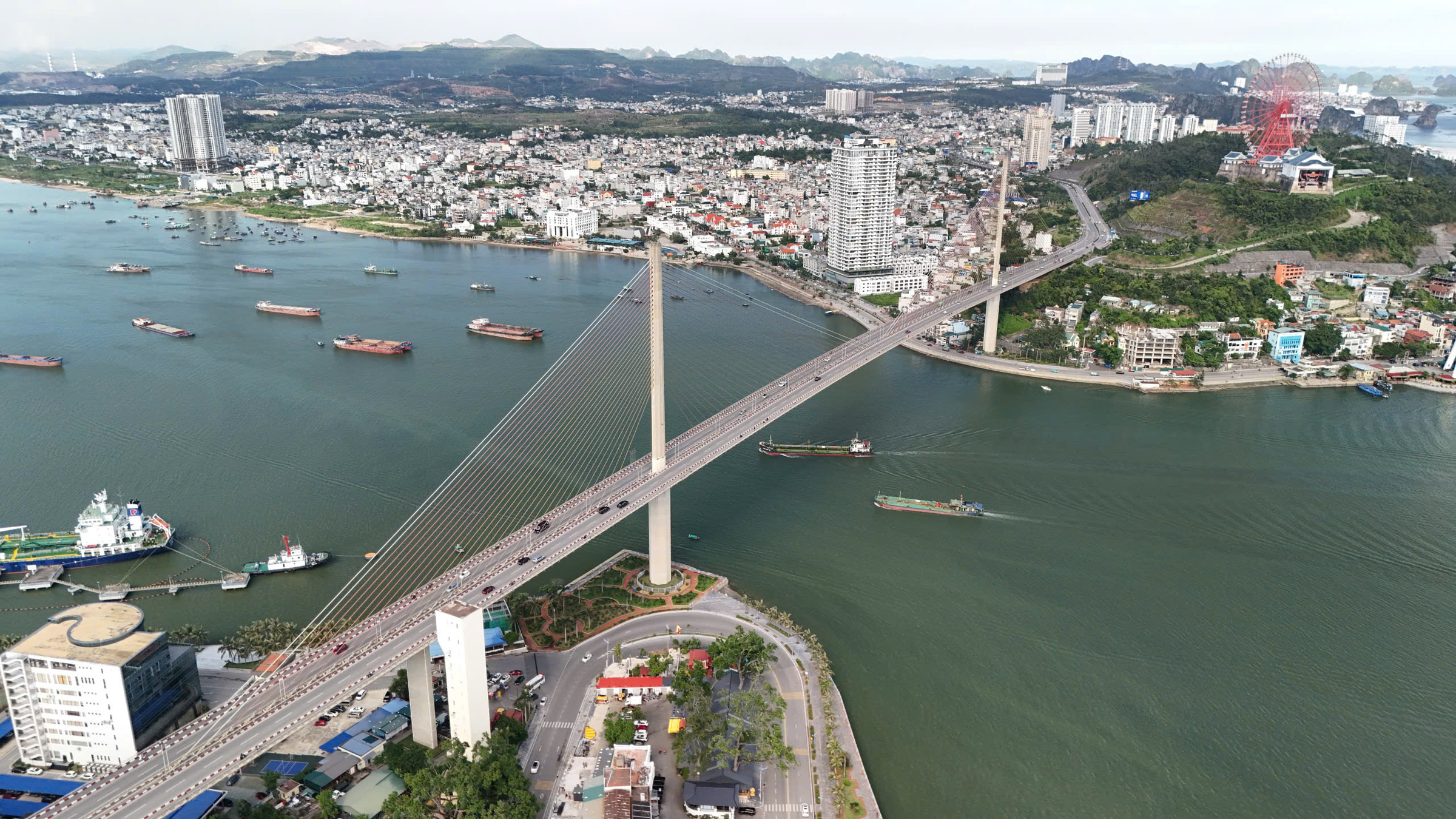 |
Vinh Cua Luc, the urban development connecting center following Quang Ninh's multi-polar model. *Photo: Le Tan*
Cua Luc Bay is designated as the central hub for multi-polar urban development, expanding northwards. The province's new administrative center is also planned for this area.
The integrated transport network will include roads, railways, waterways, and air routes. Similar to other localities, Quang Ninh prioritizes the transit-oriented development (TOD) model, where public transport nodes serve as urban centers.
As a coastal province, the plan places high demands on responding to rising sea levels. Solutions for ground elevation and surface drainage will be calculated based on land subsidence and the dual impact of climate change. A system of regulating lakes and green parks will be established to control urban flooding.
Quang Ninh holds a strategic position in Vietnam's Northeast region, bordering China, the Gulf of Tonkin, and the provinces of Hai Phong, Lang Son, and Bac Ninh. The province spans over 6,200 km2 of mainland, featuring diverse terrain including mountains, midlands, coastal plains, and over 2,000 islands, offering significant potential for tourism, seaports, and mineral resources.
In 2025, Quang Ninh's gross regional domestic product (GRDP) growth rate reached an estimated 11.89%, the highest nationwide, with an economic scale exceeding 368.445 billion VND. Total state budget revenue achieved 84.500 billion VND for the first time, ranking 6th nationwide and representing the highest level ever, a 53% increase compared to the central government's projection. Domestic revenue alone reached 68.150 billion VND. Consequently, Quang Ninh contributed 3.86% to the national economic growth, placing it 6th among all provinces.
Tourism is a strong economic sector for Quang Ninh, having welcomed 21.28 million visitors in 2025, an increase of 12% year-on-year. This included 16.78 million domestic visitors and 4.5 million international visitors. Total tourism revenue reached 57.000 billion VND.
For 2026, Quang Ninh targets a GRDP growth rate of over 12.5%, a per capita GRDP of 11,800 USD or more, and a total state budget revenue of 100.000 billion VND.
Currently, Vietnam has six centrally-run cities: Hanoi, Hai Phong, Hue, Da Nang, Ho Chi Minh City, and Can Tho. In late March, the Party Central Committee approved the policy to elevate Dong Nai to a centrally-run city, instructing the completion of necessary documents for submission to the 16th legislature of the National Assembly for consideration and decision at its early April session.
Le Tan