On 18/6, the Central Steering Committee for Anti-Corruption, Anti-Waste, Anti-Negative Phenomena convened its 30th session. Chaired by General Secretary and President To Lam, the meeting outlined key tasks to be implemented from now until the end of the year.
According to a statement from the committee's standing body, the Central Internal Affairs Commission, the steering committee emphasized strengthening power control and regularly monitoring the performance of officials and party members at the grassroots level. It mandated the timely replacement or removal of those with weak capabilities, a lack of responsibility, or signs of corruption, waste, or negativity.
The committee directed agencies to accelerate administrative procedure reform and digital transformation. This includes connecting and sharing national databases and integrating data across ministries, sectors, and localities to enhance management efficiency and curb negative phenomena. Efforts to promote thrift and combat waste, particularly effective models and practices, should also be intensified.
The steering committee also called for focusing on institutional improvement, reviewing and amending inadequate or overlapping regulations that create loopholes for corruption, waste, and negativity. This includes researching revisions to the Land Law and developing mechanisms to address legal impediments related to the state economy, private economy, science and technology, innovation, and digital transformation.
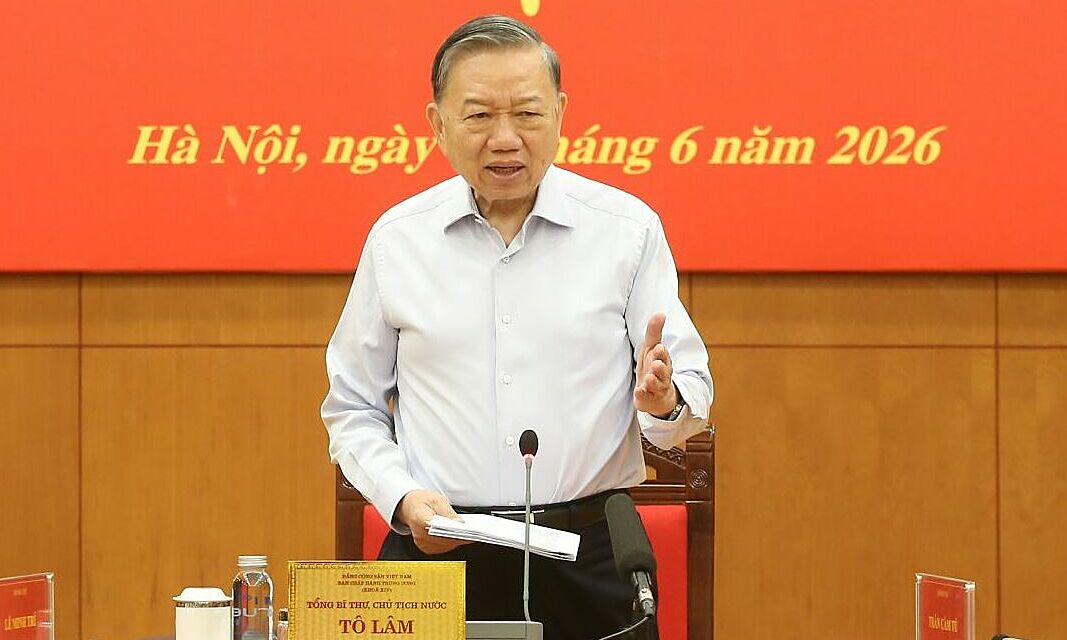 |
General Secretary and President To Lam chaired the meeting of the Central Steering Committee for Anti-Corruption, Anti-Waste, Anti-Negative Phenomena on 18/6. Photo: Communist Party Portal
Addressing long-standing dormant projects and surplus state-owned houses and land after organizational restructuring remains a priority. Legal agencies are tasked with focusing on investigating and prosecuting cases involving Long Thanh airport, the Ministry of Foreign Affairs headquarters, and issues in food safety, environment, minerals, energy, land, finance, and banking.
The steering committee underscored that asset recovery is a crucial measure for evaluating the effectiveness of anti-corruption, anti-waste, and anti-negative phenomena work.
According to a report at the session, since the beginning of the year, ministries, sectors, and localities have reviewed and added approximately 1,500 projects to the dormant list, bringing the total number of difficult or problematic projects and works to 4,492. To date, 1,531 projects have been resolved.
Across the country, 30,595 surplus state-owned houses and land facilities have been identified following organizational restructuring; of these, 14,992 have been processed and put into use.
Since the start of the year, party committees and inspection committees have disciplined 65 party organizations and 3,375 party members, including two officials managed by the Central government. Inspection and audit agencies have recommended the recovery of nearly 800 billion VND and 31 hectares of land.
Legal agencies have initiated 1,985 new cases with 4,671 defendants; prosecuted 1,886 cases with 4,520 defendants; and conducted first-instance trials for 1,721 cases involving 4,415 defendants for corruption, economic, and position-related crimes.
During the investigation phase, functional agencies provisionally seized, impounded, froze, and confiscated assets valued at thousands of billions of VND. In the prosecution and trial phases, over 1,300 billion VND was recovered; and in the civil enforcement phase, over 3,996 billion VND was recovered.