The National Center for Hydro-Meteorological Forecasting reported that at 7:00 AM, the tropical depression's center was in the waters east of the Leizhou Peninsula, with maximum wind speeds of 61 km/h, reaching level 7, and gusts increasing by two levels. It is currently moving southwest at 10-15 km/h.
By 7:00 AM tomorrow, while in the northwestern South China Sea, the tropical depression is expected to intensify into a storm, reaching level 8, with gusts at level 10, and change direction to the east-southeast.
A day later, in the northeastern South China Sea, the storm will shift its direction to the east-northeast at 20 km/h.
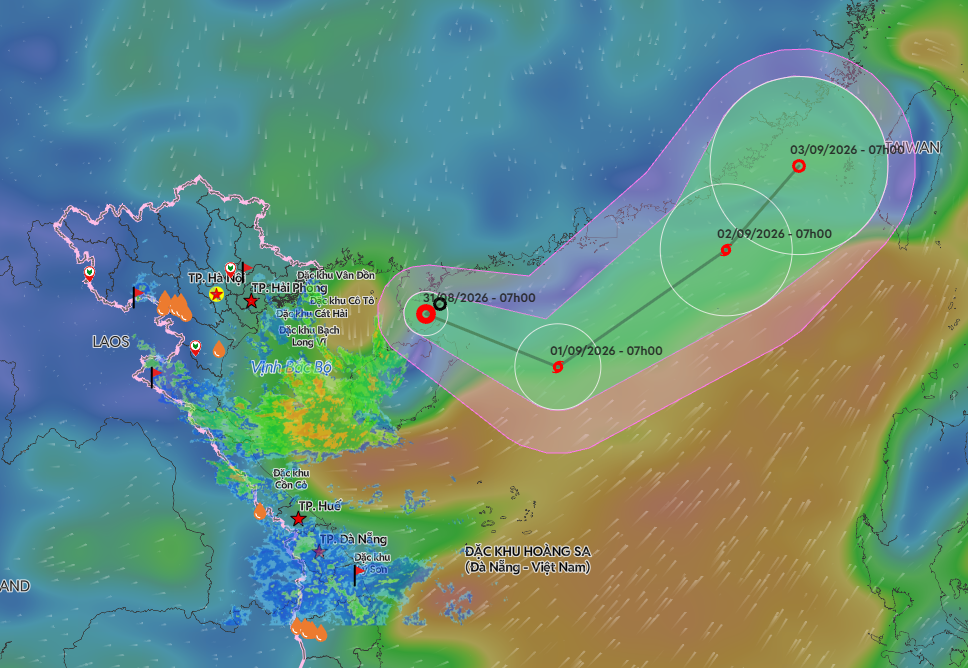 |
Forecast track and impact zone of the tropical depression. *Disaster Monitoring System*
The Japan Meteorological Agency predicted the storm would maintain an intensity of 65 km/h and move towards Taiwan (China).
Due to the tropical depression, the northwestern South China Sea will experience strong winds of levels 6-7, with gusts at level 8, and waves 2-4 meters high. Areas near the storm's center will see winds reaching level 8, with gusts at level 10, and waves 3-5 meters high. Vessels operating in these dangerous zones are likely to be affected by thunderstorms, squalls, strong winds, and large waves.
Saudel previously operated in the northwestern Pacific, strengthening into a typhoon and moving towards China. After making landfall and moving inland, the typhoon weakened into a low-pressure area. On the morning of August 31, this low-pressure area moved to the waters east of the Leizhou Peninsula, reorganized, and intensified into a tropical depression.
Previously, Typhoon Narra, along with heavy rain and thunderstorms in many northern and north-central provinces, resulted in three fatalities and three injuries. Two houses completely collapsed, 1,329 houses were damaged or had their roofs blown off, and tens of thousands of homes were flooded.
The floods submerged and affected 32,930 hectares of rice and crops, with 1,431 hectares of various other crops damaged. Approximately 213 livestock and 12,847 poultry perished, and over 1,007 hectares of aquaculture were damaged.
Regarding infrastructure: 2,135 meters of embankments and canals were damaged; 310 transportation points experienced landslides, and 71 locations were inundated. Over 10,600 customers remained without power at the time of the assessment.
Gia Chinh