One afternoon at the corner of Hoang Dieu - Phan Boi Chau, Mr. Vo Phung, former Director of Hoi An Center for Culture and Sports, witnessed a foreign tourist get injured when forced to walk into the street due to an encroached sidewalk. A bicycle pedal scraped their leg, causing bleeding. "I recorded it and sent it to the local authorities, because it was not just an accident but a warning about the unsafety of the pedestrian space," Mr. Phung said.
The incident Mr. Phung recounted occurred in late 3, amidst the Da Nang City People's Committee issuing a plan to prohibit business activities on sidewalks to create space for pedestrians. The ancient town already restricts motor vehicles, banning motorbikes during specific hours to allocate space for pedestrians and tourists. However, many streets within the heritage core lack sidewalks or have very narrow ones, only about half a meter wide. The boundary between the roadway and the pedestrian path often merges in many places.
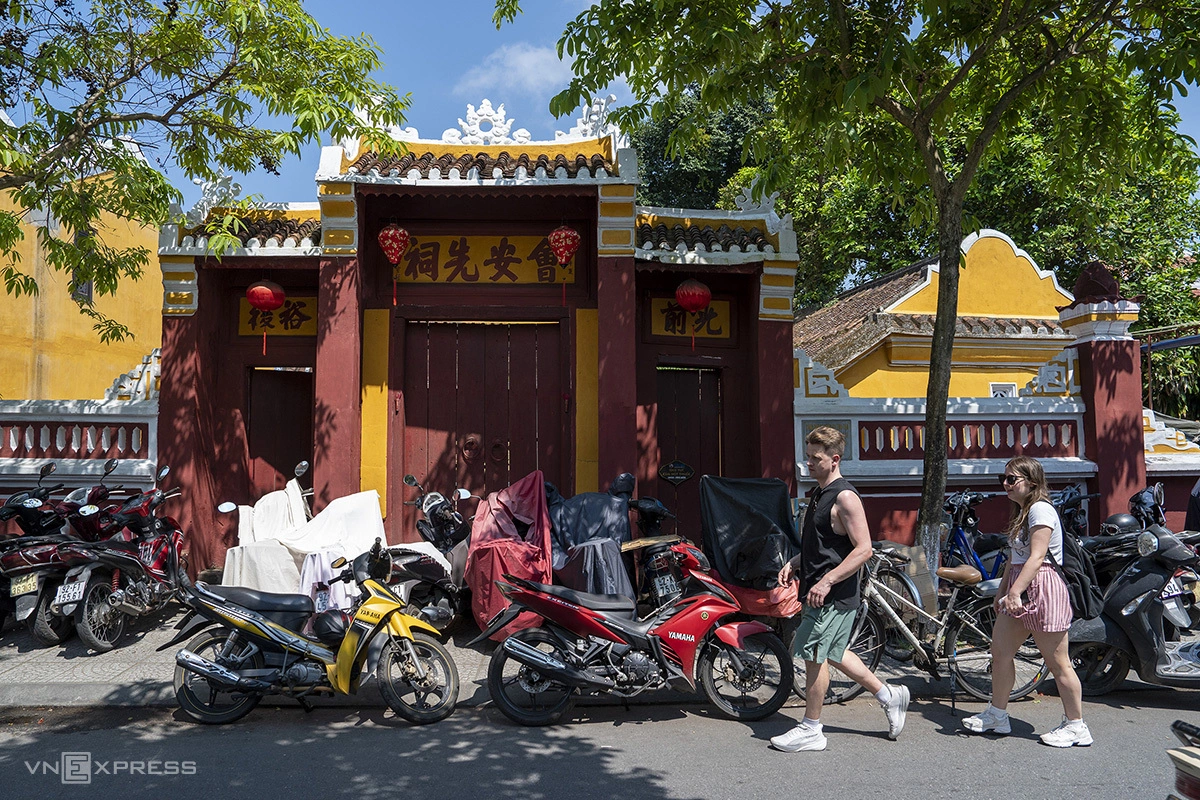 |
On Le Loi street (outside the pedestrian zone), sidewalks are encroached upon for motorbike parking, with many vehicles parked directly in the street, obstructing traffic, on the afternoon of 25/3. Photo: Nguyen Dong |
On Le Loi street (outside the pedestrian zone), sidewalks are encroached upon for motorbike parking, with many vehicles parked directly in the street, obstructing traffic, on the afternoon of 25/3. Photo: Nguyen Dong
In this context, the encroachment of public spaces is widespread. From traditional street vendors, sidewalks have gradually transformed into areas for coffee tables, eateries, and food carts. Signboards, potted plants, and hard objects spill onto pedestrian paths, forcing students and tourists into the street, where they face accident risks.
Mr. Nguyen Duc Binh, Party Committee Secretary of Hoi An Ward, acknowledged that this situation has made many areas of the ancient town "unkempt." A complacent attitude from the authorities has allowed the problem to spread, making it difficult to restore order, while the unique cultural and planning characteristics prevent the mechanical application of general regulations.
"We agree that stricter measures are needed to return pedestrian paths to the public, but Hoi An also has street vendors – a part of its heritage. Banning them all would damage long-standing values," Mr. Binh said.
In fact, Hoi An once had a specific project to manage street vendors, encouraging the image of shoulder poles selling cao lau, xi ma (black sesame sweet soup), and various cakes as part of the town's soul. Mr. Binh recounted the story of Ms. Hieu, over 100 years old, who has maintained her traditional xi ma stall for nearly a century. "That is not just a livelihood but an urban memory," he said.
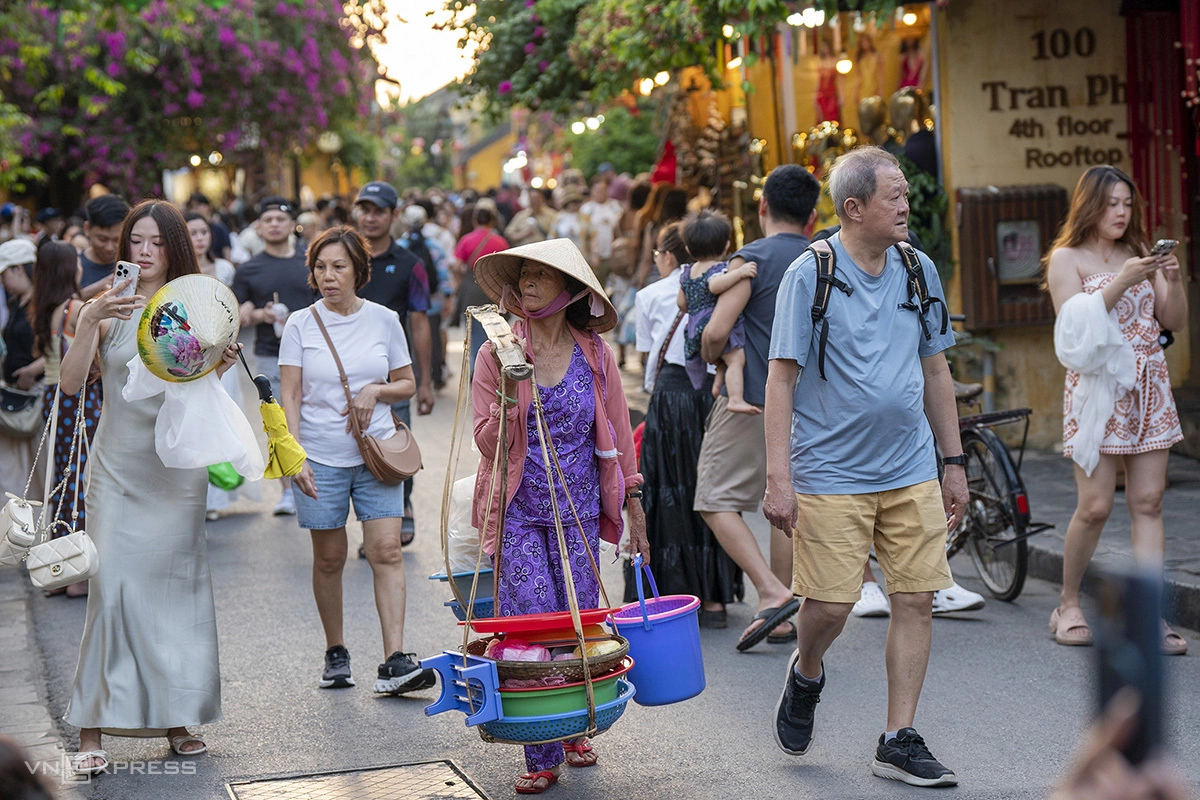 |
A street vendor among tourists in Hoi An ancient town, on the afternoon of 25/3. Photo: Nguyen Dong |
A street vendor among tourists in Hoi An ancient town, on the afternoon of 25/3. Photo: Nguyen Dong
However, according to local leaders, this "soul" is being overshadowed by new forms of business. Mr. Vo Dang Phong, Vice Chairman of Hoi An Ward People's Committee, stated that many spontaneous food carts and street vendors have appeared, accompanied by soliciting and competing for customers, distorting the image of the ancient town.
From a broader perspective, Mr. Nguyen Su, former Party Secretary of Hoi An City, suggested that the specific characteristics of this urban area need to be correctly recognized. The ancient town is entirely a pedestrian space, different from outside areas, so a uniform management approach cannot be applied. Allowing sidewalks to be encroached upon and transformed into crowded eateries is "unacceptable" in a heritage city. However, he also does not support extreme measures like "clearing out" all street vendors.
"If we clean up the area and there are no street vendors left, that is also not good, because they are a part of the daily life and culture of Hoi An residents," Mr. Su said.
From this, Mr. Su proposed a more flexible management approach. One solution is to limit the operating hours of street vendors, for instance, only allowing sales in the early morning, from about 5h to 8h, instead of throughout the day. Concurrently, clear distinctions are needed in management between the ancient town – where pedestrians are absolutely prioritized – and outer areas where standard urban regulations can be applied.
Mr. Su supports the authorities' efforts to restore sidewalk order but emphasized that decisiveness must be selective, coupled with the goal of preserving Hoi An's unique values. He stated that he would continue to present these recommendations in more detail at meetings with local authorities to find suitable solutions.
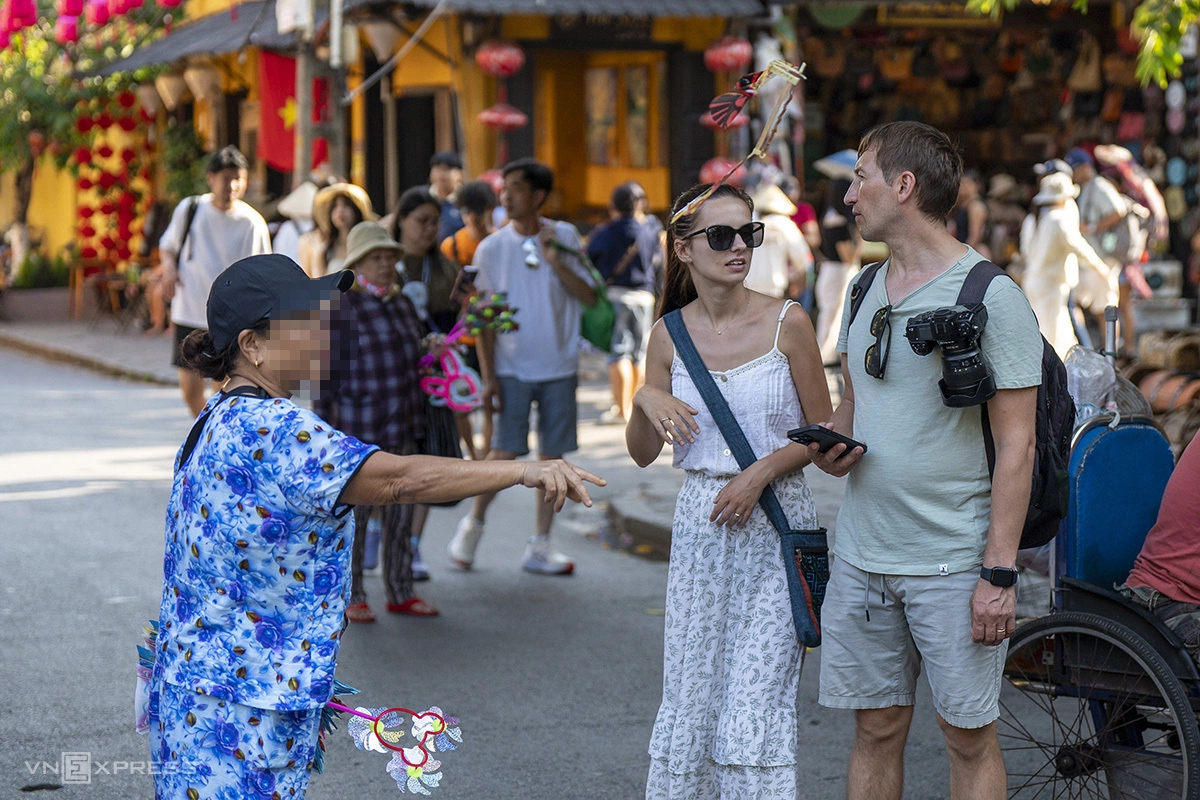 |
A street vendor soliciting customers, launching a bamboo bird directly in front of tourists. Photo: Nguyen Dong |
A street vendor soliciting customers, launching a bamboo bird directly in front of tourists. Photo: Nguyen Dong
In recent years, Hoi An has not opted for a "clear out" approach but has sought ways to manage the situation. Local authorities maintain an Urban Civilized Team for regular reminders; they regulate the area and form of street stalls; and once planned a concentrated sales area to limit encroachment. However, the effectiveness has not been sustainable, and re-encroachment still occurs.
Based on this reality, the authorities are re-evaluating their approach. According to Mr. Nguyen Duc Binh, Party Committee Secretary of Hoi An Ward, the ward will organize meetings and solicit opinions to develop flexible mechanisms, clearly distinguishing between traditional street vendors and distorted business practices. Pedestrian streets may adopt specific regulations, while intentional encroachment using hard objects will be definitively dealt with.
In parallel, local authorities are considering vocational support for those who do not fit the new regulations, while also consulting the community to build consensus.
From an expert perspective, Mr. Vo Phung proposed establishing "red lines" on sidewalks – limits that must not be encroached upon, giving absolute priority to pedestrians. Hoi An Ward needs to preserve "original street vendors" according to the plan, rather than allowing distortions, and restore the "gentle and benevolent way of life" – a value that once defined Hoi An's brand.
"The ancient town once sold tranquility to thrive, but now it often becomes noisy and chaotic," Mr. Phung said, adding that the challenge for Hoi An is not just clearing sidewalks, but finding a balance between urban order and cultural preservation.
Nguyen Dong