Many people descending Ba Son Bridge from Thu Thiem towards the city center easily spot two yellow buildings. Standing nearly 10 meters tall and about 50 meters long, these one-story structures with an upper floor face each other on Dinh Tien Hoang street. The buildings feature similar colonial architecture, yellow-painted walls, and numerous arched windows, differing only in their blue and red corrugated iron roofs.
Few realize these structures once formed a city gate erected by the French on the former site of the Gia Dinh Citadel from Emperor Minh Mang's era. In March 1859, after capturing Sai Gon, French forces destroyed the old citadel, seizing numerous weapons and provisions. Records indicate they confiscated about 2,000 antique guns, 85 barrels of gunpowder, enough rice to feed 6,000-8,000 people for one year, and local currency equivalent to approximately 130,000 French quan at the time.
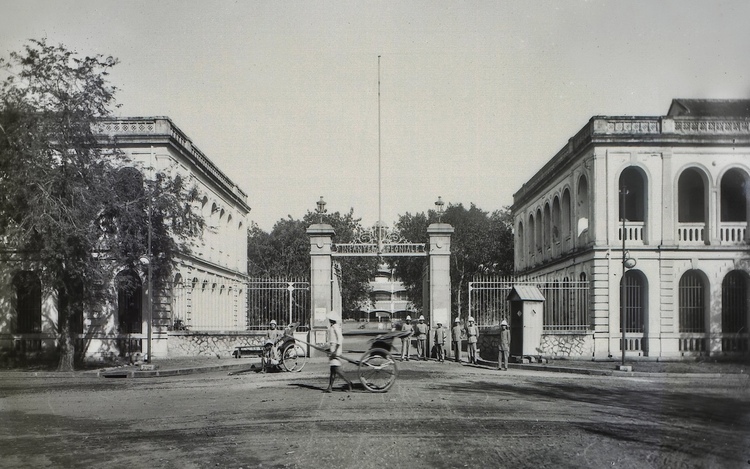
The two blocks that were once the Martin des Pallieres gate (Ong Dem Citadel) are currently the cafeteria of the University of Medicine and Pharmacy and a foreign language center of the University of Social Sciences and Humanities, Ho Chi Minh City. *Archival photo*
 |
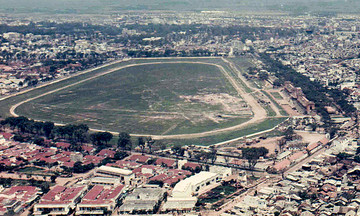
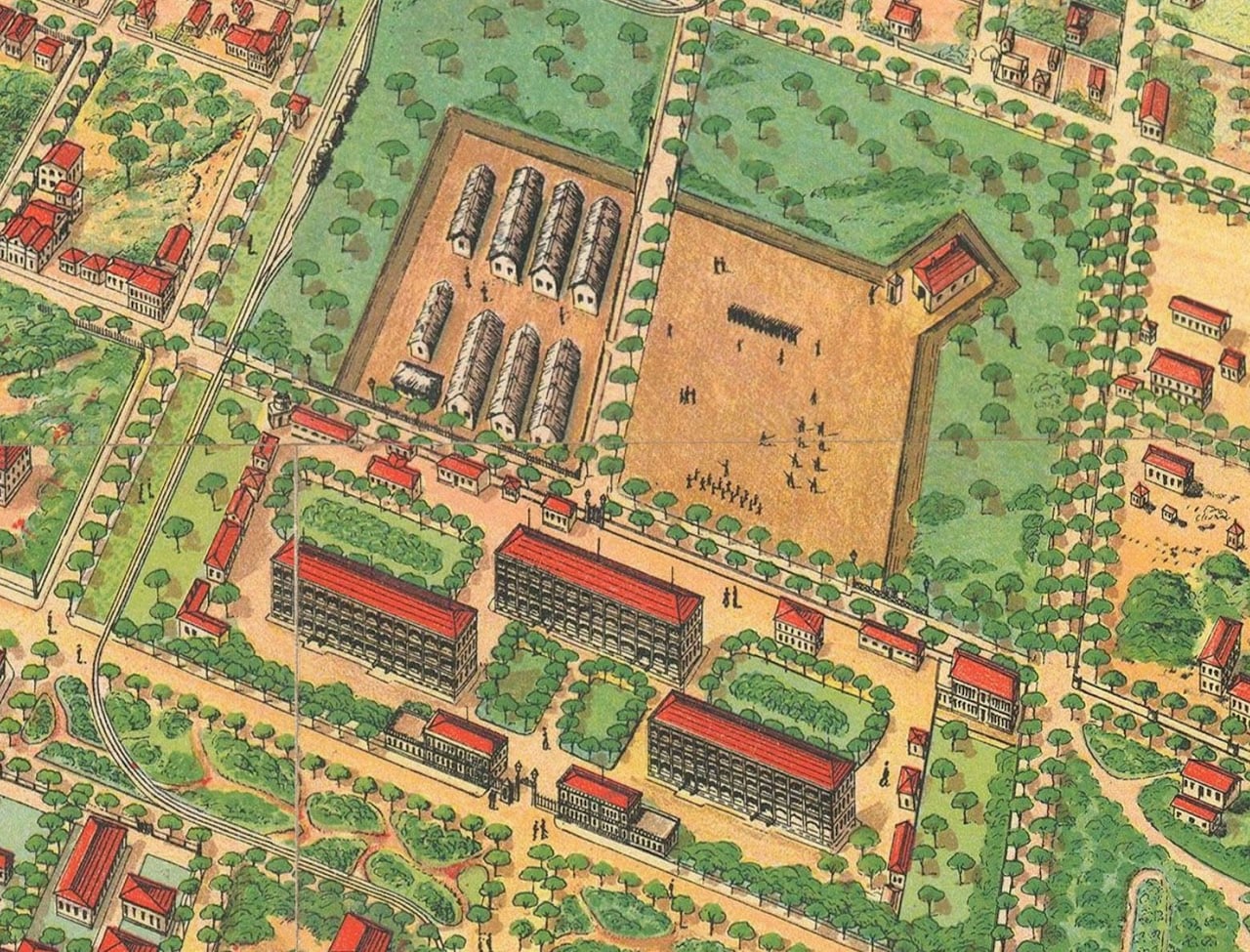
Martin des Pallieres Citadel via Gaston Pusch's 1898 map. *Archival photo* |
By 1870, the French repurposed materials and steel from the old citadel to construct new buildings, completing them in three years. The new citadel, named Martin des Pallieres after General Charles Gabriel Felicite Martin des Pallieres, became the primary French military base in Sai Gon.
At that time, the two blocks were connected by a large steel gate. It featured many arched windows for ventilation and sun protection, showcasing a colonial architectural style similar to other French structures built in the city in the late 19th century. Behind the gate, there were once many military barracks and auxiliary structures, which are no longer extant.
According to research, this location initially served as the base for the Cochinchina Field Regiment. In 1890, this unit divided into three regiments: the 8th, 10th, and 11th. The 11th regiment was garrisoned at Martin des Pallieres Citadel, which was later renamed the 11th Colonial Infantry Regiment. Sai Gon residents at the time commonly referred to this place as Ong Dem Camp or Ong Dem Citadel, a phonetic adaptation of "onzieme" (eleven in French).
 |
Between 1945 and 1975, Ong Dem Citadel underwent significant changes. On 9/3/1945, Japanese forces staged a coup against the French, imprisoning many French individuals there. More than half a year later, when British forces arrived to disarm the Japanese, the imprisoned French were released and joined British forces to retake Sai Gon.
In 1954, following France's withdrawal from Vietnam, Ong Dem Citadel was handed over to the State of Vietnam government. Prime Minister Ngo Dinh Diem deployed government military units to be stationed there. When the Binh Xuyen forces attacked, government troops counterattacked and regained control of the situation.
In 1955, after becoming President of the Republic of Vietnam, Mr. Diem renamed Ong Dem Citadel to Cong Hoa Citadel. This site became the base for the Presidential Guard Battalion, later upgraded to a Regiment and Brigade.
On 1/11/1963, during the coup, Lieutenant Colonel Nguyen Ngoc Khoi, Commander of the Guard Brigade, was arrested. However, coup forces could not immediately seize Cong Hoa Citadel. One day later, the guard unit surrendered on orders from President Diem.
In late 1963, the Guard Brigade was disbanded, and Cong Hoa Citadel was transferred to the Ministry of Education to establish a university complex. To expand the transportation axis, the authorities demolished the steel gate connecting the two blocks, along with many structures behind it, creating a road linking Dinh Tien Hoang with Cuong De (now Ton Duc Thang).
The building block of Ong Dem Citadel, which endured bombs during the 1963 coup, still retains its original architecture. *Archival photo*
 |
The road construction divided the old city gate into two independent blocks, as they appear today. In Gaston Pusch's 1898 panoramic map of Sai Gon, this area was a large complex with many training barracks and civilian structures.
Currently, the two blocks serve as the cafeteria for the University of Medicine and Pharmacy and the foreign language center for the University of Social Sciences and Humanities, Ho Chi Minh City. Ton Duc Thang street lies in front, where rows of century-old mahogany trees once stood but were replaced during the construction of Thu Thiem 2 Bridge (now Ba Son Bridge).
Having endured over 150 years, transforming from a military gate to an educational facility, the two yellow buildings near Ba Son Bridge quietly persist amidst the modern city, a lingering fragment of old Sai Gon's memory.
Dinh Van