Responding to delegates during a National Assembly discussion on the afternoon of 27/11, Minister of Science and Technology Nguyen Manh Hung stated that the Artificial Intelligence (AI) draft law is a framework law. This law draws on international experience to both control risks and foster innovation. The Government will issue detailed technical regulations to ensure flexibility as technology changes rapidly.
Minister Hung explained that AI governance is essentially intelligence governance, similar to how society regulates human knowledge use and its impact on the community. Intelligence forms from education and legitimate information; therefore, input data will be managed by the Data Law and Personal Data Protection Law. AI businesses must disclose legal data sources, and AI systems must assess risks, undergo independent verification, and be accountable.
Regarding output, the state will implement safety standards, post-inspection mechanisms, and sanctions for violations. "AI governance does not invent entirely new mechanisms but rather adapts human intelligence management experience to a more powerful and faster tool," the minister said.
He emphasized that the highest principle is human-centricity: AI serves people and does not replace decision-making authority. Transparency is mandatory, and citizens must know when they are interacting with AI. Legal liability for damages caused by AI systems will be apportioned among developers, providers, implementers, and users.
The state will establish a national supercomputing and AI data center to support research and training. It will encourage Vietnamese language models and digital data to lessen foreign dependence. AI used in public services and sensitive sectors must operate on Vietnam's AI infrastructure. Priority sectors include public administration, healthcare, education, agriculture, industry, and transport.
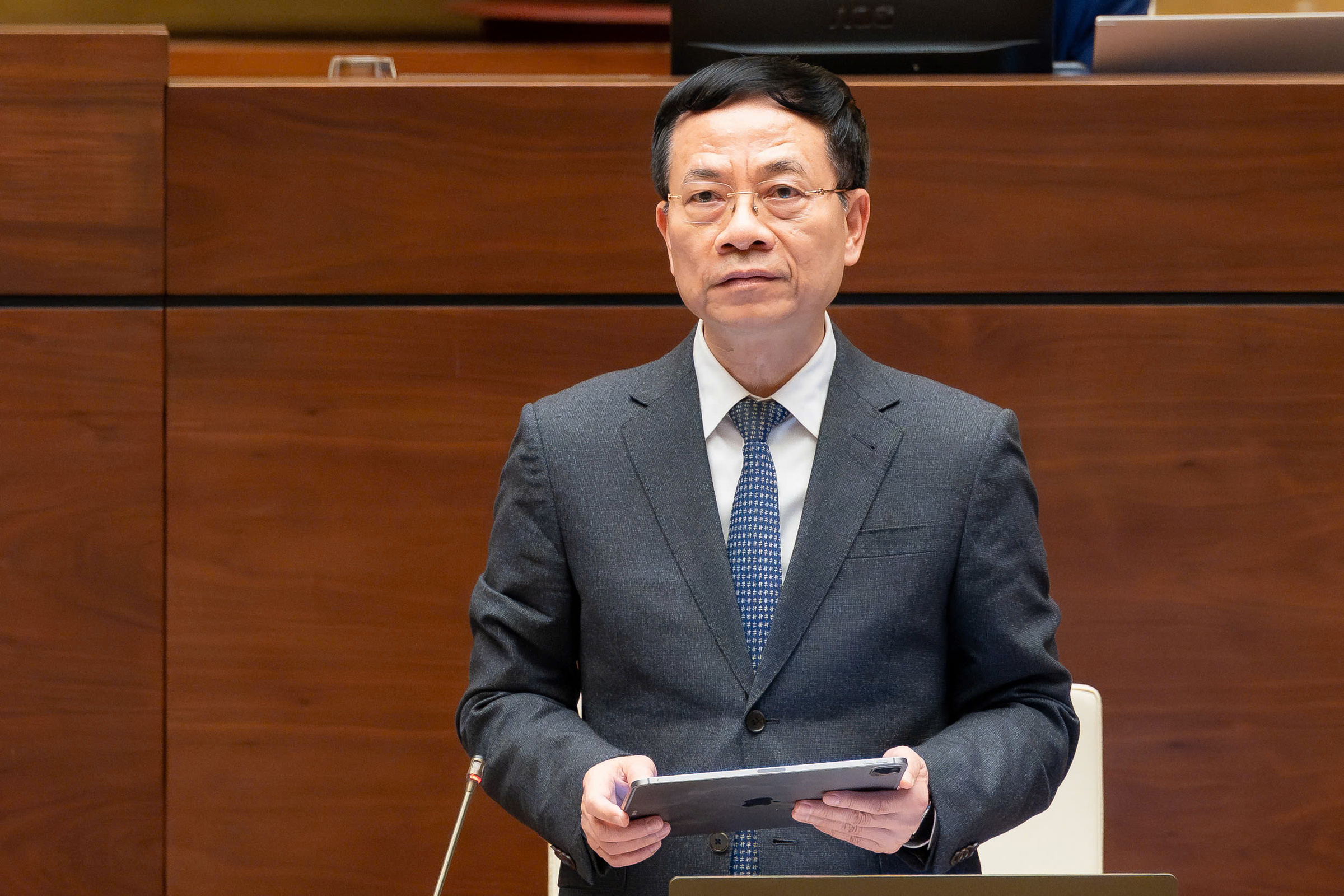 |
Minister of Science and Technology Nguyen Manh Hung spoke before the National Assembly on the afternoon of 27/11. *Photo: Hoang Phong* |
The minister also agreed to manage AI according to three risk levels: low, medium, and high. Addressing whether AI constitutes a high-risk source, he clarified that high-risk sources are typically physical means inherently dangerous, such as vehicles or explosives, which can cause accidents despite user caution. AI, as defined in this draft law, is not a physical means of danger; its risks stem from decision-making processes.
According to the minister, AI brings significant benefits but also risks. Many AI-related issues can be resolved by AI itself, such as human resource training, detecting ethical violations, or identifying deepfakes. "AI and its challenges will always exist. We will not eliminate them but rather coexist and manage them wisely," he stated.
Need for a controlled testing mechanism for AI
Representative Hoang Minh Hieu of the Legal and Justice Committee acknowledged that the drafting agency fully explained delegates' feedback during group discussions and supported the approach of fostering AI development while controlling risks. He argued that a controlled testing mechanism, or "Sandbox," is essential because AI is a new field involving many sectors, and effective implementation is difficult if solely based on existing legal frameworks.
The Sandbox aims to temporarily remove legal barriers, allowing model testing within limited scopes to gather data and prove effectiveness, thereby refining long-term regulations. This approach aligns with an "institution-first" legislative mindset, paving the way for innovation. He urged the draft law to include more specific provisions for this mechanism.
Representative Thach Phuoc Binh of the Vinh Long delegation agreed with the direction of promoting the Sandbox, open data, and computing infrastructure. He proposed prioritizing testing for healthcare, education, finance, and public administration, along with defining enterprise selection criteria, testing duration, and transparency mechanisms.
He suggested that the state should support small businesses and startups in accessing national computing infrastructure, especially GPUs and supercomputers, through subsidies or free quotas. The representative also proposed building a national open data repository and a fair data-sharing mechanism that meets security requirements. Additionally, he called for special policies to attract and retain AI talent, from university graduates to international experts.
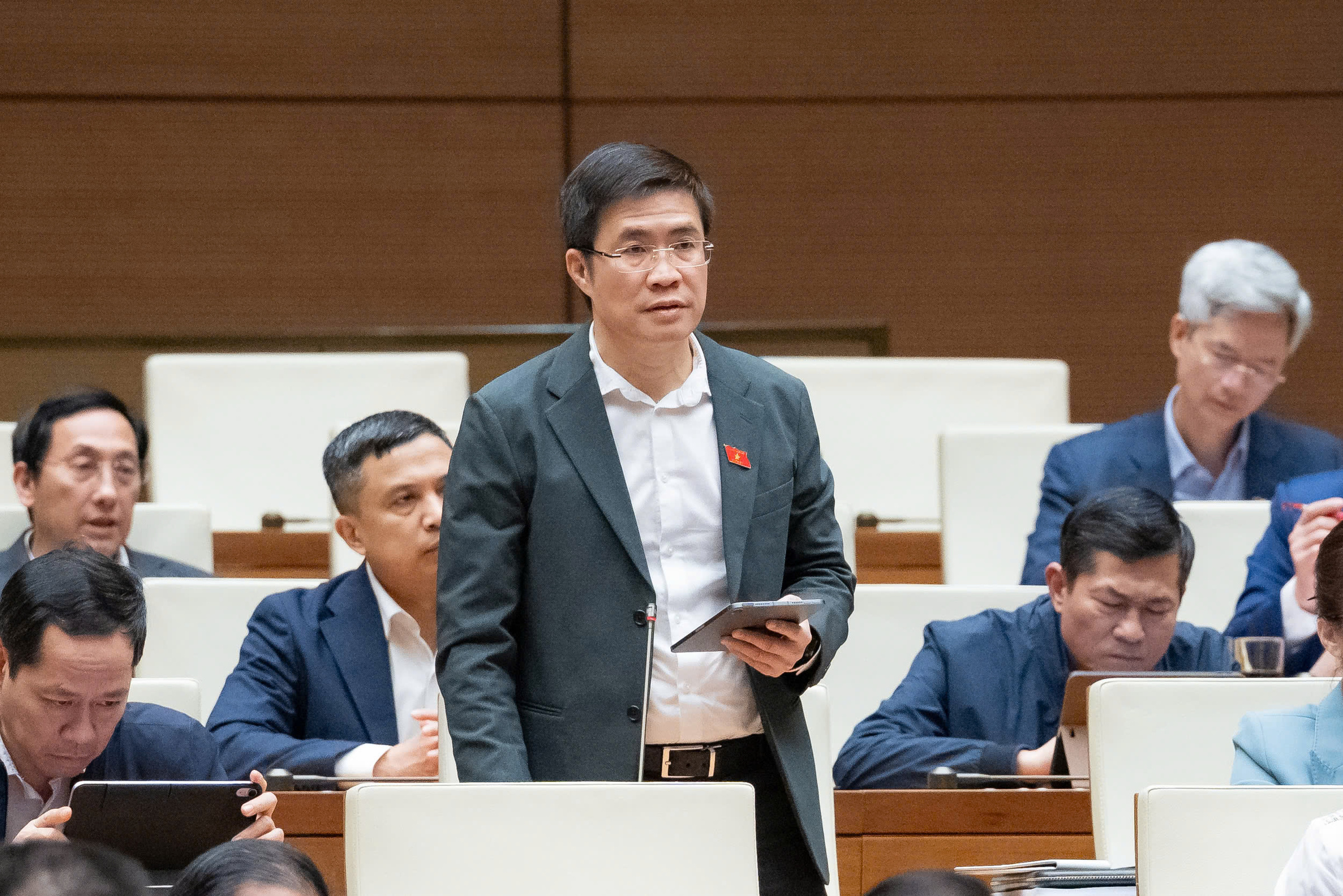 |
Representative Hoang Minh Hieu, a full-time member of the Legal and Justice Committee, spoke at the parliamentary session. *Photo: Hoang Phong* |
Criminal penalties for intentionally deploying untested high-risk AI
Representative Pham Trong Nhan highlighted several critical facts: China filed over 62,000 AI patents in just 10 months, 12 times Vietnam's total patents to date; the US attracted over 40 billion USD in private AI capital in 2024; and 99% of AI foundation models currently used in Vietnam originate from foreign sources. This serves as a strong warning regarding digital sovereignty and the risk of technological dependence.
Considering AI as the soft infrastructure of national productivity, Nhan questioned whether Vietnam could accept merely being a consumer of others' data and applications. He warned that without proactive measures, Vietnam risks being left behind in the global value chain. Three significant risks exist: data inequality and privacy; bias and lack of transparency in AI-assisted decisions; and deepfakes alongside cognitive manipulation. In the first 9 months of 2025, the world recorded over 180,000 political deepfake videos, with 41% targeting leaders in developing countries.
"Just a few seconds of fake video can cause severe damage to reputation and social security," he stated. Nhan proposed six directions: implementing risk-based management with four classification levels; protecting citizen rights; requiring foreign platforms with over 5 million users to establish legal entities in Vietnam; creating an AI System Safety Committee directly under the Prime Minister; establishing real-time update mechanisms; and enacting strong sanctions, including criminal penalties for intentionally deploying untested, non-transparent high-risk AI.
Representative Pham Trong Nhan also emphasized that the draft law is not just a technical document but a declaration of Vietnam's development philosophy, aiming to transform AI into a new driving force, a new strength, and a new competitive advantage for the nation.