Deputy Prime Minister Tran Hong Ha recently signed Decision No. 456, approving a project to build a data center system for traffic management, monitoring, violation processing, and operation for the 2026-2030 period, with a vision extending to 2050.
Vietnam will implement the project nationwide from 2026 to 2050, divided into three phases. During the 2026 to 2028 period, the country will operate a two-tier interconnected national center system. This center is designed with a distributed interconnection model but centralized management.
The tier 1 center, led by the Traffic Police Department (Ministry of Public Security), will synthesize and analyze specialized data, coordinate nationwide interconnection, and provide a shared platform. Tier 2 centers will be organized and operated directly by provincial and city police departments, ensuring interconnected and synchronized operations with the tier 1 center.
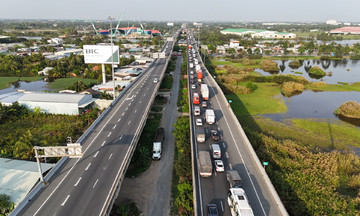
Also during this initial phase, 100% of operational expressways will be equipped with surveillance camera systems.
 |
Dozens of traffic police officers work via computers and large screens at the Traffic Police Department's Command Information Center. Photo: Viet An |
By 2030, the surveillance camera system will expand to national highways, provincial roads, and urban roads. The two-tier interconnected national center will operate based on real-time data and artificial intelligence (AI).
By 2050, Vietnam aims to achieve modern, highly automated digital traffic governance across all road, rail, and waterway types. This will involve effectively utilizing big data and AI to manage traffic, reduce accidents, and alleviate congestion.
Funding for the project will come from state and local budgets, security and order expenditure, revenue from traffic fines, license plate auctions, and other legal sources. The total estimated cost for the 2026-2030 period is approximately 14.86 trillion VND, excluding regular operation and maintenance costs.
The Ministry of Public Security will lead the planning and implementation of the entire project, urge relevant ministries and sectors, and develop technical standards for the system. The Ministry of Finance, Ministry of Science and Technology, Ministry of Construction, Ministry of Justice, and People's Committee (UBND) of provinces and cities are responsible for coordination, data connection, and proactively allocating local resources for implementation according to the overall roadmap.
Viet An