According to a representative from Phu Tho Department of Culture, Sports and Tourism, the province's tourism development philosophy emphasizes integrating heritage conservation with value promotion, serving the cultural and spiritual lives of its people, and contributing to sustainable development. Consequently, numerous mechanisms and policies have been enacted, including: investment support for relic restoration, policies for relic caretakers, assistance for artisans honored by the State, plans to combat relic degradation, and projects to preserve and promote the values of Xoan singing, Muong culture, and the "Hoa Binh culture".
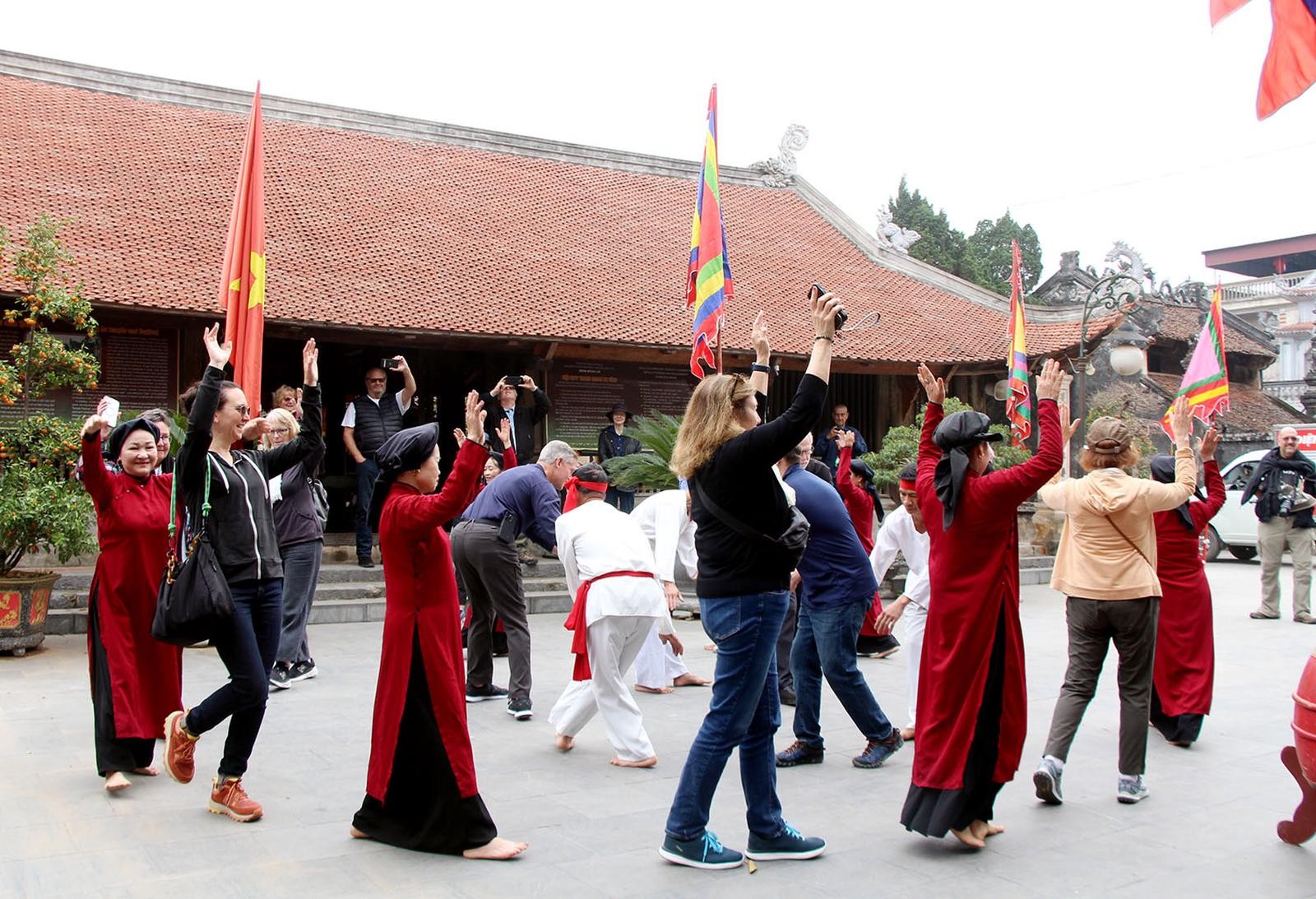 |
Trai nghiem hat Xoan. Anh: Huyen Trang
The Department representative stated that significant attention is given to relic planning, with many special national relic site plans being implemented, such as Den Hung, Hang Xom Trai and Mai Da Lang Vanh, Dinh Tho Tang, Binh Son Tower, and Tay Thien - Tam Dao. The preparation of scientific dossiers for relic ranking at various levels and for inclusion in the national intangible cultural heritage list is carried out regularly.
During the 2021-2025 period, the Department of Culture, Sports and Tourism advised the Provincial People's Committee (PPC) to announce 571 intangible cultural heritages. It also developed scientific dossiers proposing the Ministry of Culture, Sports and Tourism to include three heritages in the national intangible cultural heritage list and is currently finalizing 15 scientific dossiers for intangible cultural heritage to submit to the Ministry of Culture, Sports and Tourism.
However, heritage conservation in Phu Tho still faces many challenges. Some archaeological and revolutionary historical sites have not received adequate investment; many types of intangible heritage are at risk of fading due to a lack of successors; funding for relic restoration remains limited compared to actual needs; and incentives for artisans and direct relic caretakers have not truly created long-term motivation.
In the coming time, Phu Tho aims to accelerate the establishment and implementation of special national relic site planning; research appropriate management models for each heritage type; and enhance the digitization of heritage data for management, research, and smart tourism development. For intangible heritage, the province will continue to implement protection projects recognized by UNESCO; develop dossiers for UNESCO to acknowledge the Tay Thien Mother Goddess Worship and Mo Muong; and simultaneously focus on preserving the unique cultural values of ethnic minorities, craft villages, and traditional festivals.
 |
Le hoi Tay Thien. Anh: Tran Kien
Phu Tho is a locality possessing a cultural space with many layers of historical sedimentation, reflecting the formation and development process of the Vietnamese community. Currently, the province has 2,778 relic sites, of which 979 are ranked, including 6 special national relic sites, 176 national-level relic sites, and 797 provincial-level relic sites. Additionally, there are 6 National Treasures along with thousands of artifacts preserved at the Hung Vuong Museum, private museums, and the system of relic sites within the area.
Regarding intangible cultural heritage, Phu Tho has nearly 2,000 heritages, 41 of which are included in the National List. The province has 5 UNESCO-recognized heritages, comprising two primary entities: the worship of Hung Kings and Phu Tho Xoan singing; along with three widespread practices: the keo co (tug-of-war) ritual, ca tru singing of the Vietnamese people, and the practices related to the Mother Goddesses of the Three Realms (Tam Phu) worship of the Vietnamese people.
In recent years, the province has synchronously implemented the identification and announcement of heritage in accordance with the Law on Cultural Heritage. "This serves as an important foundation for Phu Tho to develop cultural-spiritual tourism while preserving its identity during socio-economic development", a representative from Phu Tho Department of Culture, Sports and Tourism stated.
Thanh Thu