Ukrainian President Volodymyr Zelensky is facing a pivotal moment for his nation's future. Last weekend, the administration of US President Donald Trump presented him with a 28-point peace plan that many Ukrainians and Western allies describe as heavily favoring Russia. He has seven days to accept the proposal or risk the withdrawal of all US support, potentially losing one of Ukraine's most crucial partners.
The plan arrives at an exceptionally difficult time for Zelensky, as Ukraine faces unprecedented pressure from a series of battlefield setbacks and a widespread corruption scandal. All attention is now on how President Zelensky will respond to reverse Ukraine's unfavorable situation, a feat he has accomplished many times throughout nearly four years of conflict.
 |
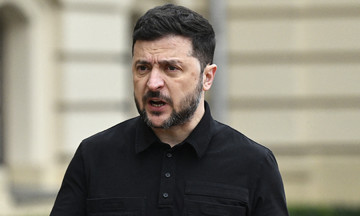
Ukrainian President Volodymyr Zelensky during a joint press conference with French President Emmanuel Macron in Paris on 17/11/2024. Photo: AFP |
Under the proposal, Ukraine is required to cede the Donbass region to Russia, recognize territories currently controlled by Russia, abandon its ambition to join NATO, and limit the size of its military in exchange for security guarantees from the US. Russia, meanwhile, is expected to make virtually no significant concessions.
President Zelensky has publicly acknowledged that the US proposal poses one of the most serious challenges Ukraine has ever faced. However, it has also helped consolidate his domestic standing, at least for now.
This peace plan has sparked outrage among the Ukrainian public, helping to divert attention from a corruption scandal that implicated his inner circle and threatened to paralyze the government. It has allowed him to return to his most successful role: uniting the nation.
Before Russia launched its campaign in Ukraine in February 2022, President Zelensky endured nearly three difficult years leading the country. Everything he did was scrutinized due to his past as a comedian.
However, his decision to remain in Kiev when Russian tanks encircled the capital and to film videos demonstrating an unwavering spirit on the streets helped him change the dynamic. This boosted public morale, garnered international support, and rallied the nation to fight, establishing his image as a resilient wartime leader.
"When pushed into a corner, Zelensky tends to go on the offensive," commented Viktor Shlinchak, head of the Institute of World Policy, based in Kiev.
Since then, he has guided Ukraine through numerous challenges, thanks to his remarkable adaptability amid the conflict's harsh trials. He helped avert a catastrophic ammunition shortage by pivoting to domestic drone production, restored US support for Ukraine, often through persistent lobbying of lawmakers in Washington and emotional appeals.
In February 2025, after facing harsh criticism from President Trump in the Oval Office, which led to a halt in US military aid to Ukraine, President Zelensky acted swiftly to mend relations with Washington. Aid was subsequently restored, and his domestic approval ratings surged.
Each time, Zelensky managed to navigate and endure. Experts suggest this is partly due to his skillful communication. This year, whenever under pressure from the US administration, he combined that skill with a tactic of courting European allies to draw them to Kiev's side, forming a united front against the pressure.
In what is perhaps his most precarious situation yet, Zelensky will have to decide how strongly to oppose a settlement proposal that could halt fighting but leave Ukraine's future more uncertain. To find a way out, he needs strong support from European partners and the Ukrainian public.
And this is precisely what Zelensky did during a series of phone calls last weekend to discuss the new peace plan.
On 22/11/2024, the European Union (EU) nations, along with the United Kingdom, Canada, and Japan, issued a joint statement demanding reconsideration of the most contentious points in the peace plan for Ukraine, such as border changes or reducing the country's military size. They argued that the US proposal would leave Ukraine more vulnerable in the future.
"I've never seen anyone operate as effectively as he does in rallying Europe to provide things I never thought possible," remarked Katarina Mathernova, EU Ambassador to Ukraine, adding that communication is President Zelensky's "superweapon," helping him secure finances, weapons, and diplomatic support from allies.
As Zelensky sought Europe's help, Trump criticized both on social media on 23/11/2024. This was seen as the clearest sign of the challenge the Ukrainian President is facing.
"The Ukrainian leadership has shown no gratitude for our efforts, and Europe continues to buy oil from Russia," Trump wrote.
Before the peace plan was introduced last week, President Zelensky was in a politically weakened position. He had angered the Ukrainian public by attempting to neutralize anti-corruption agencies investigating his close associates.
After Zelensky's allies were accused of involvement in a large-scale bribery scheme, members of parliament called for a vote of no confidence in the government. Some members of his party defected and demanded the resignation of top officials from the Presidential Office.
While the Ukrainian public was agitated by the corruption scandal, the peace plan, with its many unfavorable points, was released by Trump, capturing their full attention and anger.
President Zelensky immediately seized this opportunity to "turn danger into opportunity." On the evening of 21/11/2024, standing on the very street where he delivered his message of defiance on the second day of the conflict nearly four years ago, Zelensky again called for national unity.
"I want to speak to all Ukrainians. Our people, every citizen, politician, everyone, we need to unite, regain our senses, stop arguing, and stop playing political games," he said.
President Zelensky stated that the US peace plan is forcing Ukraine to choose between abandoning Washington's support or "losing dignity" by accepting Russia's conditions.
Analysts suggest that with this statement, Zelensky likely aims to prepare the Ukrainian people psychologically for potential concessions, while distancing himself from the plan by emphasizing pressure from the US. However, whether to make concessions, and to what extent, remains another difficult question for him.
"No Ukrainian leader has the right to agree to anything similar. If he does, Zelensky will no longer be President when he returns home," commented Nico Lange, a former senior German defense official involved in European efforts to assist Ukraine.
 |
Ukrainian soldiers fire towards Russian forces in Donetsk in August 2024. Photo: AFP |
The Trump administration still holds significant leverage if it wants to pressure Ukraine to accept a deal. Although it no longer directly funds aid to Ukraine, Washington continues to sell crucial weapons to Kiev through a joint mechanism with European allies.
Nevertheless, this leverage is not absolute in a conflict that many Ukrainians view as an existential threat.
"You can refuse to share intelligence, refuse weapon support, but that won't make a short-term difference because the Ukrainian army will continue to fight. They have no thought of surrender," said Tymofiy Mylovanov, President of the Kyiv School of Economics. "For any agreement to pass, someone must convince the people and the military in Ukraine that their lives will be safe and the conflict will not continue."
According to observers, the Ukrainian people have shown they are willing to set aside domestic political grievances when facing external challenges.
Shlinchak, head of the Institute of World Policy, believes Ukrainians are likely to support President Zelensky in negotiations because he is "the only legitimate representative of Ukraine, embodying the belief of the majority that they cannot sign a surrender agreement proposed by Russia."
"We have no other legitimate leader, so we have no alternative," he added.
Vu Hoang (According to WSJ, AFP, Reuters)