In a vote at the United Nations Security Council on 7/4, a draft resolution, authored by Bahrain and supported by the US, garnered 11 votes in favor, two against, and two abstentions. Russia and China, both permanent members of the Security Council, exercised their veto power against the proposal.
Pakistan and Colombia, two nations advocating for diplomatic solutions, chose to abstain from the vote.
Bahrain's Foreign Minister Abdullatif bin Rashid Al Zayani expressed his country's regret over the draft resolution's failure to pass, noting that Gulf nations were "disappointed".
US Ambassador to the United Nations Mike Waltz reacted sharply to the outcome. "Today's veto marks a new setback. In the coming days, as vital shipments face delays, the world will recognize who chose obstruction over responsibility", Waltz stated before the Security Council.
Conversely, Russian Ambassador Vasily Nebenzya argued that the resolution, if adopted, would establish a "dangerous precedent" for international law and global peacekeeping efforts.
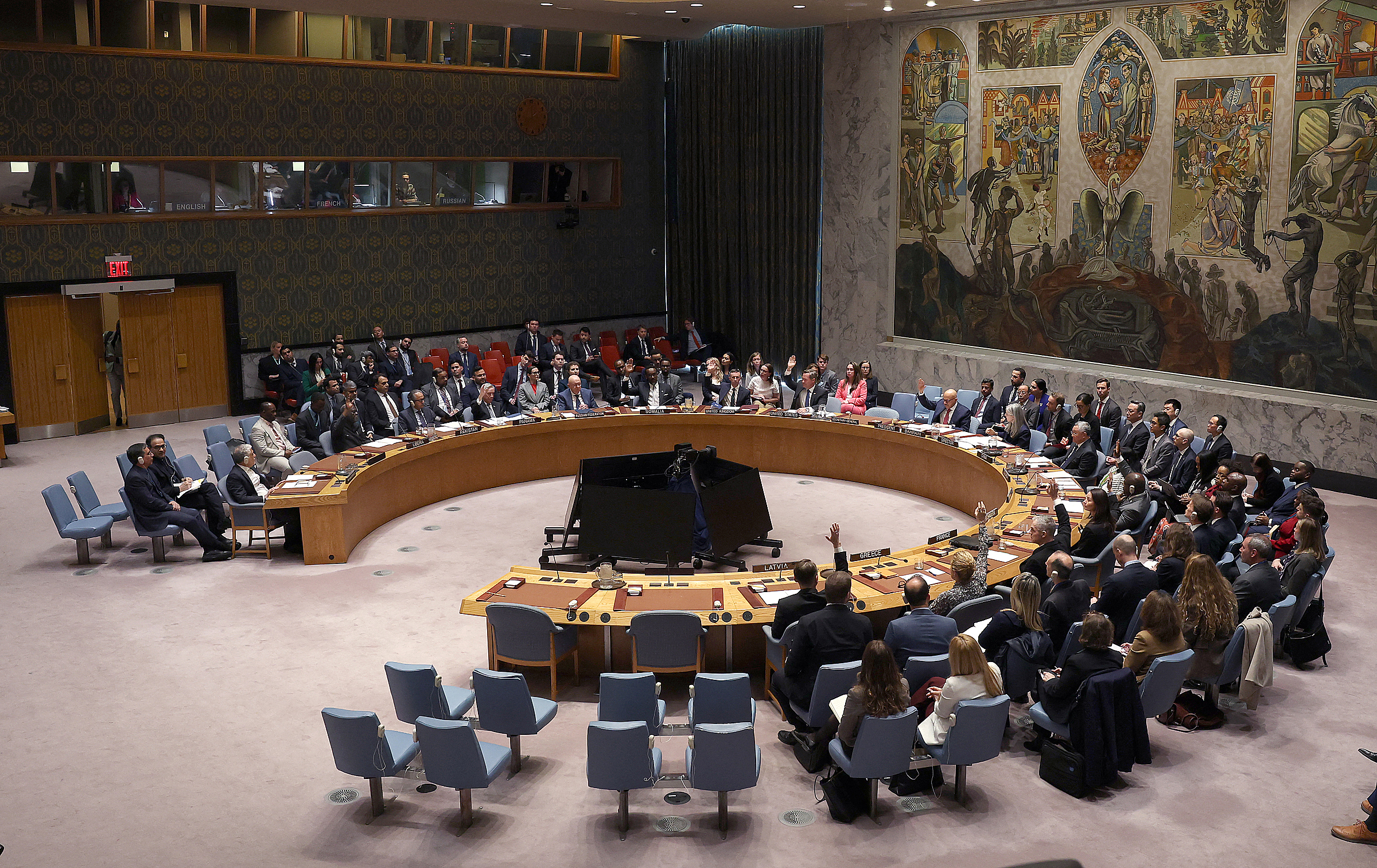 |
Members of the United Nations Security Council during the vote on the draft resolution concerning the Strait of Hormuz at the United Nations headquarters in New York, US on 7/4. *AFP*. |
The initial draft of the resolution had invoked Chapter VII of the United Nations Charter, which permits the Security Council to authorize the use of force to restore peace. This provision was later removed due to strong opposition from three of the 5 permanent members of the Security Council: Russia, France, and China. These nations contended that such language would legitimize a full-scale military attack on Iran.
According to the final draft obtained by AFP, the resolution "strongly encourages states to coordinate and implement self-defense measures appropriate to on-site developments, thereby contributing to security and navigation, including organizing escorts for cargo ships".
The document also demanded that Iran "immediately cease all attacks on vessels, as well as all attempts to obstruct trade flow and freedom of navigation in the Strait of Hormuz". Furthermore, the draft called on all parties to halt attacks targeting civilian infrastructure, such as water, electricity, and oil and gas systems.
The Strait of Hormuz, a crucial maritime artery responsible for 20% of the global oil supply, has been nearly paralyzed since conflicts involving the US, Israel, and Iran escalated in late February. Currently, approximately 1,000 ships are stranded in the Gulf region due to the ongoing hostilities.
The United Nations Security Council, composed of 5 permanent and 10 non-permanent members, had originally scheduled the vote for 3/4 but subsequently postponed it.
Prior to the vote, Iranian Foreign Minister Abbas Araghchi urged parties within the UN Security Council to refrain from "any provocative actions", warning that such actions would only exacerbate the already complex situation.
By Huyen Le (AFP, AP, Wion News)