The revised policy package lowers the projected 2035 target of 100% zero-emission vehicles to 90%. It also introduces measures to accelerate the transition to electric vehicles while offering greater flexibility for manufacturers.
Immediately after the proposal, major car manufacturers and other automotive industry members reacted, showing a clear division: some supported, while others criticized.
BMW, one of Germany's three automotive giants, hailed the move as an important first step. The company noted that the European Commission (EC) is no longer pursuing a technology ban as a guiding principle, instead acknowledging the future viability of the internal combustion engine.
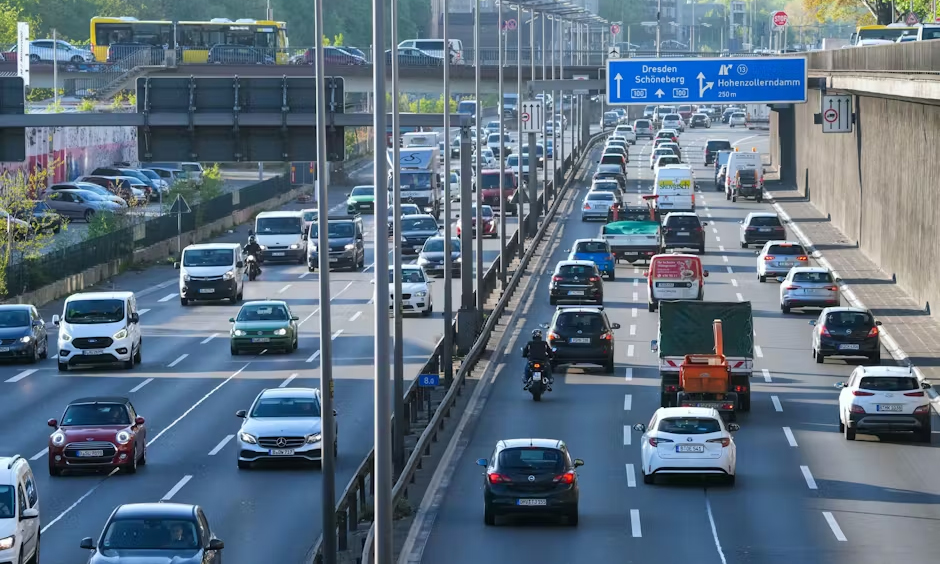 |
Vehicles drive on the A100 in Berlin, one of Germany's busiest highways. *DPA*
Steffen Kawohl, a policy advisor at the German Association for Small and Medium-sized Businesses (DMB), also from Germany, suggested that lifting the internal combustion engine ban might slow the automotive industry's transition but would not halt it entirely. This slowdown would only be meaningful if the German economy used the extra time to accelerate its shift towards fossil-fuel-free transportation.
Mercedes also welcomed the EU's move, calling it a step towards greater flexibility for manufacturers and the necessary technological neutrality. This indicates that the EU is responding to the stagnation in electric vehicle development across Europe.
German Chancellor Friedrich Merz also spoke out, praising the relaxation of automotive regulations following clear signals from the German government. He stated that being more open to technology and more flexible are the right steps to better harmonize climate goals, market realities, businesses, and employment.
Italian Foreign Minister Antonio Tajani said the EU's action was a choice to protect 70,000 jobs in Italy alone. A Volkswagen representative called the EC's proposal "economically reasonable," while a representative for French automaker Renault also welcomed the EC's move, mentioning the introduction of small electric vehicles under 4,2 meters.
Opposition came from a representative of Stellantis, the parent company of brands such as Chrysler, Fiat, Jeep, Maserati, Peugeot, and Ram. The group argued that the proposals do not meaningfully address the issues currently facing the industry. Specifically, the package fails to provide a viable roadmap for the critical light commercial vehicle segment and lacks the necessary flexibility until 2030 that the industry requires for passenger cars.
Dominic Phinn, head of transport at the Climate Group, a non-profit organization aiming for a carbon-neutral world by 2050, criticized the softening of the petrol and diesel engine phase-out. He stated that this move goes against leading companies across Europe that are investing billions of USD into electric vehicle fleets and require the stability such a phase-out provides.
By reopening the door to plug-in hybrids and biofuels, Europe is slowing itself down in a fiercely competitive global race, according to Chris Heron, secretary general of E-Mobility Europe. "The future of transport is electric; the question is whether Europe will produce it itself or import it," Heron questioned.
One of the few strong objections from automakers came from Volvo. The brand has built a full electric vehicle portfolio in under 10 years and is ready to transition entirely to electric vehicles with a range of long-range hybrid vehicles. Volvo argued that if they can do it, others can too.
The EC's delayed policy package resulted from intense lobbying efforts to allow transitional technologies like plug-in hybrids and CO2-neutral fuels. This contrasts with climate activists and electric vehicle-focused companies, who pushed for maintaining the original target.
Under the plan, automakers can still sell plug-in hybrids and range-extended vehicles after 2035. Manufacturers failing to meet the 100% CO2 emission reduction target will need to offset the shortfall.
CO2-neutral fuels, including advanced biofuels produced from waste such as used cooking oil, and low-carbon steel will also be factored into emission calculations. This means automakers producing vehicles with this "green steel" made in the EU could further reduce emissions.
Automakers utilizing these flexibilities will not be able to pool their emissions with brands that exclusively produce electric vehicles, such as Tesla and Polestar, to meet the set targets. This practice is commonly known as carbon credit trading.
My Anh (according to Reuters)