Unlike traditional gasoline, ethanol can absorb moisture from the air. This leads many users to worry that E10 gasoline might undergo "phase separation" if stored for extended periods in fuel station tanks or vehicle fuel tanks. However, experts state that E10 does not automatically separate water after a typical storage period.
Ho Ngoc Linh, Deputy Head of the Petroleum Technical Department at Vietnam National Petroleum Group (Petrolimex), reported that E10 samples stored for three months under laboratory conditions showed no phase separation.
Petrolimex's test results align with international studies on E10 fuel stability. A 2016 report by the National Renewable Energy Laboratory (NREL) in the US indicated that even under continuous high temperature and humidity, E10 gasoline needs approximately three months or more to absorb enough water for phase separation to occur. This suggests that the risk of E10 phase separation under normal storage and distribution conditions is not as rapid as many people fear.
When does E10 gasoline separate water?
By nature, ethanol is a polar alcohol, allowing it to dissolve water, unlike mineral gasoline which is almost immiscible with water. According to technical documents on ethanol fuels, E10 gasoline can dissolve less than 0.5% water by volume before phase separation occurs, depending on temperature conditions. Only when the amount of contaminated water exceeds the saturation limit does phase separation occur, where ethanol pulls water to the bottom of the tank (due to its higher specific gravity than gasoline), forming two distinct layers: a gasoline layer above and an ethanol-water mixture below.
Notably, this solubility decreases at lower temperatures. According to technical documents from Advanced Motor Fuels TCP, part of the International Energy Agency (IEA), 3.8 liters of E10 gasoline at 15 degrees Celsius can dissolve about 22 ml of water, but when the temperature drops to around minus 7 degrees Celsius, the amount of water it can dissolve decreases to about 16 ml. This means that lower temperatures increase the potential for E10 phase separation.
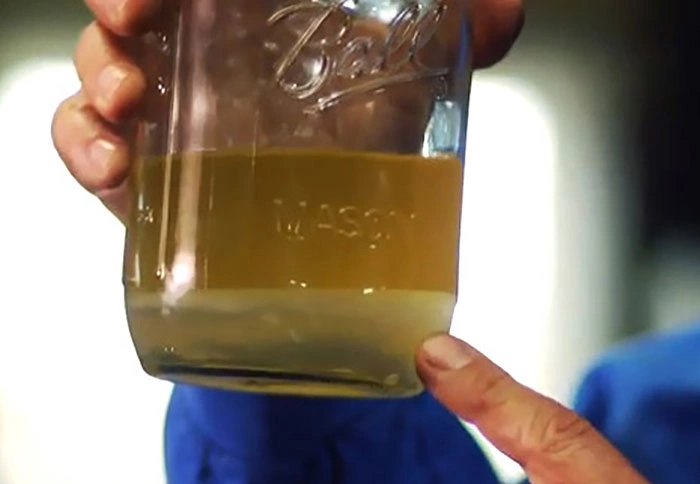 |
Ethanol gasoline undergoing phase separation, with a gasoline layer above and a water layer mixed with impurities below. Photo: ymarinaboats |
However, technical experts believe this is not a major risk under normal fuel distribution conditions. This is because modern fuel station tanks are typically sealed, equipped with systems to check for water at the bottom, and fuel is continuously circulated rather than stored for excessively long periods.
In practice, E10 gasoline has been widely used for many years in the US, Europe, Australia, and Thailand. According to fuel experts, the risk of phase separation is typically more significant in cases where fuel is left for extended periods in humid environments, such as in boats, generators, infrequently used vehicles, or unsealed containers. In such situations, moisture can accumulate over time, increasing the risk of water contamination beyond E10's dissolution limit.
Furthermore, Vietnam's ambient temperature is a more favorable factor for E10 compared to countries with severe winters. Under higher temperature conditions, the E10 mixture has a better ability to dissolve water, thereby reducing the risk of phase separation.
Meanwhile, ethanol is still valued for its environmental advantages, helping fuel burn cleaner and partially reducing carbon emissions compared to pure mineral gasoline. This is also why many countries have continued to expand the use of ethanol-blended fuels in recent years.
Pham Hai