India's Supreme Court recently put forth an unusual proposal to recover unpaid traffic fines, suggesting that outstanding amounts could be added directly to citizens' electricity bills. This idea emerged during a hearing on the recovery of e-challans, where the court emphasized that merely issuing hundreds of thousands of notices is insufficient; the greater challenge lies in collecting the money. The court believes linking fines to an essential service like electricity would be an effective tool for recovery, compelling violators to pay to avoid power disconnection.
This suggestion, however, is currently just a proposal from the Supreme Court and not yet a nationwide mandatory regulation. Local authorities would need to study the operational aspects of implementing such a system.
The Supreme Court's suggestion came during its review of a petition concerning automated traffic enforcement and the recovery of outstanding e-challans. This forms part of a public interest litigation (PIL) on road safety, initiated by social activist S Rajasekaran in 2012. During the hearing, the court was informed that approximately 450 billion rupees (about 4.7 billion USD) in e-challans remain unrecovered, with only about 250 billion rupees collected so far.
The panel of judges highlighted that while police can issue numerous e-challans, this does not solve the core issue if the fines are never paid into the treasury. Consequently, the court requested regulatory agencies to devise feasible, practical solutions for fine recovery.
If an individual continues to ignore e-challan notices, the outstanding fine could be directly added to their household electricity bill. Since citizens are compelled to pay electricity bills on time to avoid disconnection, the court believes this mechanism would be effective in recovering fines.
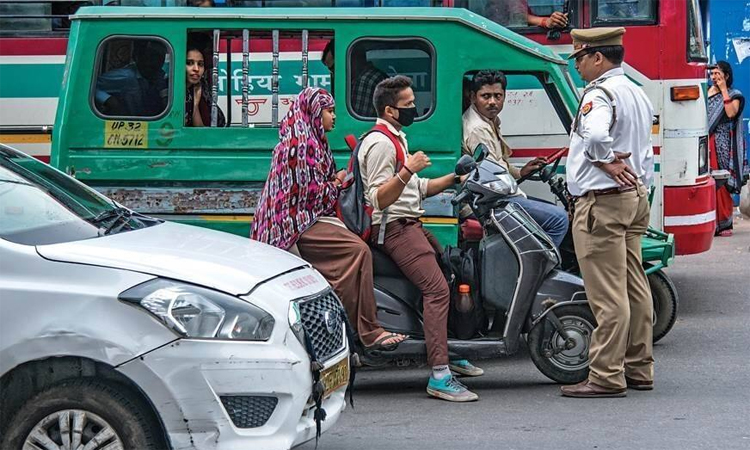 |
Indian traffic police stop a moto carrying two people, both without helmets. *Photo: ABP*
Beyond electricity bills, the Supreme Court also discussed other stringent measures. Regulatory agencies could refuse vehicle registration renewals, stop re-issuing lost vehicle registrations, or restrict ownership transfers for vehicles with outstanding fines. Refusing to issue technical safety inspection certificates for these vehicles is also an option. Additionally, vehicles with outstanding fines could be blacklisted on the national traffic information portal or denied a pollution under control (PUC) certificate. The court also proposed increasing random vehicle inspections on roads. If a vehicle with outstanding fines is found, authorities would have the right to apply necessary enforcement measures, including vehicle impoundment.
The Supreme Court's suggestion to integrate e-challans into electricity bills is sparking much debate. Both citizens and road safety experts question its legality and feasibility. Many support this measure, arguing that linking e-challans to essential services like household electricity will prevent violators from delaying payment. They contend that people might ignore messages or reminder letters for fines, but they cannot live in a house without electricity.
Conversely, many express concern, suggesting that authorities should improve management efficiency and traffic infrastructure before implementing stringent enforcement measures. From a legal perspective, lawyers point out that traffic fines are subject to appeal or litigation in court. Automatically combining e-challans with electricity bills could limit citizens' right to appeal. Furthermore, this process would require a clear legal framework and parliamentary approval before official implementation.
My Anh, reporting for Cartoq.