On highways, where vehicles typically travel at speeds of 80-120 km/h, the presence of a stationary or slow-moving maintenance vehicle poses a significant collision risk. This endangers both workers and circulating traffic. To mitigate this risk, many developed countries have established specialized protection vehicle systems, operating as a mobile protective formation to reduce hazards for workers and vehicles engaged in construction.
Shadow vehicle
A shadow vehicle, also known as a "shadow vehicle," is a vehicle that travels behind the main maintenance vehicle. Its tasks include warning, guiding, and shielding against the risk of rear-end collisions. In countries such as the US, Japan, and Europe, shadow vehicles are an indispensable component of all highway maintenance operations.
The name "shadow vehicle" stems from its consistent movement closely behind the maintenance vehicle, like a shadow. Additionally, a shadow vehicle creates a safety buffer zone for workers and maintenance vehicles, as the distance between the two vehicles is typically 50-150 m. A standard shadow vehicle is usually equipped with a rear attenuator, designed to absorb energy and minimize damage in the event of a rear-end collision. Furthermore, the vehicle can be fitted with counterweights to increase its mass, preventing it from being pushed too far forward during a severe impact and thus avoiding multi-vehicle accidents.
Finally, shadow vehicles are equipped with high-intensity warning light systems, including rotating and flashing lights, to attract driver attention in all weather conditions. On the vehicle's bed, a large electronic arrow board directs drivers into a safe lane.
Automatic cone laying vehicle
In areas requiring fixed traffic diversion or extended construction, many developed countries use automatic cone laying vehicles. These replace the manual placement of cones by workers on the road. This specialized machine mechanism deploys cones at a precise rhythm and standard spacing, ensuring they are neatly aligned and uniform even at night or in heavy traffic.
The effectiveness of cone laying vehicles lies not only in safety but also in speed. For example, on a highway section requiring tens to hundreds of cones, manual placement can be time-consuming and necessitates multiple workers operating near high-speed traffic. In contrast, an automatic cone laying vehicle requires only one operator and completes the task much faster. When work concludes, the machinery automatically retrieves the cones in reverse, ensuring the entire process is efficient and highly safe.
Countries such as Japan, the UK, and many states in the US have widely adopted this type of vehicle for road repair or surface upgrades. This has significantly reduced labor accidents and established consistent, fast, and accurate traffic management procedures.
Mobile sign vehicle
In highway maintenance operations, mobile sign vehicles act as an early messenger, helping drivers identify situations before approaching a work zone. These vehicles are equipped with large electronic information boards that can display messages such as "work ahead," "merge left/right," or "slow-moving vehicles ahead." These warnings are broadcast with high brightness, clear, and legible fonts, making them easy for drivers to see from a distance or in unfavorable weather conditions.
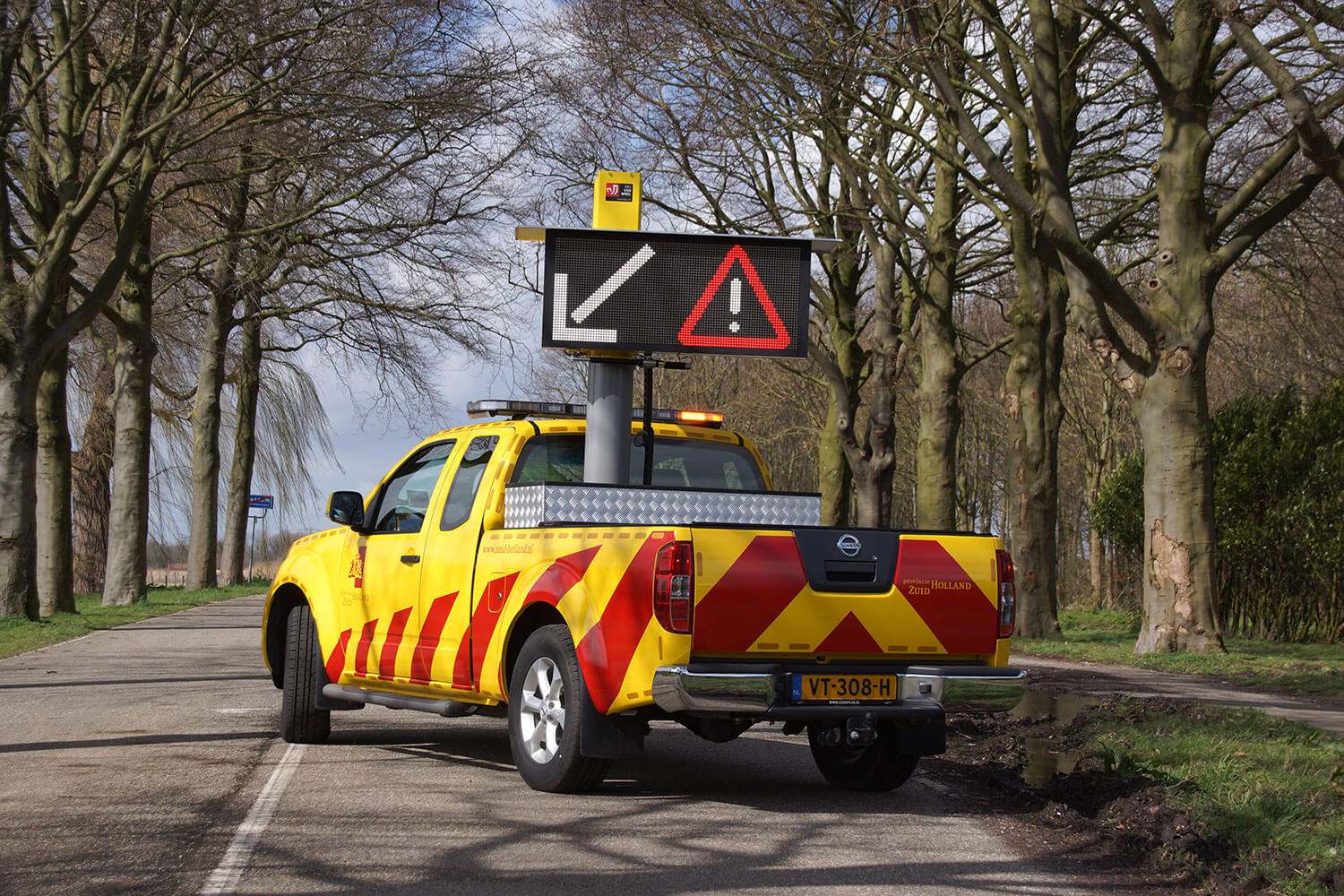 |
Pickup truck with a mobile sign. Photo: Ebovanweel |
Mobile sign vehicles are typically positioned ahead of the work crew or stationed at a fixed point at the beginning of a traffic diversion. This allows drivers to proactively adjust their speed, thereby limiting sudden braking situations. In many countries, these vehicles integrate GPS and remote control systems, enabling operators to change warning content based on the construction phase or real-time traffic conditions.
When performing highway maintenance, the typical formation often consists of three layers: the mobile sign vehicle in the outermost position, followed by the shadow vehicle acting as a safety buffer, and finally, the main maintenance vehicle. These vehicles maintain continuous communication via walkie-talkie or GPS, moving at the same speed to create a mobile safe work zone along the entire section of road.
Ho Tan