Automotive giants BMW, Toyota, Bosch, and energy group Repsol have launched a six-month testing program, starting in July, to explore a new solution for sustainable mobility. This initiative aims to prove that renewable gasoline can reduce carbon emissions in internal combustion engine vehicles without requiring major technological changes. The project comes as Europe maintains its focus on sustainable automotive solutions, contrasting with the US market's renewed interest in large-displacement engines.
Approximately 20 BMW and Toyota vehicles will participate in the trial, running exclusively on Repsol's renewable gasoline, Nexa 95. Bosch will contribute its Digital Fuel Twin technology to monitor the fuel's journey throughout the supply chain and verify that the participating vehicles operate on standard-compliant renewable fuel. Spain was chosen as the testing location because Repsol operates the country's only public fueling station network that supplies 100% renewable gasoline.
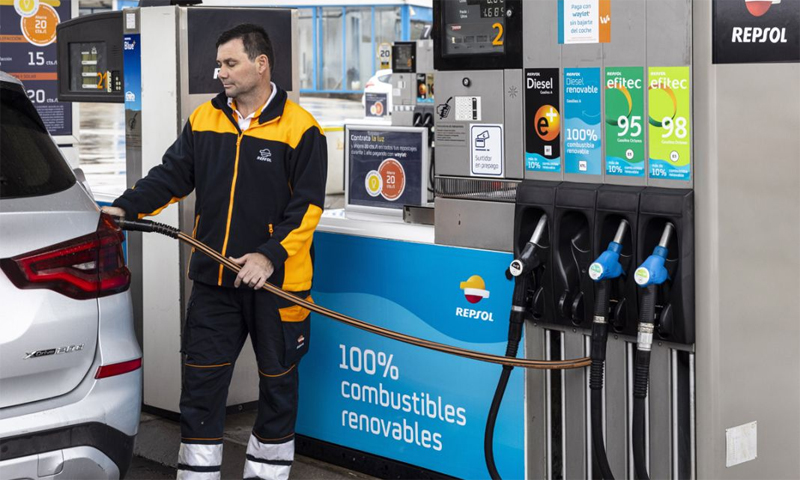 |
A car pumps renewable gasoline at a Repsol fuel station in Spain. Photo: Motor16. |
A car pumps renewable gasoline at a Repsol fuel station in Spain. Photo: Motor16.
The project focuses on three objectives: First, it seeks to demonstrate that renewable gasoline can be distributed directly through existing public fueling stations. Second, it aims to validate Bosch's digital certification system for this fuel. Finally, the partners intend to prove that current gasoline-powered car models can immediately switch to using renewable gasoline without mechanical modifications or new infrastructure development.
Renewable gasoline is chemically similar to conventional market fuels, but it is produced from renewable sources such as used cooking oil, agricultural waste, and other organic by-products, rather than crude oil. This allows current engines to operate normally without adjustments. While combustion still produces CO2 from the exhaust, manufacturers argue that the total carbon emissions over the fuel's life cycle are significantly lower. This is because the carbon originates from recently living organisms, not from fossil crude oil buried for millions of years.
The timing of this project is strategic, aligning with ongoing discussions within the European Union (EU). While the EU remains committed to its goal of stopping new internal combustion engine vehicle sales by 2035, policymakers are debating whether to exempt models running entirely on carbon-neutral fuels. BMW has long advocated that Europe should not "put all its eggs in one basket" with electric vehicles. Toyota agrees, suggesting renewable fuels could bridge a gap if the EU's 2035 net-zero emissions target faces challenges.
The car manufacturers will share data from this test with European lawmakers. This aims to promote regulations that recognize vehicles running entirely on renewable fuels.
My Anh (according to Automotive World)