Many families wonder about the best place to install a child car seat in their vehicle. Research indicates that the middle position in the back seat provides the best protection for children in a collision. This is because it places the child farthest from the sides of the vehicle. However, not all car models can securely accommodate a child seat in this central position, often due to limitations in ISOFIX anchor points or the design of the rear seats.
In practice, most users choose to install the child seat either behind the driver's seat or behind the front passenger seat. Each option presents distinct advantages and disadvantages.
Behind the front passenger seat
This position is often suitable for many families in Vietnam when only one child car seat is installed. In vehicles with left-hand drive, the rear right door opens towards the sidewalk if the driver parks correctly with the flow of traffic. This allows adults to safely buckle or unbuckle children directly from the sidewalk, minimizing the child's exposure to moving vehicles.
Additionally, placing the child seat behind the front passenger seat allows the driver to easily observe the child through the rearview mirror. This position also provides the driver with more room to adjust their seat, which is particularly beneficial in cars with limited rear seat space or when the driver is tall.
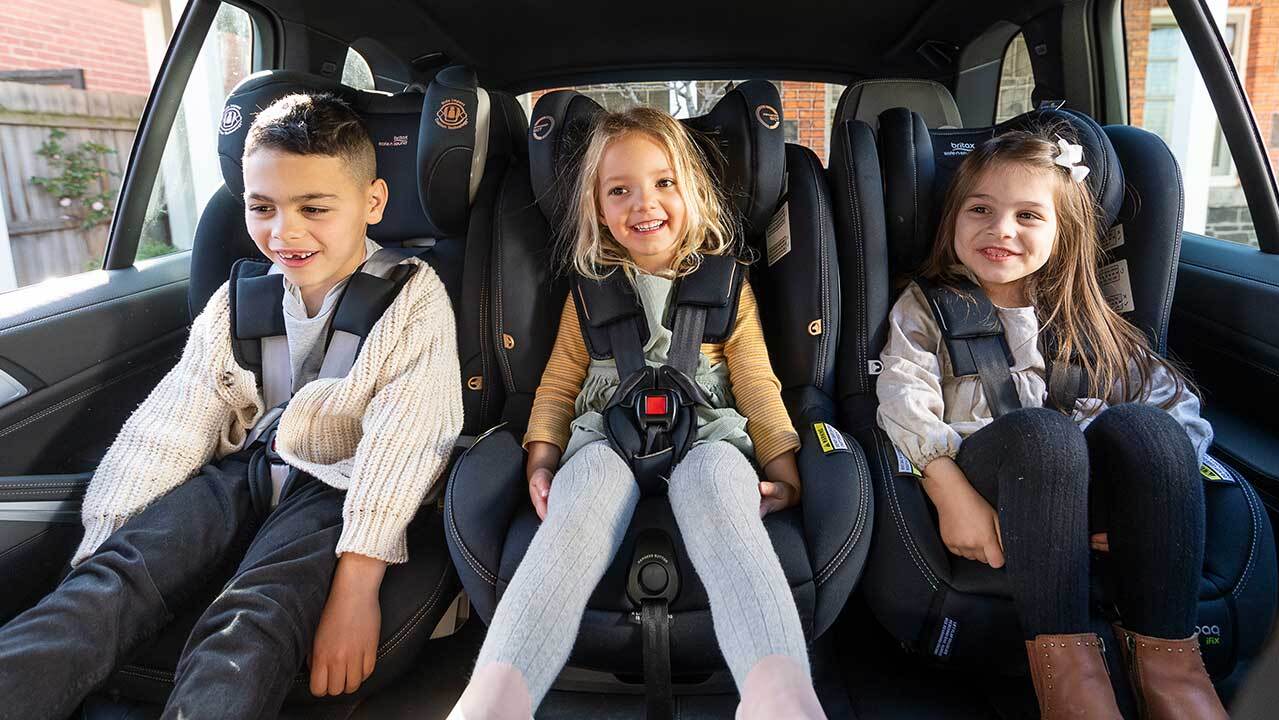 |
Children sitting in three positions in the back seat. *Photo: Turbo*
A drawback of this position is that the child seat occupies space, making it less convenient for other adults to enter or exit the back seat from the sidewalk side. This can be especially challenging on busy streets or when there is limited space to fully open the door. Therefore, when opening the right rear door to exit the vehicle, adults must carefully check for oncoming traffic to avoid potential collisions.
Behind the driver's seat
The primary advantage of this position is that adults in the back seat can enter and exit the vehicle from the sidewalk side if the child seat is placed behind the driver. This facilitates easier access and reduces the need to open a door directly into the path of traffic.
However, a disadvantage arises when parking curbside: it becomes less convenient to get children in or out of the car if adults wish to transfer them to the right-side door for enhanced safety. If children are taken out from the left rear door, both adults and children will be closer to the flow of traffic, necessitating careful observation to prevent collisions.
The recommendations above apply to situations where only one child car seat is installed. For families with two or more children, the positioning of the seats depends on several factors: the number of seats, the design of the rear bench, the availability of ISOFIX anchor points, and the specific guidelines provided by both the car manufacturer and the child car seat manufacturer.
Ho Tan