Regarding the ongoing debate among many VnExpress readers about whether a driver traveling at 120 km/h should yield to a vehicle behind signaling to pass, Colonel Nguyen Quang Nhat, Head of the Department for Propaganda and Dissemination of Traffic Order and Safety Laws, Traffic Police Department, provided guidance on handling this situation.
No concept of overtaking on expressways
Readers often ask, "If I am driving at 120 km/h and a vehicle behind me signals and flashes its lights to pass, do I have to yield?" However, according to the 2024 Law on Road Traffic Order and Safety, "overtaking" is a term exclusively for roads with only one lane in each direction, where the trailing vehicle moves to the left to pass the vehicle ahead. Expressways have at least two lanes in each direction, so the concept of overtaking does not apply. The exception is certain expressway sections that narrow to a single lane per direction, where "no overtaking" signs are posted.
Therefore, on expressways with two or more lanes per direction, vehicles operate according to lane usage regulations. Accordingly, drivers can proactively use the appropriate lane and maintain the regulated speed. If a vehicle ahead is moving slowly, the driver can switch to the right lane. When changing lanes, it is essential to use adequate signals, avoid changing two lanes simultaneously, and ensure a safe distance from both front and rear vehicles.
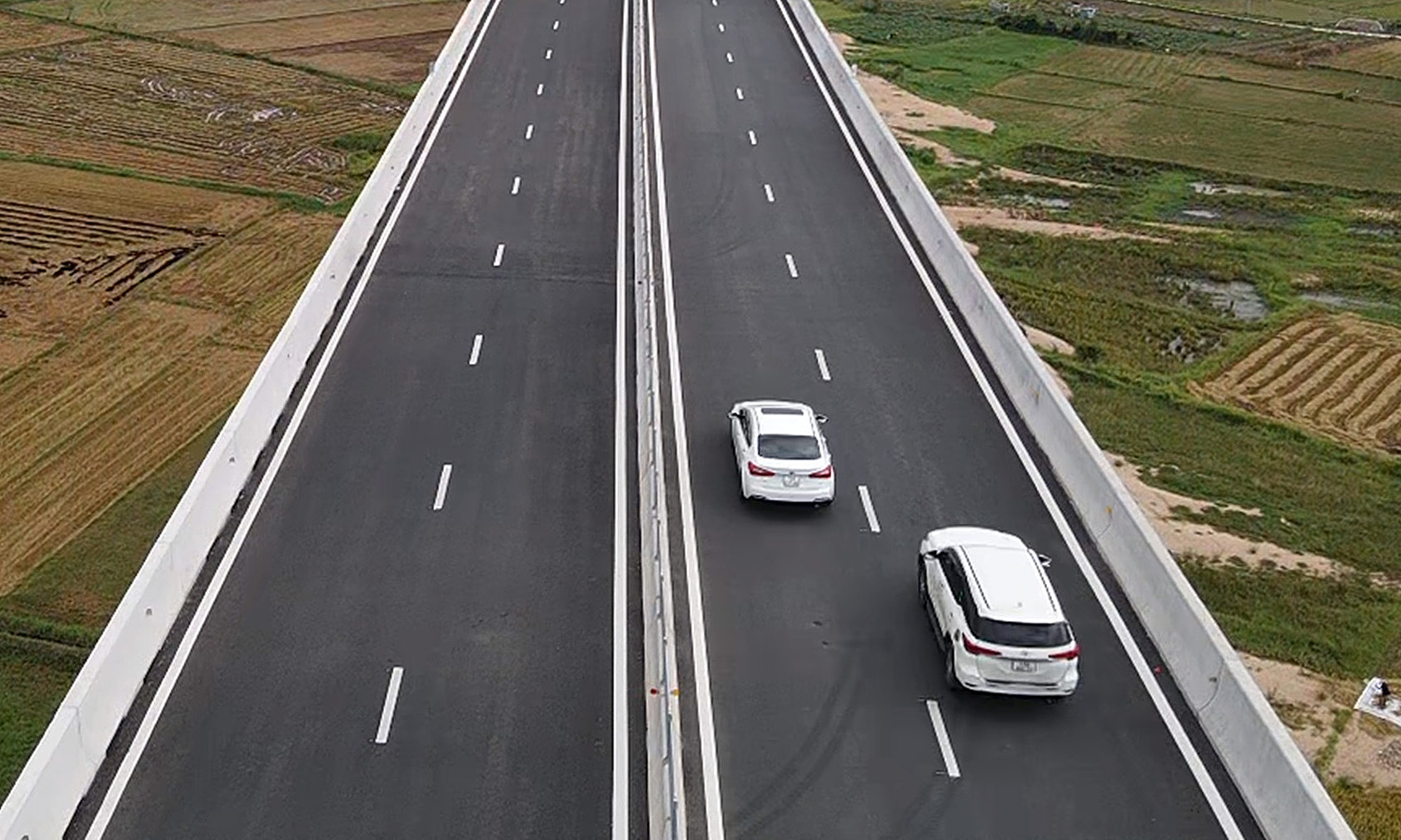 |
Vehicles traveling on the North-South expressway, over Ky Lo bridge, Dak Lak. Photo: Tran Hoa
How to yield when driving in the left lane
The law mandates that vehicles traveling at lower speeds must keep to the right in their direction of travel, unless other vehicles in the same direction are exceeding the speed limit. Therefore, if a driver does not need to go fast, or if their driving skills or vehicle's technical limits do not permit it, they should use the right lane, yielding the left lane to faster vehicles.
If a driver is traveling at 80-90 km/h in the left lane, where the maximum speed is 120 km/h, they must switch to the right lane. However, if a driver is already traveling at the maximum speed of 120 km/h in the left lane and a vehicle behind flashes its lights, the driver is not breaking the law by staying in that lane, provided the vehicle behind is not an emergency vehicle on duty.
A representative from the Traffic Police Department added that this interpretation aligns with current legal regulations. However, from a perspective of driving culture and ethics, if safe to do so, drivers should still yield. The vehicle behind might be in a special situation, such as transporting someone for emergency medical care, or experiencing a technical issue like a stuck accelerator or brake failure. Therefore, yielding the lane when possible is also a good way to ensure one's own safety.
Regarding the issue of many drivers hogging the left lane, Colonel Nguyen Quang Nhat stated that recently, the Traffic Police Department, in conjunction with the Road Department (Ministry of Construction), reorganized traffic by prohibiting passenger cars and trucks from using the first lane of expressways, thereby clearing the way for faster vehicles.
Currently, Vietnamese law does not specifically mandate that the left lane of an expressway is exclusively for passing; this is merely a recommendation from authorities. In the future, the Traffic Police Department is researching to advise higher authorities on amending the law to include more specific regulations regarding passing lanes on expressways.
While awaiting the completion of infrastructure and the legal framework, the Traffic Police Department advises expressway users to comply with regulations on maximum and minimum speeds, safe distances, and rational lane usage. Slower vehicles should keep to the right to clear the left lane, thereby facilitating efficient traffic flow.
Nguyen Vu