After a period of strong growth, China's car market faces a significant crisis. New car sales have sharply declined this year, potentially making 2026 the auto industry's worst year since 2021.
Data from China's National Bureau of Statistics shows transport energy costs surged 15,3% year-on-year in June, compared to the same period in 2025. This surge led to a sharp drop in demand for internal combustion engine vehicles.
The China Passenger Car Association (CPCA) reported a 20,2% decline in vehicle deliveries to customers during the first half of the year, totaling 8,7 million units. The association projects full-year sales to reach approximately 20,4 million units, marking a 14% decrease from 23,7 million units in 2025.
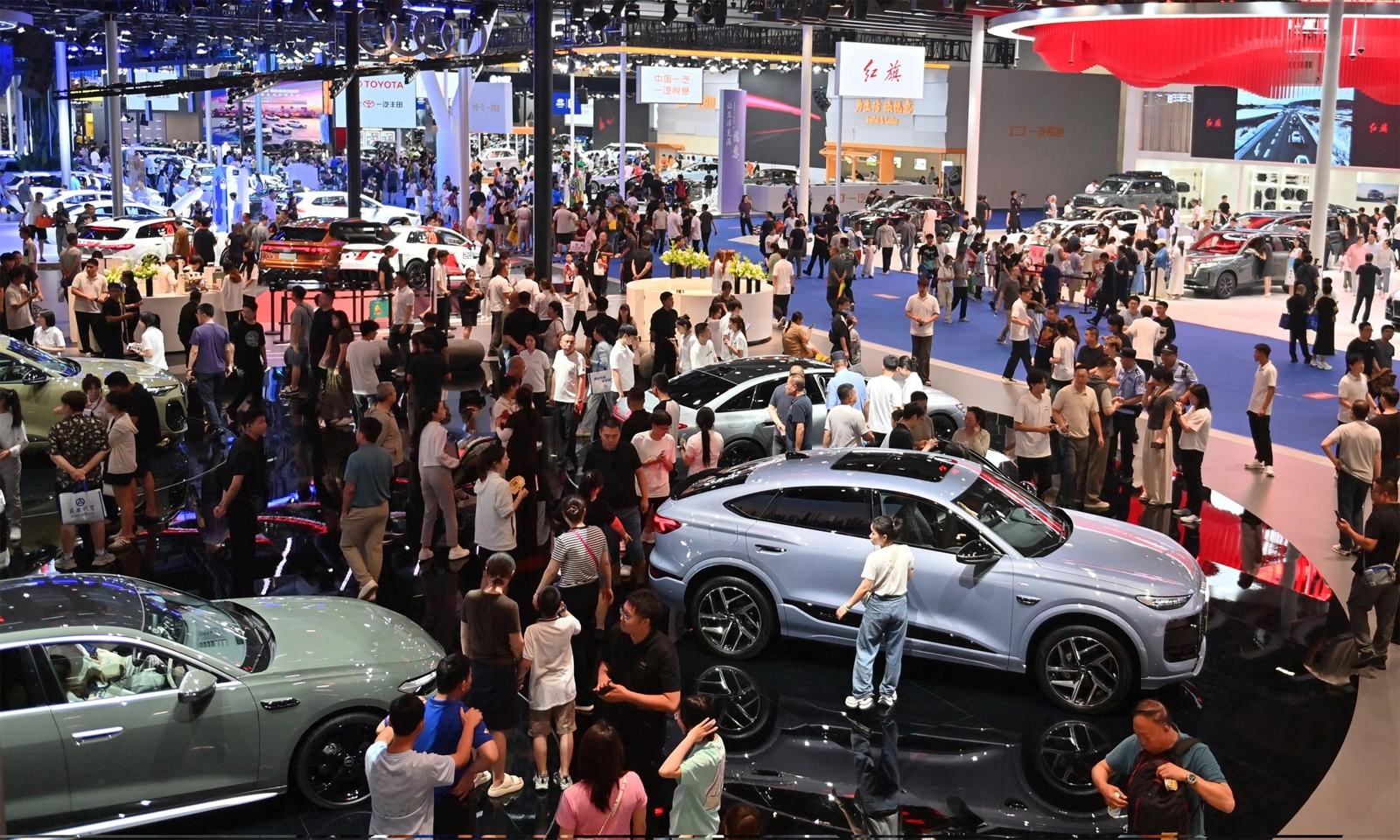 |
Visitors at the Changchun Auto Show, China, held from 11-20/7. Photo: Chinanews |
However, this projection may be overly optimistic. Xiao Feng from Citic CLSA told CNBC that full-year sales could decline by up to 20%. He anticipates new energy vehicles (NEVs), which include pure electric and plug-in hybrid cars, will only experience a slight decrease of about 5-6%.
In June alone, gasoline vehicle sales dropped 39% compared to June 2025, accounting for 78% of the total market decline. This significant reduction stems from escalating fuel prices, influenced by the Middle East conflict.
Furthermore, the Chinese government began scaling back some electric vehicle support policies. Rising lithium costs also drove a sharp increase in chip prices, a critical component in modern electric vehicles.
The situation is expected to improve next year. Feng forecasts a strong recovery in consumer purchasing power, driven by the surge in auto exports from domestic car manufacturers.
Amidst market volatility, a wave of large-scale consolidation and mergers is inevitable. The Citic CLSA expert predicts that by 2030, only 7-8 major electric vehicle groups will remain in China.
He predicts American automakers will struggle to survive in China's fiercely competitive car market, leaving only domestic manufacturers like BYD, Geely, and Leapmotor, along with Germany's Volkswagen and Japan's Toyota.
Even with Volkswagen's pivot to electric vehicles in China, the company reported a 25,9% decrease in deliveries during the first half of 2026 compared to the same period in 2025.
Analysts emphasize that maintaining large-scale sales is crucial for survival in the current electric vehicle race.
Feng estimates that a Chinese automaker needs annual sales of 500,000 units to break even, one million units for sustainable profit, and two million units to achieve maximum economies of scale. Smaller manufacturers failing to meet these targets will be "almost eliminated from the market".
My Anh