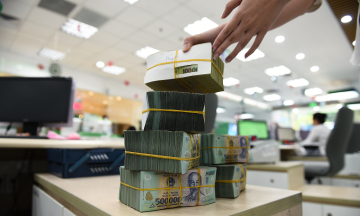
According to data released by the State Bank of Vietnam, the average lending interest rate in August reached 10.7%, an increase of 0.2 percentage points from the previous month. This rate marks a rise of approximately 3 percentage points compared to loans disbursed a year ago.
State-owned banks, including BIDV and Vietcombank, reported average lending rates of about 7.4-7.6%. Meanwhile, some private banks such as Eximbank, KienlongBank, and MBV showed rates ranging from 8.4-9.5%.
However, a VnExpress survey revealed that actual rates are significantly higher. The "Big4" group currently lends at rates between 9-10.5%, while private banks can charge up to 12%. Actual rates depend on several factors: loan term, purpose, collateral, and credit history.
Short-term lending rates for priority sectors, such as export, agriculture, supporting industries, small and medium-sized enterprises, and high-tech applications, also edged up in August, reaching the 4% cap set by the State Bank of Vietnam. This marks the first time in many years that banks have loaned to priority sectors at the maximum allowable interest rate.
Analysts at SSI Securities Company note that banks are increasingly shifting their loan structures towards medium and long-term, moving away from short-term loans, as interest rates remain high. Home loan disbursements have slowed, even among banks with ample credit limits and strengths in this segment. This trend is understandable given that popular floating loan rates hover around 12-14%.
Lending interest rates show no signs of easing, despite Prime Minister Le Minh Hung's request mid-last month for banks to reduce costs, stabilize rates, and genuinely lower lending charges to support individuals and businesses. This indicates that banks still face pressure to protect profit margins amidst persistently high capital mobilization costs.
Statistics from the State Bank of Vietnam show that the highest deposit interest rate for 6-12 month terms reached 8%, while terms longer than 24 months climbed to 8.1%, both increasing by 0.2 percentage points compared to the previous month. However, actual transactions often exceed publicly listed rates, as many banks offer additional interest to new customers or during weekends and "double-day" promotions.
Six-month term rates are currently around 8.5-9.3%. Negotiated rates have also increased, surpassing 9.7% for deposits exceeding one billion dong over 12 months. Staff at some smaller banks reported that interest payments could approach 10% for deposits over 10 billion dong, typically with a requirement against early withdrawal.
Banks are also accepting higher capital costs to mobilize funds through debt instruments, including certificates of deposit and bonds. The average interest rate for bank bonds issued last month, according to VIS Ratings, was 8.7%.
The high interest rate environment primarily stems from an imbalance between credit growth and mobilization. The gap, which at times neared 2,000 trillion Vietnamese dong, has compelled banks to compete fiercely to attract savings deposits. This is supplemented by mobilizing additional funds through issuing debt instruments, interbank borrowing, and State Treasury deposits.
Several analysis groups lean towards the possibility that both deposit and lending interest rates will not cool down in the short term, especially as credit demand tends to accelerate towards the year-end.
According to experts from SSI Securities Company and Yuanta Vietnam, central banks will likely need to maintain current interest rate levels or continue to increase them if inflation persists. This development adds pressure on domestic liquidity, potentially keeping commercial bank interest rates high.
Phuong Dong