Starting June 1, E10 RON 95-III gasoline will be widely available, replacing mineral RON 95-III gasoline in the market. E5 RON 92 gasoline will continue to be sold until the end of 2030. According to Nguyen Sinh Nhat Tan, Deputy Minister of Industry and Trade, the parallel sale of mineral gasoline and bio-fuels in recent times aimed to help the market gradually adapt and support businesses in completing their distribution infrastructure.
However, citing international experience, the Deputy Minister explained that maintaining too many fuel types for a prolonged period creates inefficiencies, such as increased logistics, storage, and distribution costs. This also poses challenges for retail businesses and reduces the effectiveness of the green energy transition.
According to the Ministry of Industry and Trade's leadership, the roadmap for transitioning to E10 gasoline was thoroughly assessed by regulatory agencies, ensuring it is not abrupt. In fact, under the Prime Minister's Decision 53/2012, E5 bio-fuel was widely sold starting in 2018. E10 gasoline was initially slated for implementation by the end of 2017 but was not carried out.
"The transition to E10 gasoline from June is the next step to complete the bio-fuel roadmap we have established", Deputy Minister Tan shared on 27/5.
Furthermore, shifting to bio-fuels helps achieve green energy development goals and reduces reliance on fossil fuel sources. This solution also promotes domestic bio-fuel consumption, creating a sustainable market for agriculture and enhancing energy autonomy.
Deputy Minister Tan affirmed that this conversion roadmap does not impose restrictions on people's choices. Instead, it aims for sustainable development, energy security, and the fulfillment of international commitments on emission reduction.
He also stated that E10 gasoline underwent research, testing, and evaluation before its widespread release. The Ministry of Industry and Trade, along with experts and associations like the Vietnam Automobile Manufacturers' Association (VAMA) and the Vietnam Association of Motorcycle Manufacturers (VAMM), collaborated to assess vehicle compatibility.
Results indicate that most automobiles and motorcycles currently operating in Viet Nam can use E10 as recommended by manufacturers.
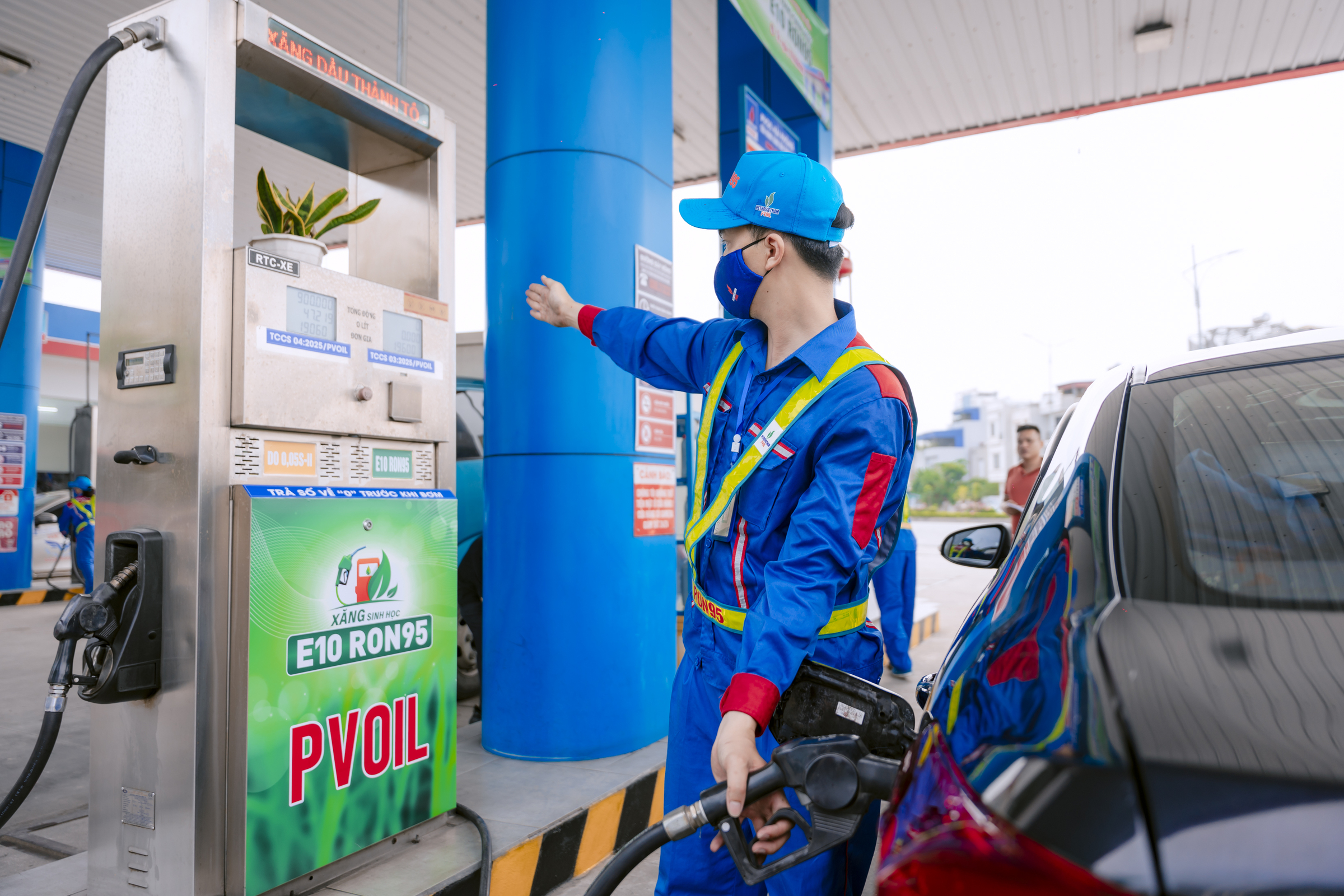 |
A staff member at a gas station pumps fuel for a customer. Photo: PVOIL |
Internationally, countries such as the US, Brazil, Thailand, and the Philippines have widely sold E10 gasoline for many years. Viet Nam also conducted tests of this fuel type within the distribution systems of several major companies starting in August 2025.
"To date, no scientifically-backed reports or official technical conclusions have indicated that E5 or E10 gasoline commonly affects vehicle engines", Mr. Tan said.
For some older or less-maintained vehicles, regulatory agencies recommend regular checks of the fuel system and using the fuel type specified by the manufacturer to ensure efficient operation. Therefore, E5 RON 92 gasoline will continue to be sold to serve older vehicle models not fully compatible with E10.
"Bio-fuel development must align with technical safety, quality, and consumer rights", he stated, adding that the Ministry will continue to provide transparent information to reassure the public.
The Ministry of Industry and Trade announced that preparations for the E10 gasoline roadmap are largely complete, covering ethanol supply, blending capacity, and retail distribution systems, to prevent market disruptions.
Regarding supply, with a gasoline consumption demand of about 1 million m3 per month, approximately 100,000 m3 of E100 ethanol is required. Of this, about 25,000 m3 is produced domestically each month, with the remainder imported by businesses for blending.
In retail, PVOIL began selling E10 bio-fuel at 1,000 retail stores nationwide in mid-May. Meanwhile, Petrolimex completed the conversion of its entire system to sell this fuel type by 20/5.
Currently, half of the petroleum wholesalers (13 traders) have invested in bio-fuel blending systems with a total capacity exceeding 1 million m3 per month, surpassing the country's consumption needs. Additionally, Binh Son Refining and Petrochemical Company, which operates the Dung Quat oil refinery, can blend E5 and E10 gasoline at a capacity of 70,000-90,000 m3 per month starting in June if required.
To encourage public adoption of E10, the Ministry of Industry and Trade is proposing reductions in special consumption and environmental protection taxes. This aims to create a sufficiently attractive price difference between bio-fuel and mineral gasoline.
Phuong Dung