Rajesh Achanta, former Vice President of Supply Network Operations for Asia, the Middle East, and Africa at P&G, noted that many businesses face a dilemma in the volatile global economy: reduce inventory to free up cash flow or maintain higher stock levels to protect their supply chain. This decision, seemingly straightforward, can directly impact a business's operational capability and growth.
 |
Rajesh Achanta, former Vice President of Supply Network Operations for Asia, the Middle East, and Africa at Procter & Gamble. *Photo: Courtesy of the interviewee*
He stated that inventory management is one of the most challenging problems for scaling businesses. Inadequate inventory levels can strain cash flow or disrupt market responsiveness. Inventory directly affects a business's free cash flow.
Excessive inventory ties up capital in storage, reducing liquidity. Conversely, aggressive cuts can lead to stockouts when demand rises or supply chains face disruptions. Poor inventory management can deplete a company's cash and lead to closure. However, focusing solely on reducing inventory might optimize balance sheets but leave no products to sell.
"Therefore, inventory decisions are always a balancing act between cost optimization and safeguarding market serviceability", Rajesh Achanta said.
He also noted that "inventory management is a science, not an art", yet many business leaders still make inventory decisions based on experience or intuition. Following periods of stock shortages, businesses often significantly increase inventory. Conversely, under cash flow pressure, they tend to deeply cut inventory to free up capital. This approach often leads to unbalanced decisions.
He emphasized that inventory management requires analytical models, not isolated experience. The appropriate inventory level should be determined by various factors: supply chain characteristics, supply and demand volatility, and each business's operating model. Consequently, there is no fixed inventory number applicable to all organizations. A fast-moving consumer goods company with a global supply network will define inventory differently from a make-to-order business or one heavily reliant on imported raw materials.
Beyond using internal models, Rajesh suggested businesses should consult data from peers to understand their inventory position relative to the market. Publicly listed companies often disclose inventory information in their annual reports, providing a valuable reference.
He cited Procter & Gamble as an example, where total inventory typically accounts for about 5-6% of sales. This figure includes finished goods, packaging materials, and work-in-progress. He noted this is not a universal standard but serves as a benchmark for market comparison.
If a business's inventory level is significantly higher than competitors in the same industry, it may indicate opportunities for operational efficiency improvements. Conversely, if competitors maintain low inventory but achieve stable growth, businesses should investigate the operational methods enabling such results.
Rajesh also argued that inventory is not solely an operations or supply chain issue. In fact, inventory levels reflect numerous decisions across an entire organization. The accuracy of sales forecasts, product strategies, promotional plans, and transportation capabilities all have a direct impact.
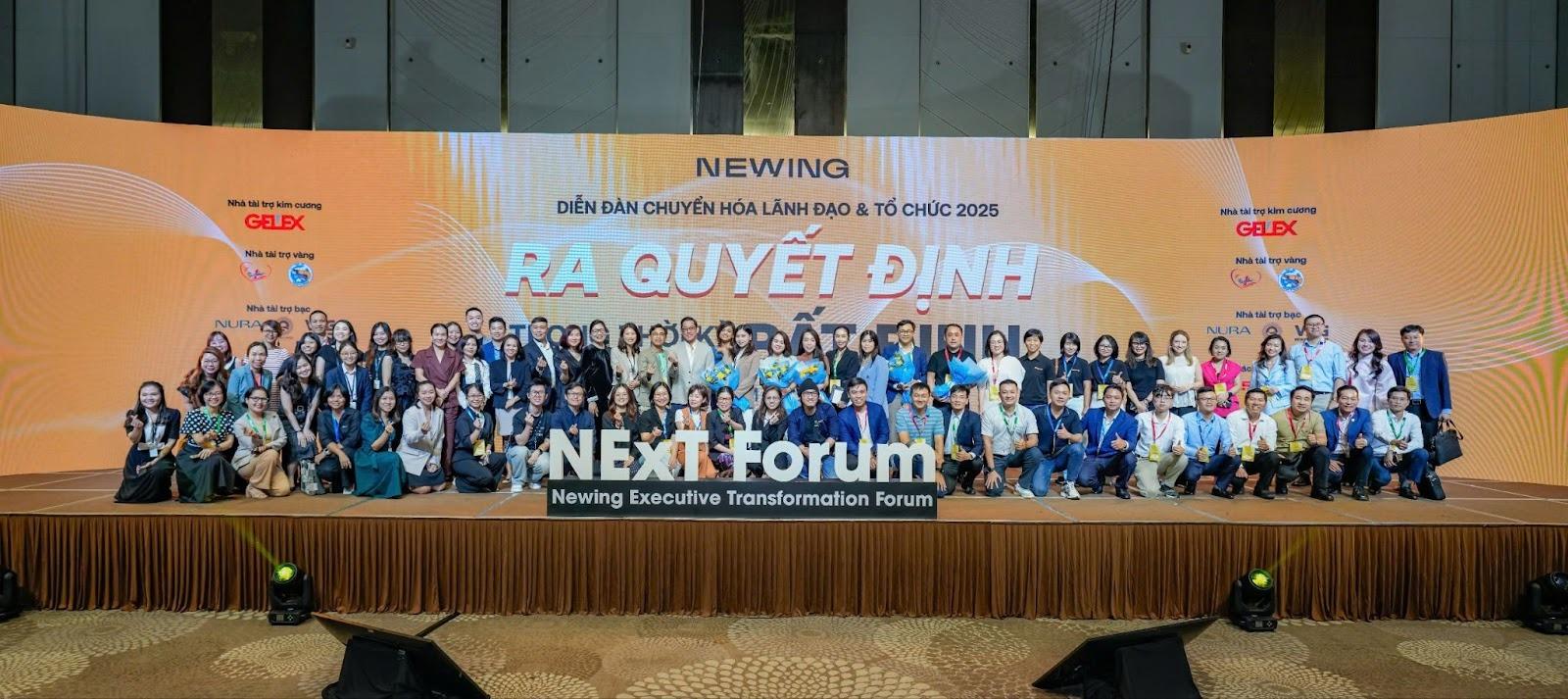 |
Newing and VPBank organize SME Forum 2026. *Photo: Newing, 2/3*
Effective inventory management therefore demands coordination among business, finance, and operations departments. When these departments align towards shared goals like revenue, profit, and cash flow, businesses are better positioned to establish appropriate inventory levels.
Small and medium-sized enterprises (SMEs) often have a decision-making speed advantage over large corporations. However, speed is only effective when coupled with clear direction. He likened SMEs to high-speed trains that can change course quickly, while large corporations resemble slower-moving, larger ships that typically follow stable routes.
"Success doesn't come from speed alone; it's crucial that speed is accompanied by the right direction. Therefore, leaders need to view operational decisions, including inventory, not just from a short-term quarterly perspective, but within the context of the business's long-term strategy", Rajesh stated.
Rajesh Achanta will share these inventory management insights at SME Forum 2026, themed "New Momentum for the Big Game", scheduled for 20/3 in TP HCM. Organized by Newing in collaboration with VPBank SME, the program expects to gather over 700 CEOs, founders, and business leaders, alongside representatives from multinational corporations. Discussion sessions will focus on practical lessons in operations, supply chain, and growth amidst economic volatility. Following the forum, the shared content is expected to evolve into in-depth application workshops and international study tours, supporting leaders in transforming management knowledge into concrete organizational actions.
SME Forum 2026 is part of a series of leadership forums initiated by Newing in 2022, featuring speakers who are operational leaders and experts directly managing and making large-scale decisions at corporations regionally and globally. Between 2022 and 2025, these forums convened over 800 CEOs and leaders from over 300 businesses, fostering an environment for exchanging modern management methods and practical lessons from business operations.
Hoang Dan