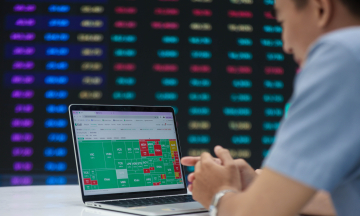
On 10/6, the State Bank of Vietnam announced the central exchange rate at 25,153 VND, a slight increase of 2 VND compared to yesterday. With a 5% margin, banks are permitted to buy and sell US dollars within the range of 23,895 - 26,410 VND.
Simultaneously, commercial banks listed US dollar prices around the permitted ceiling. Vietcombank bought and sold US dollars at 26,100 - 26,410 VND, BIDV listed at 26,130 - 26,410 VND, and Eximbank traded around 26,100 - 26,410 VND, a slight increase of 3 VND compared to yesterday.
The US dollar rate in the official market has shown a slight upward trend recently, but the increase is not significant compared to the beginning of the year.
Meanwhile, the US dollar rate on the free market has decreased and is now close to the official market exchange rate. Foreign currency exchange points buy US dollars around 26,300 - 26,310 VND per US dollar; the selling price trades around 26,330 - 26,360 VND. This level is 50-80 VND lower than bank rates.
Internationally, the US dollar Index, which measures the strength of the greenback, has strengthened by about 1.9% over the past one month. Compared to the beginning of the year, the US dollar Index has risen by approximately 1.7%.
Analysts at Vietcombank Securities (VCBS) believe the USD/VND exchange rate continues to face upward pressure during this period. The Federal Reserve's (Fed) slower-than-expected interest rate cut trajectory tends to strengthen the US dollar.
Additionally, the risk of imported inflation requires monitoring, as energy prices and input costs for certain imported goods may remain elevated. These factors increase import values and businesses' demand for foreign currency payments.
However, according to VCBS, exchange rate pressure remains low due to several supporting factors. Foreign direct investment (FDI) disbursement continues positively and is expected to further accelerate. Export growth is anticipated to pick up in the coming months as manufacturing enters the preparation phase for second-half orders.
According to VCBS, a trade deficit of nearly 14 billion USD was recorded in the first five months of the year, primarily due to significant imports of raw materials, machinery, equipment, and components (mainly by the FDI sector). This indicates relatively positive input demand for production and export. VCBS expects these imports to transform into export goods after a certain delay, thereby supporting foreign currency supply in the near future.
Quynh Trang