During the government's regular meeting on 3/8, Prime Minister Le Minh Hung instructed the Ministry of Finance to propose tax measures to boost production and business activities, especially for small and medium-sized enterprises, individuals, and business households. The ministry must promptly research and report to the National Assembly on amending the Law on Corporate Income Tax, aiming to reduce taxes for these entities, effective immediately this year.
Additionally, the Prime Minister requested consideration of including individuals and business households within the scope of the draft Law on Small and Medium-sized Enterprise Development. This aims to create mechanisms encouraging business households to transition into enterprises, particularly one-person enterprise models.
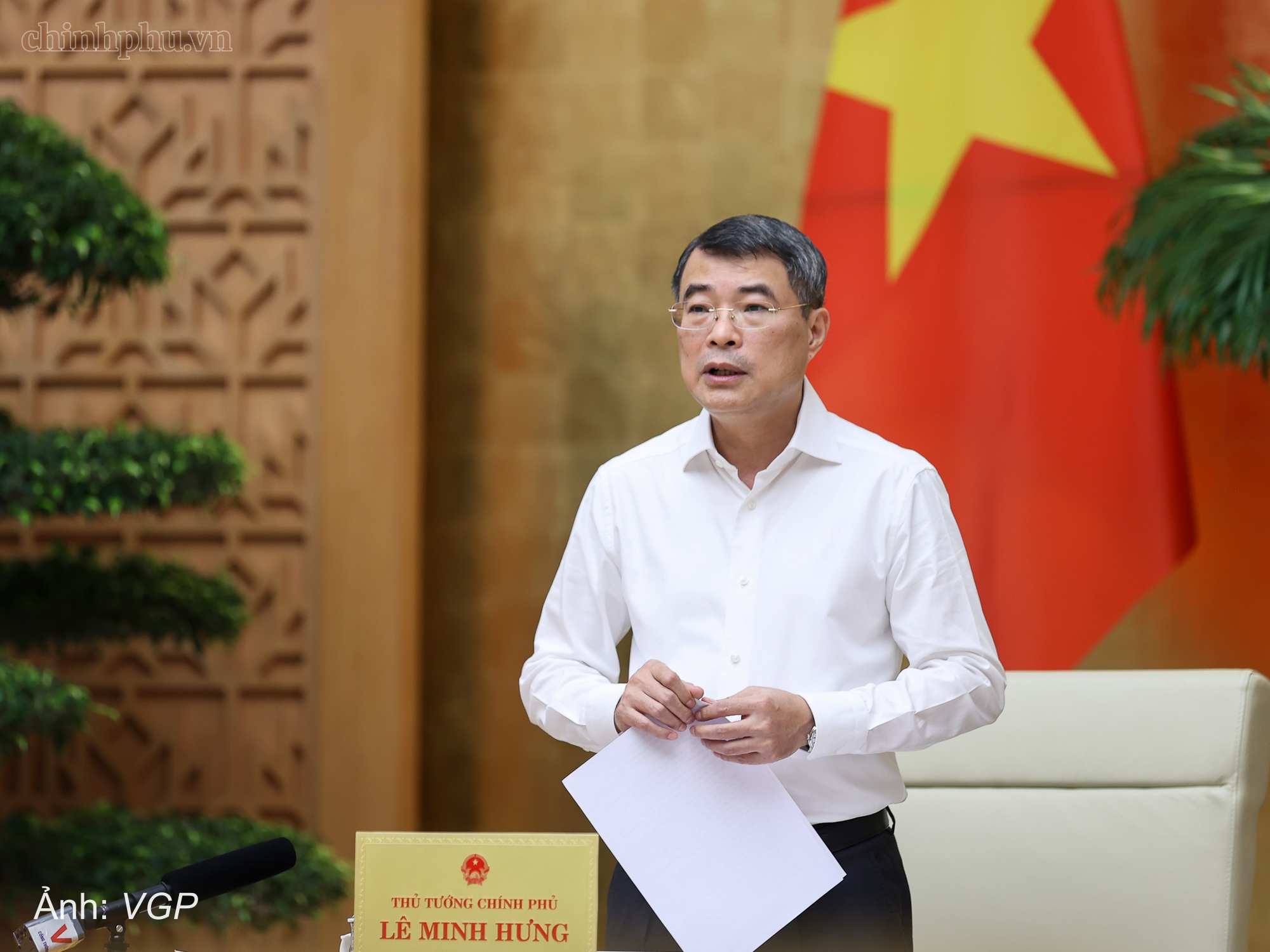 |
Prime Minister Le Minh Hung speaks at the regular meeting on 3/8. Photo: VGP
The government leader's directive aims to stimulate production and business amid economic pressure to maintain double-digit growth.
According to reports from the meeting, macroeconomic stability continued through the first 7 months of the year. The consumer price index (CPI) in July is estimated to have decreased by 0.12% compared to the previous month, with an average increase of about 4.39% over the 7-month period. State budget revenue reached over 1.83 trillion VND, equivalent to 72.5% of the annual estimate.
Public investment disbursement reached approximately 425.3 trillion VND, accounting for 41.9% of the plan, which is higher than the same period last year in both absolute value and implementation rate. Meanwhile, newly registered foreign direct investment (FDI) exceeded 38 billion USD, marking a 58% increase. Import-export turnover for the first 7 months is estimated at nearly 660 billion USD, up 28.1% year-on-year.
Industrial production remained a bright spot, with the industrial production index (IIP) in July increasing by 14.5%—the highest in many years. Fruit and vegetable exports surpassed the 1 billion USD mark in one month for the first time, while international arrivals reached nearly 14 million, an all-time high.
However, the Prime Minister noted that the economy still faces challenges. The double-digit growth target necessitates both growth promotion and macroeconomic stability. Financial and monetary markets continue to face pressure regarding capital, interest rates, and liquidity, while import-export activities remain heavily dependent on the FDI sector. Many enterprises and business households continue to struggle, and the disbursement progress in some ministries, sectors, and localities has not met expectations.
According to the head of government, the macroeconomy will face challenges in the remaining months of the year, as global growth is projected to slow down and inflation risks may increase, while Vietnam enters the peak season for storms and floods.
To achieve the 2026 growth target, the Prime Minister instructed ministries, sectors, and localities to regularly update growth scenarios and ensure 100% disbursement of allocated public investment capital. The Ministry of Finance must pilot a scoring system for ministries, sectors, and localities based on public investment disbursement progress, continue to reduce specialized inspection costs, and finalize investment procedures for projects using medium-term capital.
The State Bank of Vietnam is tasked with managing monetary policy to stabilize interest rates, ensure system liquidity, reduce lending rates, and lower the cost of capital for the economy. Concurrently, the banking sector needs to control credit flow into risky sectors, handle bad debts, and restructure credit institutions.
The Prime Minister also assigned Deputy Prime Ministers to work directly with ministries, sectors, and enterprises to address difficulties and obstacles in their respective areas of responsibility.
In the industrial and trade sector, the Ministry of Finance, together with the Ministry of Industry and Trade, will research flexible adjustments to fuel tax policies based on market developments. The Ministry of Industry and Trade must promptly update Power Development Plan VIII and finalize a replacement decree on petroleum business, ensuring a supply of ethanol for blending E10 and E5 gasoline.
The Ministry of Construction is required to ensure progress on key projects such as the North-South high-speed railway, beltways in Ha Noi and Ho Chi Minh City, projects for APEC 2027, and Long Thanh International Airport. They must also promptly finalize the draft Law on Housing and Real Estate Business, review key projects for submission to the National Assembly (Ha Noi-Lao Cai-Hai Phong railway, Beltway 5, etc.).
Beyond economic tasks, the Prime Minister instructed ministries and sectors to complete action plans implementing the resolutions of the 3rd Central Committee conference before 10/8. Agencies should accelerate the development of draft laws for submission to the National Assembly in upcoming sessions, while continuing institutional reform, planning, digital transformation, science and technology development, and improving the efficiency of the administrative apparatus.
Phuong Dung