On 26/3, global spot gold prices closed down 126 USD at 4,377 USD per ounce. Prices recovered slightly on the morning of 27/3, reaching 4,384 USD.
The market's downturn was driven by a strengthening dollar and a rebound in crude oil prices. Investors expressed concern that rising prices would lead to sustained high global interest rates. Additionally, market participants are re-evaluating the prospects of a ceasefire agreement among parties involved in the Middle East conflict.
Jim Wyckoff, a senior analyst at Kitco Metals, predicted, "If the conflict persists, gold prices could continue to fall below 4,000 USD. Only when nations reach a ceasefire agreement and expectations for interest rate reductions return, can prices recover."
Gold, traditionally seen as a hedge against instability and inflation, becomes less appealing in a high-interest rate environment because it yields no fixed interest. Since the outbreak of the conflict, gold prices have decreased by 17%.
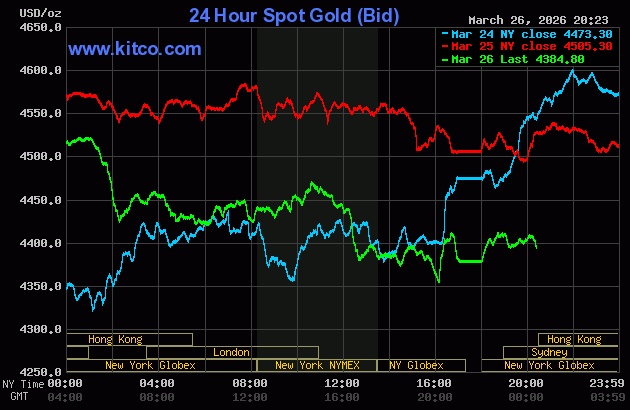 |
Global gold prices fell sharply on 26/3. Chart: Kitco.
In the crude oil market, Brent oil closed trading on 26/3 with a 5,7% increase, reaching 108 USD per barrel. US WTI crude also rose by 4,6% to 94,4 USD. The prospect of an extended Middle East conflict amplified investor concerns about potential supply disruptions.
US President Donald Trump stated that Iran had permitted 10 oil tankers to traverse the Strait of Hormuz, signaling a willingness to negotiate. However, a senior Iranian official, speaking to Reuters, characterized the US proposal to conclude nearly four weeks of hostilities as "one-sided and unjust."
US Special Envoy Steve Witkoff confirmed that Washington had presented Iran with a "15-point action list" to serve as a framework for negotiations to end hostilities. Earlier, Iranian Foreign Minister Abbas Araqchi indicated that Tehran was reviewing the US proposal, but emphasized that no formal negotiations on the matter had taken place.
The conflict has almost brought the flow of oil and gas through the Strait of Hormuz to a standstill. Previously, this critical waterway transported approximately 20% of the world's oil and liquefied natural gas (LNG). The International Energy Agency (IEA) has identified the current situation as the largest oil supply disruption in history. Brent crude oil prices have surged by over 50% in the past month.
Ha Thu (according to Reuters, Kitco)