On March 25, oil prices briefly dropped sharply following news that the White House had sent Iran a 15-point peace plan to end the conflict. However, conflicting messages and actions from Washington and Tehran subsequently pushed prices back up.
Currently, Brent crude oil remains around 105 USD per barrel, while West Texas Intermediate (WTI) trades above 92 USD, an increase of about 2%. "Optimism for a ceasefire has faded", noted Tsuyoshi Ueno, a senior economist at the NLI Institute for Research.
However, in the futures market, oil prices decrease significantly with longer delivery periods. Specifically, Brent and WTI crude for next-month delivery are priced at nearly 92 USD and 87 USD per barrel, respectively. This trend continues with prices becoming progressively cheaper each month, dropping to under 80 USD and 75 USD for contracts due at the end of the year.
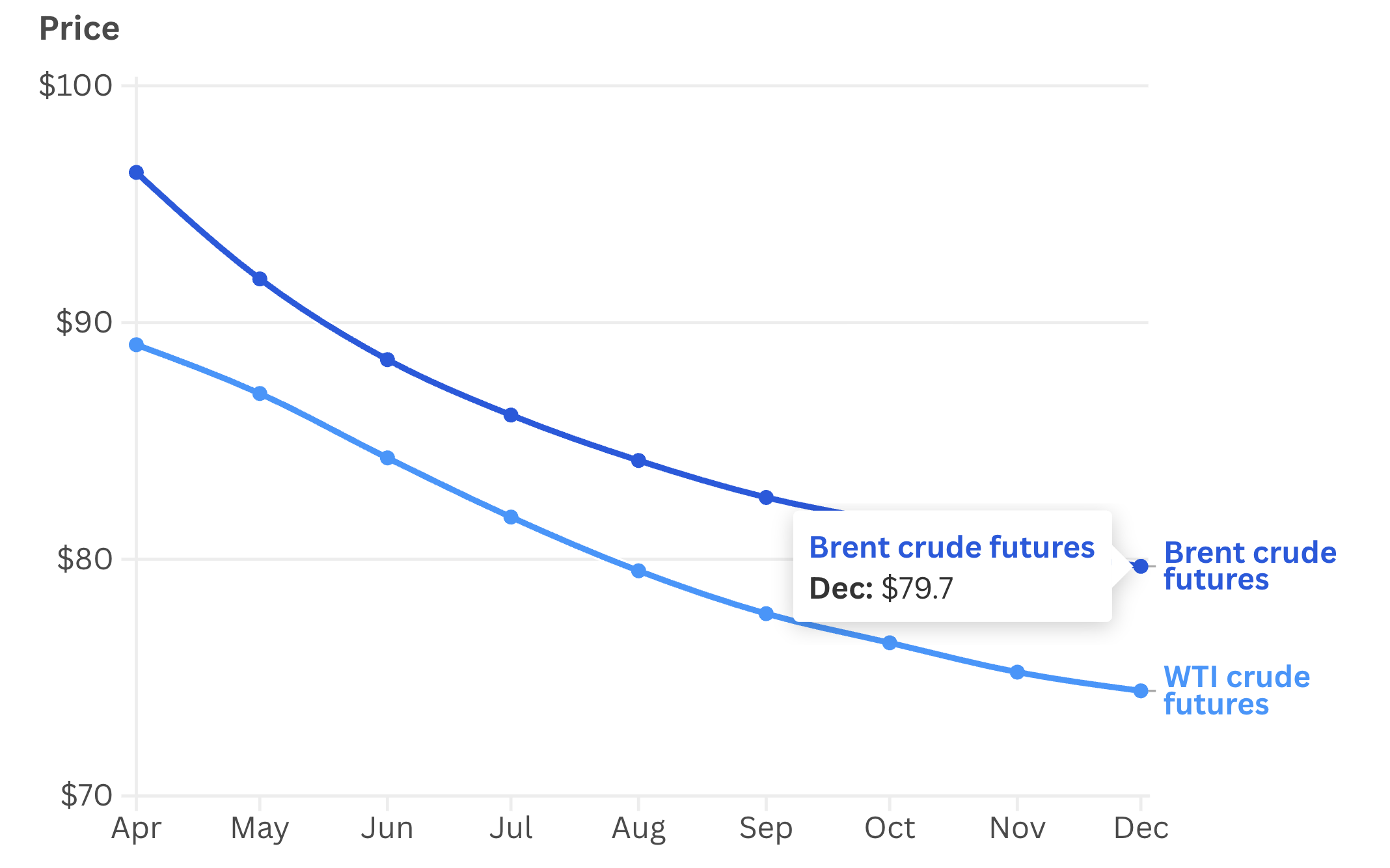 |
Oil futures prices (USD/barrel) for 2026 delivery months. *Source: CNBC*
This market condition is known as "backwardation", a phenomenon where short-term contracts trade at higher prices than long-term ones. According to Toni Meadows, Head of Investment at BRI Wealth Management, "backwardation" indicates that the market perceives the current oil price shock as temporary. "Otherwise, you would be paying more for future deliveries due to scarce supply", he stated.
Meadows believes it is difficult to assess the rationality of this expectation, given the conflicting information surrounding negotiations between the United States and Iran, and the still fragile situation. "We do not know the full story of what is happening. I think the market is simply being cautious", he said.
Katy Stoves, Investment Manager at Mattioli Woods, considers "backwardation" a normal market reaction. "I think people are expecting a reduction in hostilities. But at the same time, on another front, a more worrying aspect is that 'backwardation' can also signal a decline in demand", she noted.
The oil futures market is currently pricing in a "risk premium" of approximately 10-12 USD per barrel. For instance, the December Brent crude contract is currently 79.7 USD per barrel, which is 17% lower than the spot price but still about 10% higher than before the conflict.
Nevertheless, experts suggest that volatility and risks are not yet fully reflected, such as congestion in the Strait of Hormuz or the potential destruction of energy infrastructure. A single major attack could completely alter the situation, especially since restoring liquefied natural gas (LNG) facilities could take many years.
Toni Meadows of BRI Wealth Management stated that even one missile could change the entire dynamic. According to him, the issue is not solely about negotiations, as once infrastructure is destroyed, it will take years to restore operations.
Echoing this sentiment, Katy Stoves highlighted that much energy infrastructure has already been destroyed. "Even if some ceasefire agreement is reached, repairing and bringing those facilities back online will take time. I am not sure the market has fully accounted for that", she said.
By Phien An (based on CNBC, Reuters)