On 19/8, the US Treasury Department announced that the nation's "total public debt outstanding" reached 40.047 trillion USD. This new milestone indicates that US officials are struggling to control finances.
The 40 trillion USD mark is more symbolic. Experts and investors usually focus on the debt-to-GDP ratio—a measure reflecting the economy's fiscal resilience—or the portion of the debt held by the public (non-government entities).
Nevertheless, this remains a massive figure. At least in the short term, it could draw attention back to an issue economists agree on: an unsustainable fiscal trajectory. In 1981, the US national debt first reached 1 trillion USD. This time, the national debt of the world's largest economy hit 40 trillion USD less than 5 months after reaching 39 trillion USD.
According to analysts, the current national debt is much larger than the US's 2025 GDP, which is estimated at 31 trillion USD. The WSJ reported that this means even if all of America's annual income were used to repay debt—instead of paying wages, corporate profits, or investments—the government would still owe trillions of USD. Even if Elon Musk, the world's wealthiest person, used his entire net worth of nearly 1 trillion USD to help repay the debt, he would only contribute a tiny fraction.
The total government debt is also equivalent to the combined debt of all US households and businesses (excluding banks). On average, each US citizen currently bears a debt of over 117,000 USD.
Several factors contribute to the surge in US national debt. First, the nation's population is aging, and older individuals are living longer. This means the government must increase spending on social security and healthcare for the elderly. The financial resources for these programs are becoming increasingly precarious as there are not enough workers to support the rapidly growing number of beneficiaries.
Additionally, over the past few decades, the US Congress has passed numerous policy packages that both cut taxes and increased spending, including the Tax Cuts and Jobs Act of 2017 and the "One Big Beautiful Bill" (OBBB) of 2025 under President Donald Trump, along with several pandemic relief packages. These policies are projected to add trillions of USD to the federal debt in the coming years.
The US Federal Reserve's (Fed) aggressive interest rate hikes several years ago to combat inflation have forced the government to spend more on interest payments. This makes it difficult to fund other programs. "We are spending a huge amount of money paying interest on debt instead of investing in our future. Debt begets debt, creating a vicious cycle", Marc Goldwein, policy director at the CRFB organization, told CNN.
Although former Fed Chair Jerome Powell and others have warned that the US is on an "unsustainable fiscal trajectory", Congress has not yet committed to addressing this situation in recent years. This has prompted several credit rating agencies to downgrade US ratings.
 |
US national debt compared to other national figures. Chart: WSJ |
US national debt compared to other national figures. Chart: WSJ
Rising national debt impacts the bond market and various lending interest rates. As the US delves deeper into debt, investors demand higher risk premiums, leading to an increase in bond yields.
In the US, the yield on 10-year government bonds influences interest rates for home mortgages, auto loans, and business loans. Higher yields therefore tighten financial conditions, putting pressure on consumption and investment. High yields also mean higher government borrowing costs, further increasing interest payments.
"The 40 trillion USD debt doesn't just exist on government ledgers; it impacts the entire economy and people's wallets", Maya MacGuineas, president of the CRFB organization, stated on Reuters.
She added that the US government's increasing borrowing raises inflation risks. Concurrently, budget priorities become constrained, and the US becomes more vulnerable to domestic and international emergencies.
The US Treasury Department announced on 19/8 that it would increase long-term government bond buybacks in the coming months. Analysts suggest this move reflects the Trump administration's concerns about rising yields and their impact on the government's ability to repay debt, as well as consumer spending.
US 30-year and 10-year bond yields cooled down after surging during the 18/8 session.
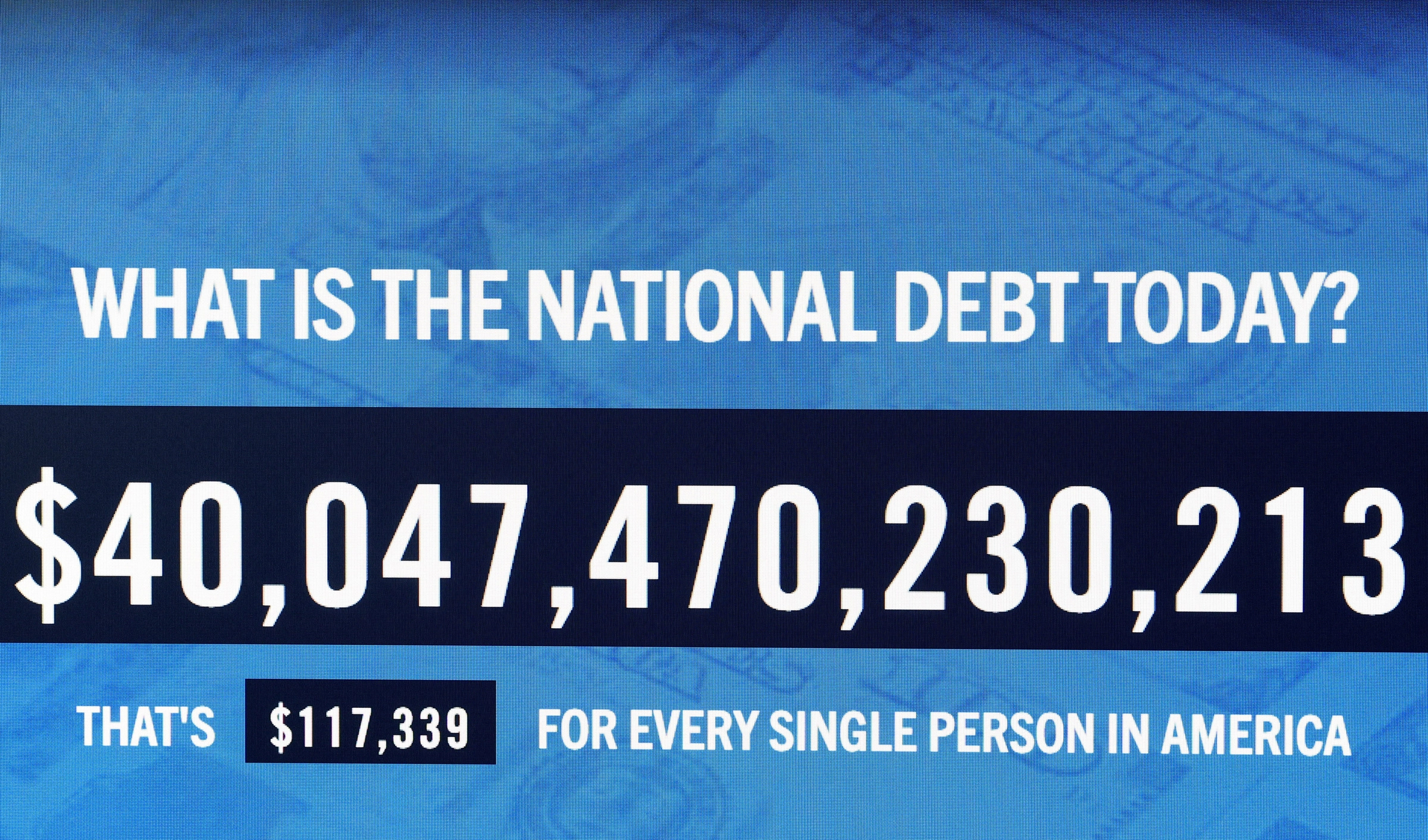 |
A screen displaying US national debt in New York City on 19/8. Photo: Reuters |
A screen displaying US national debt in New York City on 19/8. Photo: Reuters
Ha Thu (Reuters, CNN, WSJ)