In its year-end economic report on 29/12, India's government announced that its GDP reached 4.18 trillion USD this year. The report highlighted India as "one of the world's fastest-growing major economies, with a solid foundation to sustain this momentum." The government asserted that "India has surpassed Japan to become the world's 4th largest economy."
The nation expects to replace Germany as the 3rd largest economy in 2.5 years, projecting its economic size to reach 7.3 trillion USD by 2030. However, these figures remain estimates, with official numbers due for release next year. The International Monetary Fund (IMF) previously forecast India would surpass Japan in 2026, with respective GDPs of 4.51 trillion USD and 4.46 trillion USD.
New Delhi presented these optimistic forecasts despite economic concerns, including the United States raising import tariffs on India by 50% in August due to its purchase of Russian oil. In the report, the South Asian nation stated that its sustained growth "reflects resilience amid continuous fluctuations in global trade." India became the world's 5th largest economy in 2022, surpassing the United Kingdom, according to IMF data.
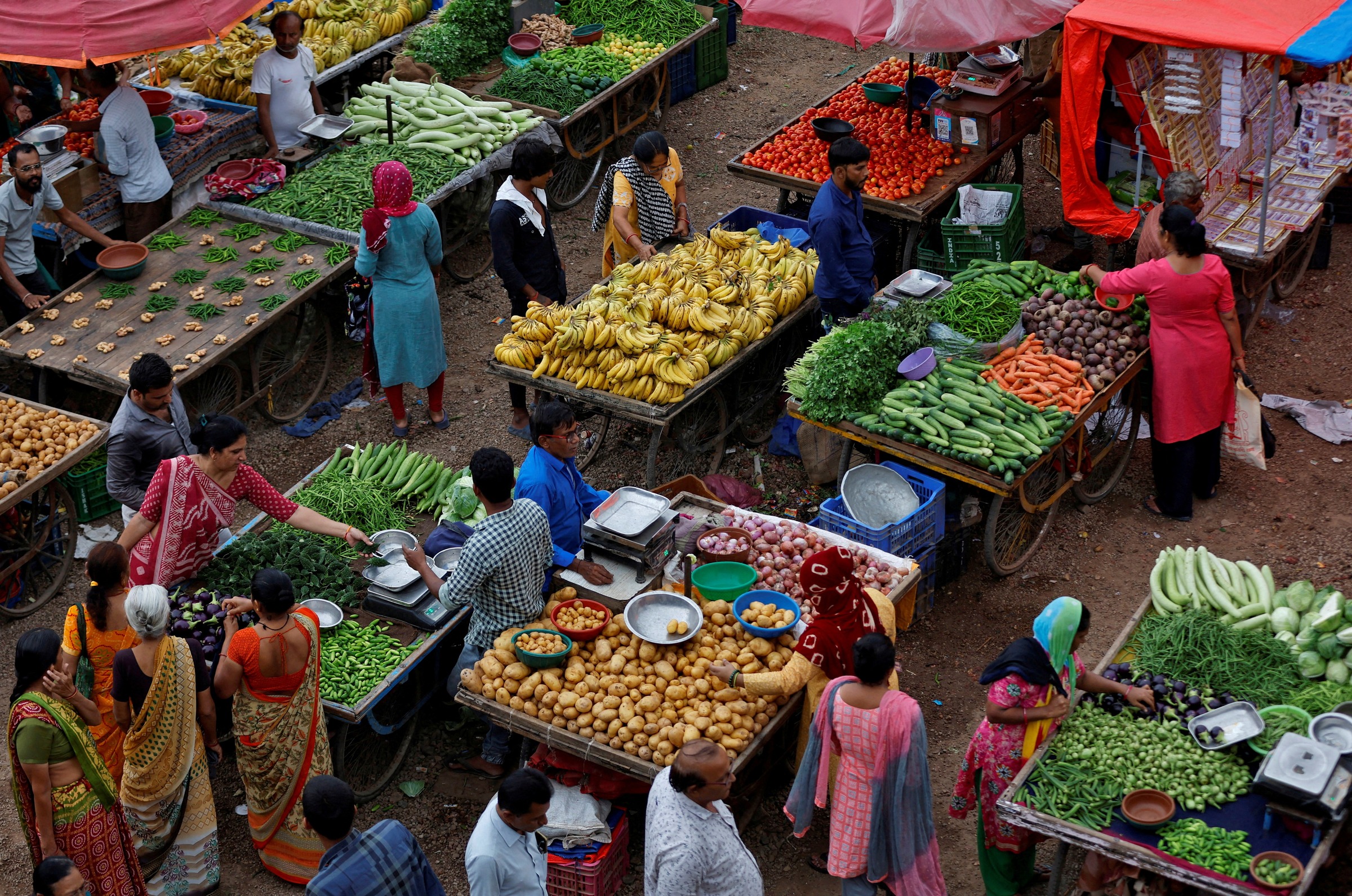 |
Customers buying vegetables at an open-air market in Ahmedabad, India. *Photo: Reuters* |
Beyond GDP figures, other data points reveal persistent challenges for the South Asian economy. India surpassed neighboring China as the world's most populous nation in 2023. However, according to the World Bank (WB), its per capita GDP last year was only 2,694 USD. This figure is 12 times lower than Japan's and 20 times lower than Germany's.
More than 25% of India's population is currently in the 10-26 age group, according to government data. The country struggles to create high-paying jobs for millions of young people. This year, Indian Prime Minister Narendra Modi announced significant cuts to consumption taxes and pushed for labor law reforms after the nation's growth hit a 4-year low in March. The rupee also reached a record low against the US dollar earlier this month, as investors worried about India's lack of a trade agreement with the United States and the impact of import tariffs on its goods.
Ha Thu (according to AFP)