Prime Minister Pham Minh Chinh signed Directive 10 on 30/3, aiming to boost electricity savings and expand rooftop solar power. This marks the second government directive on energy conservation in two weeks.
The prime Minister noted that the international energy market faces significant risks, directly impacting national energy security. Without timely and comprehensive solutions, Vietnam risks an electricity supply-demand imbalance, especially during the 2026-2028 period.
Therefore, the government requires ministries, sectors, provinces, cities, organizations, and citizens to strive for a minimum 3% reduction in total national electricity consumption this year. For peak hot months, from april to july, the electricity saving target is 10%.
At the same time, self-produced and self-consumed rooftop solar power solutions should be promoted in public agencies, production facilities, businesses, service establishments, and households. Rooftop solar should integrate with battery energy storage systems (BESS) to reduce peak hour loads and enhance power source autonomy.
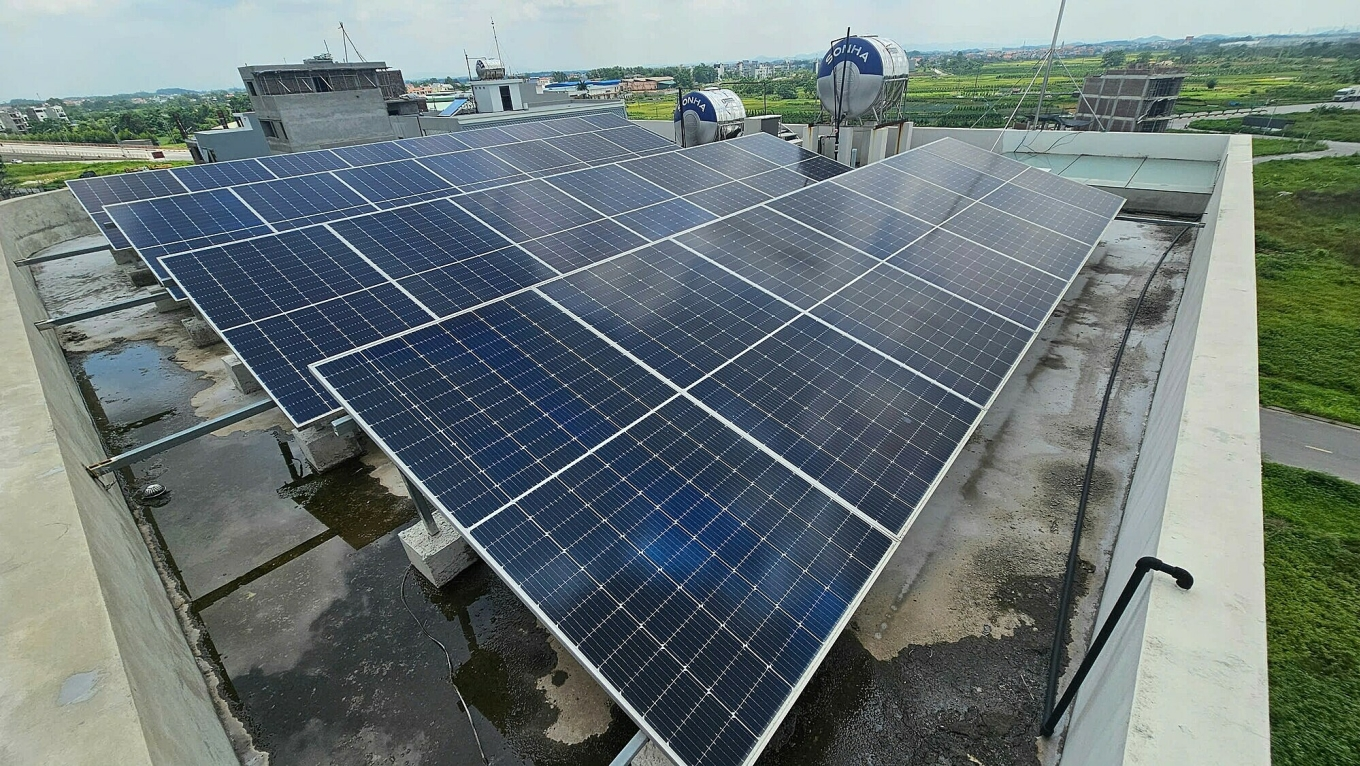 |
A rooftop solar power system at a household in the North, june 2025. Photo: Phuong Anh |
The government leader set a goal for about 10% of public agencies and 10% of households nationwide to install and use self-produced and self-consumed rooftop solar power. Alternatively, the target is to achieve a total development capacity of 20% of the 2026-2030 plan for localities.
The Ministry of Finance, in coordination with the Ministry of Industry and Trade and other relevant agencies, will propose solutions for allocating appropriate state budget funds to support households in installing rooftop solar power. Concerned agencies will also discuss suitable solutions to provide green credit and preferential loans for households and businesses installing rooftop solar power and storage batteries.
Electricity saving targets must be set for each department and sector. Agencies and public offices are required to set quarterly electricity saving goals, integrating these into performance evaluations, internal discipline compliance, and annual commendation and reward programs. Heads of units will be held responsible for violations of electricity saving regulations within their respective units.
Public lighting systems must also implement electricity saving measures, adjusting operating hours based on actual demand. Authorities will turn off or reduce lighting capacity in low-demand areas, during peak hours, and after 23h. Outdoor advertising and decorative lighting systems must be completely turned off. This activity aims to achieve at least 30% electricity savings.
Restaurants, hotels, commercial service establishments, office complexes, and apartment buildings must turn off or reduce outdoor advertising and decorative lighting capacity by at least 50% during evening peak hours, as required by local electricity units.
Manufacturing businesses, especially those on the list of key energy-consuming facilities, are to proactively implement electricity saving plans, integrating these criteria into their production, business, and energy management strategies. Units consuming over 500,000 kWh per year must save at least 3% of electricity consumption per unit of product or 3% of total annual electricity consumption.
For households, the government encourages the use of rooftop solar power combined with BESS, the installation of solar water heating systems, and the application of suitable renewable energy solutions.
Thuy Truong